





 Portuguese
  English
  Spanish
  6 min of reading
  0 comments


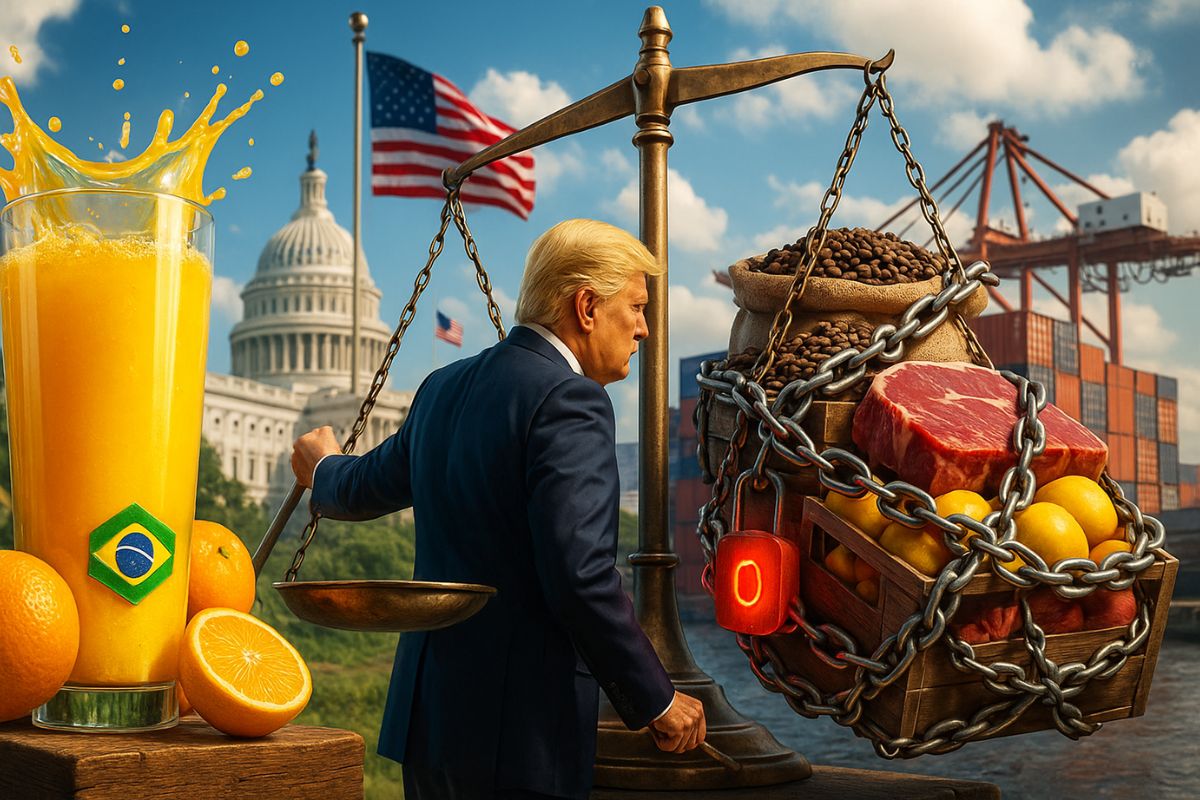
Partial Adjustment of US Tariffs Removes Extra 10% Rate on Brazilian Orange Juice, but Leaves Coffee, Beef, Mango, and Other Agricultural Products Still Subject to 40% Surcharge on Exports to the US Market.
According to information gathered from G1’s portal, the decision by Donald Trump’s government to roll back part of the tariffs on imports alleviates a very specific point on Brazil’s agenda: orange juice. The product, which was already exempt from the 40% surcharge imposed on Brazil, now also escapes the additional 10% charge, making it the primary beneficiary of this partial rollback, while coffee, beef, mango, and other items continue to pay heavy taxes.
In practice, what dropped was only the global rate of 10% announced in April for several countries, including Brazil. The 40% surcharge created in response to the ruling of former President Jair Bolsonaro remains in effect for much of Brazilian exports, maintaining the pressure of the tariffs on sectors such as coffee, fruits, and animal protein at a time when the country is trying to regain space in the US market.
What Exactly Changed in the Tariffs
Under the new executive order signed on Friday, Trump decided to reshape the scope of the tariffs of 10%, removing this additional charge from some products listed in the annex.
-
Brazilian city gains industrial hub for 85 companies that is equivalent to 55 football fields.

-
Peugeot and Citroën factory in Argentina cuts production by half and opens a layoff program for more than 2,000 employees after Brazil drastically reduced purchases of Argentine vehicles.

-
A Brazilian city gains a factory worth R$ 300 million with the capacity to process 200 thousand tons of wheat per year, a mill of 660 tons/day, silos for 42 thousand tons, and an industrial area of 276 thousand m².
-
Havan will leave the shopping mall in Blumenau to inaugurate something that the chain has never done before: a megastore in half-timbered style in the Historic Center of the city, which is expected to be completed in May and change the landscape of local retail.

Among them are important items on Brazil’s agricultural agenda, such as coffee, several cuts of beef, acai, Brazil nuts, tapioca, cassava, and fruits like bananas, oranges, and coconuts.
Even so, the relief is limited. The 40% surcharge specifically created to punish Brazilian products remains in effect for most of these items. This means that, in many cases, the total tax drops from 50% to 40%, which eases the burden but does not restore the competitiveness Brazil had before the escalation of the tariffs.
According to the Vice President and Minister of Development, Geraldo Alckmin, the share of Brazilian exports exempt from any extra tariff increased from 23% to 26%, which represents about 10 billion dollars in sales to the United States.
Still, the vast majority of the agenda remains under severe pressure from additional tariffs, directly impacting margins, contracts, and long-term planning of companies.
Orange Juice Becomes the Big Winner
In the midst of this scenario, orange juice stands out as a symbol of relief. Exports of the product to the United States total approximately 1.2 billion dollars per year, and about 40% of all Brazilian juice sent abroad is destined for the American market, with strong production concentration in São Paulo.
The juice was already exempt from the 40% surcharge applied to Brazil. Now, with the removal of the 10% rate as well, the product completely escapes the new tariffs, recovering a tax condition more akin to that which existed before the tightening of American trade policy.
For a sector that operates with long-term contracts and margins pressured by logistical costs and exchange rates, this difference of 10 percentage points in tariffs has real weight in importers’ buying decisions.
The government views this move as protecting a chain in which Brazil is a consolidated leader and in which the United States has strong external dependence, limiting Trump’s willingness to maintain tariffs high without causing price increases for American consumers.
Coffee, Beef, and Mango Remain Under Pressure from 40% Tariffs
The situation is quite different for other products. Brazilian coffee, for example, continues to be subject to the 40% surcharge. Alckmin has publicly insisted that it doesn’t make sense to keep such high tariffs on an item for which Brazil is the largest supplier to the United States and has already been recording a significant decline in shipment volumes.
Calculations based on official foreign trade data show that in September, the amount of Brazilian coffee sent to the US dropped almost by half compared to the same month in the previous year, with a retraction of 47%.
In this segment, tariffs act as a direct brake on orders, affecting cooperatives, exporters, and producers throughout the chain.
The same applies to fruits. Brazil is the fourth largest supplier of mangoes and guavas to Americans, with shipments around 56 million dollars in 2024, behind Mexico, Peru, and Ecuador.
Brazilian mango producers report unsold production and order cancellations since the tariffs were increased, while the US continues to depend on imports to supply domestic consumption.
In beef, the situation is more ambiguous. Brazil is the world’s largest exporter and accounts for about 23% of American imports. However, the United States is also a large producer and currently faces the lowest number of cattle in over seven decades, after years of drought and low prices.
In this context, any decision on tariffs disrupts the delicate balance between consumer interest, who wants lower prices, and local producers, who fear greater competition.
Negotiations Underway Between Brasília and Washington
While Trump adjusts the design of global tariffs of 10%, the Brazilian government is trying to separate this movement from the hard core of the dispute, which is the 40% surcharge applied specifically to Brazil since July.
Alckmin, Finance Minister Fernando Haddad, and Chancellor Mauro Vieira are leading a negotiation front that involves meetings at multilateral summits and direct trips to Washington.
After a brief meeting between Lula and Trump at the United Nations General Assembly in September, the two countries reopened the dialogue channel on tariffs.
In October, the presidents met in Malaysia to discuss the topic, while Vieira and US Secretary of State Marco Rubio held talks in Canada and Washington throughout November.
According to the chancellor, Brazil has already presented a proposal in response to the first American offer, discussed in a meeting at the White House in October.
The idea is to finalize an agreement this month that establishes a “roadmap” for a broader negotiation, with an estimated timeframe of two or three months to try to gradually dismantle the package of tariffs that currently weighs on Brazilian products.
Inflation in the US, Political Calculation, and Partial Pullback by Trump
The partial pullback of the tariffs of 10% does not stem only from diplomatic negotiation tables. It also reflects internal pressure on Trump due to American inflation.
The president always claimed that his tariffs would not be passed on to consumers, but the widespread increase in prices, with food rising more than two percent in a year, reinforced fears that the cost of import taxes was reaching supermarket shelves.
Coffee is a didactic example. The product has significant inflation in the US, and the surcharge on the main external supplier created an additional supply shock.
Trump himself admitted, in a conversation with Lula in early October, that the United States was “missing” some Brazilian products affected by the tariffs, specifically mentioning coffee.
In beef, the combination of a smaller herd and firm demand has also driven domestic prices higher. In this context, Trump even declared that he would buy more beef from Argentina, governed by Javier Milei, in an attempt to lower prices, which irritated American producers.
The selective relief in tariffs on beef benefits both Brazil and Argentina, but it does not yet resolve the central issue: the continued 40% surcharge on a large part of Brazilian shipments.
By publishing the executive order that reshapes the tariffs of 10% and spares some products, Trump sends a double signal. To the internal electorate, he shows concern about the cost of living.
To trading partners like Brazil, he indicates a willingness to adjust measures considered excessive, without giving up, for now, the pressure tool of higher surcharges.
In the end, the partial pullback in tariffs leaves Brazil in an uncomfortable middle ground. Orange juice celebrates a clear gain in competitiveness, while coffee, beef, mango, and other sectors continue to calculate under the shadow of a 40% tax that increases contract costs and diverts buyers to competitors.
Given this scenario, do you think Brazil should prioritize the swift removal of tariffs on some strategic products, such as coffee and beef, or insist on a broader agreement that tackles the entire structure of surcharges applied by the United States at once?





Seja o primeiro a reagir!