





 Português
  Inglês
  Espanhol
  5 min de leitura
  0 comentários


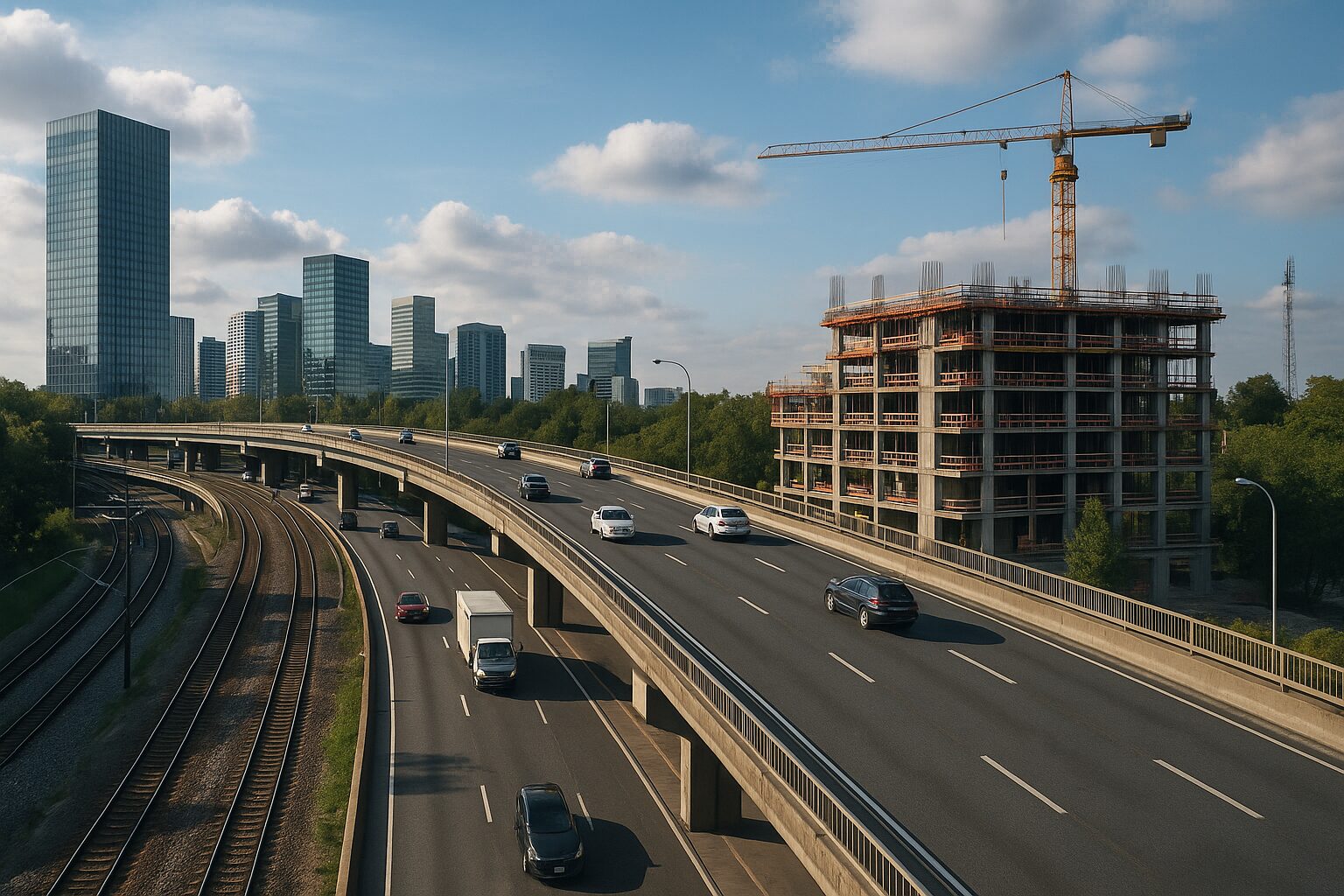
Understand How Infrastructure Perspectives Influence Country Development and Shape the Future of Cities, Economy, and Quality of Life.
Discussing infrastructure perspectives is undoubtedly to discuss one of the most important pillars for the development of any country.
Infrastructure has historically been responsible for connecting societies and driving their progress.
It is present in the roads that connect cities, in the water and energy supply systems, in the railways that move goods, in the ports that link international markets, in the homes, in the schools, and in the hospitals, as well as, of course, in the internet we use daily.
-
Employee Fired After Accumulating 114 Days of Medical Leave in One Year, Labor Court Upholds Company’s Decision

-
Employee Fired While Treating Depression Wins in Court and Vale Is Required to Rehire Him Following Decision Based on the CLT and INSS Benefits

-
Workers Should Be Aware! March 6 Will Be The Fifth Business Day Of March And The Final Deadline For Companies To Pay Salaries According To The CLT

-
2026 FGTS Anniversary Withdrawal Is Released According to Birth Month, Sets Amounts by Balance Range, Establishes Deadlines for March and April, and Changes Rules in Case of Dismissal


Furthermore, to understand the present and plan for the future of infrastructure, it is essential to look at the past and realize how we have evolved in this aspect.
In fact, the development of infrastructure is, historically, one of the greatest drivers of societal progress.
A Historical View of Infrastructure
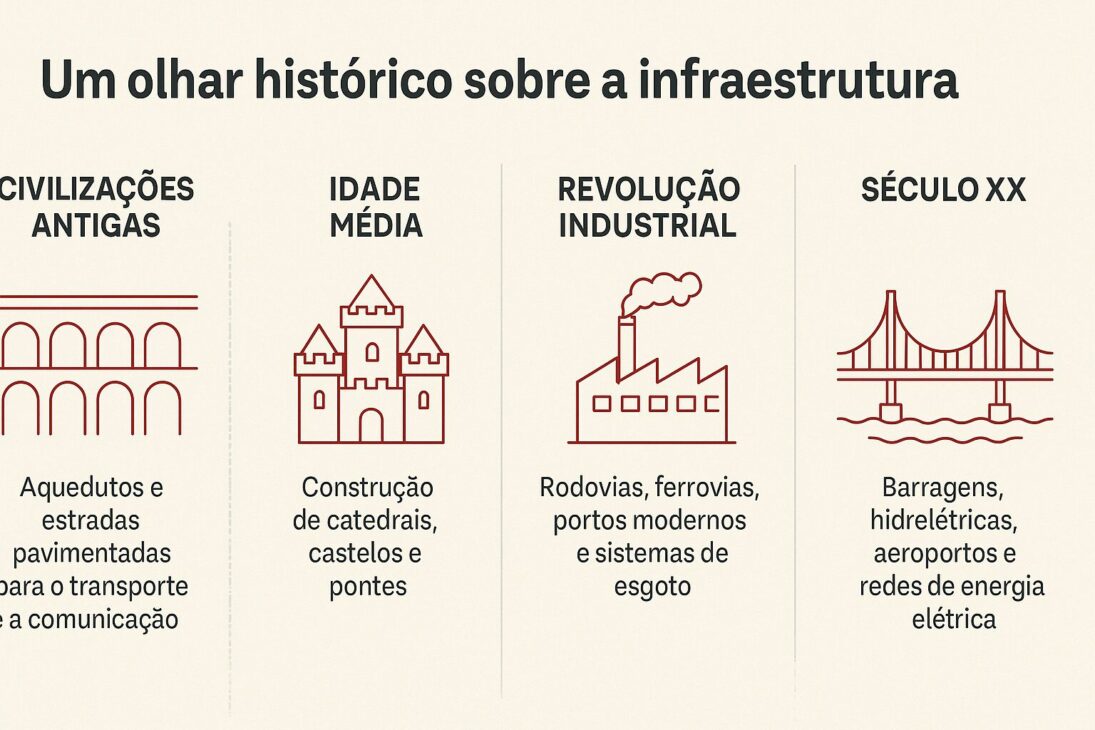
It is important to note that concern for infrastructure is not a recent issue. Since ancient civilizations, such as the Roman, there was already significant investment in public works.
An example of this is the Roman aqueducts, which transported water over long distances to supply cities.
In addition, the Roman paved roads facilitated the movement of armies, goods, and information, creating an efficient communication and trade network.
Such infrastructure investments provided the Roman Empire with a solid foundation that lasted for centuries.
The “Encyclopedia Britannica” mentions that during the peak of the Roman Empire, infrastructure was seen as essential for maintaining power and territorial cohesion.
The Empire invested heavily in infrastructure, which helped consolidate its dominance over vast regions.
However, during the Middle Ages, the pace of construction slowed, although some large works were still carried out, such as cathedrals, castles, and bridges.
In the 20th century, with the advancement of technologies, the construction of large engineering works became possible. Dams, hydroelectric plants, airports, power grids, and highways were built on a large scale.
Thus, infrastructure came to be seen not only as a necessity but as a crucial strategy to boost economic growth and improve the quality of life of populations.
The Importance of Infrastructure in Development
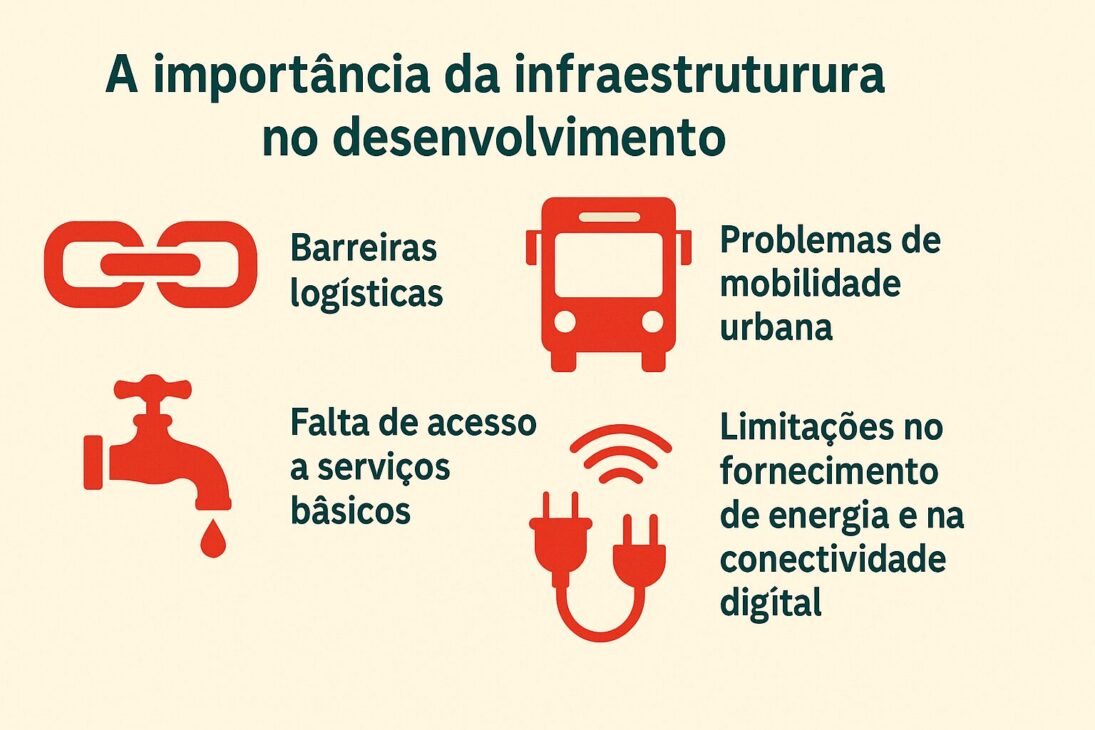
Infrastructure plays a crucial role in the economic and social development of any country. Without it, sustainable growth becomes virtually impossible.
Countries with inadequate infrastructure face serious difficulties, as logistical barriers, urban mobility issues, the lack of access to basic services such as safety and health, in addition to limitations in energy supply and digital connectivity, create enormous obstacles.
According to the “National Confederation of Industry” (CNI), in 2020, Brazil still faced a significant infrastructure deficit, with insufficient investments in essential areas such as transportation and safety.
The lack of investments in these areas resulted in high logistical costs and limited the growth of the domestic market.
Although Brazil has made progress in important areas, there is still a significant need for investments in essential sectors such as urban mobility, public transport, and basic safety.
These areas directly impact the lives of millions of citizens and must be addressed urgently.
The “CNI” in its 2020 report stated that infrastructure investments are fundamental for increasing competitiveness and productivity in Brazil.
Improvement in these sectors can even create new jobs and foster a more favorable environment for developing businesses in the country.
Although Brazil has made significant progress, many projects still face obstacles, such as delays, lack of proper planning, resource shortages, and management issues.
These obstacles, therefore, create a scenario of inefficiency that hinders progress and affects the country’s competitiveness in the global arena. However, in Brazil, alternatives are being pursued, such as concessions and public-private partnerships (PPPs).
The goal is to attract private investments, accelerating projects and enabling the modernization of existing infrastructures.
This opens new infrastructure perspectives, especially in the sectors of renewable energy, transportation, and telecommunications, thus providing a new path for development.
Infrastructure Perspectives in Brazil and the World
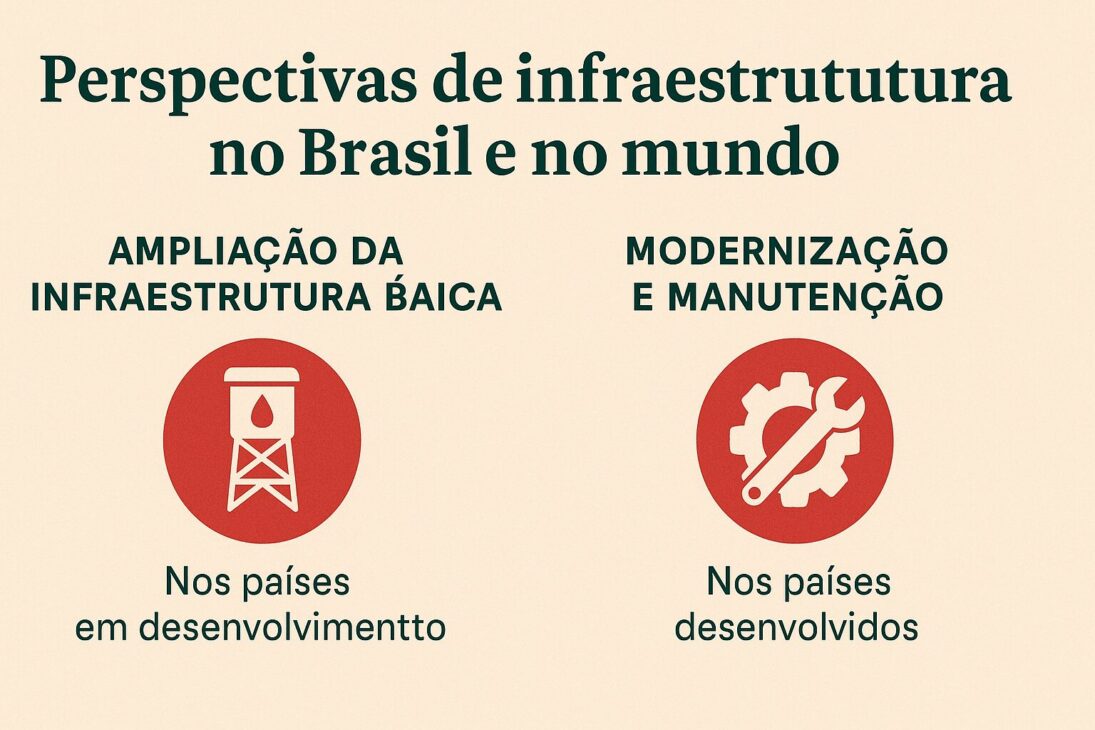
Infrastructure perspectives vary according to the context of each country.
In developed countries, the main challenges are related to modernization and maintenance of existing infrastructure.
However, in developing countries, such as Brazil, the priority remains the expansion of basic infrastructure and overcoming historical deficits.
In 2021, the “Global Competitiveness Report” by the World Economic Forum highlighted that countries that stand out in terms of infrastructure have efficient transportation systems and high-quality digital networks, fundamental to ensure competitiveness in the global scenario.
The transition to a more sustainable economy is a growing trend that impacts infrastructure perspectives.
The implementation of green technologies, such as the use of solar and wind energy, is increasingly present.
According to the “International Energy Agency” (IEA), the transition to a low-carbon economy will be vital to address climate challenges and will also be a significant source of infrastructure investments in the coming decades.
For countries like Brazil, it is essential to continue and accelerate investments in sustainable infrastructure.
For example, the construction of hydroelectric plants and the expansion of the solar energy network in Brazil are among the main strategies to achieve sustainable development and reduce greenhouse gas emissions.
Challenges and Opportunities
The main challenges that infrastructure currently faces include the aging of existing structures, the effects of climate change, and the need to adapt to new technologies.
Bridges and old highways require constant maintenance, for example. Additionally, the increase in floods and droughts necessitates re-evaluation of drainage, dams, and irrigation systems.
The digitalization of services and the use of real-time data demand considerable investments in connectivity and security.
The “United Nations” (UN) in its 2021 report on water and sanitation noted that around 2 billion people still lacked access to basic sanitation services, highlighting the significant disparity between regions with adequate infrastructure and those lacking investments.
Moreover, the increase in global temperatures and extreme climate events put infrastructure at risk, demanding increasingly resilient solutions.
Finally, technological innovations require public managers to stay updated with the latest tools.
Besides ensuring that professionals receive training to deal with these new challenges. However, at the same time, technological innovations bring new opportunities.
3D printing for infrastructure construction, for example, smart sensors for monitoring bridges and buildings.
The use of artificial intelligence in urban planning. And the use of drones for inspection are just some of the technologies that are revolutionizing how we plan and manage infrastructure.
The use of big data and The Internet of Things (IoT) has the potential to optimize traffic management, improve the delivery of public services, and make cities smarter and more resilient.











Seja o primeiro a reagir!