





 Portuguese
  English
  Spanish
  5 min of reading
  0 comments



Understand How the Job Market Trends Emerge, Which Transformations Marked the Past, and What to Expect from the Professional Future in a Scenario of Constant Social, Technological, and Economic Changes.
The job market is continuously transforming. Throughout history, social, technological, and economic changes have directly impacted the way people perform their professions.
From the Industrial Revolution to the digital age, understanding job market trends has become essential for those seeking relevance and growth in their careers.
We live in a time when changes occur at an accelerated pace. Therefore, globalization, technological advancements, and new forms of professional organization have drastically changed the view of work.
-
Employee Fired After Accumulating 114 Days of Medical Leave in One Year, Labor Court Upholds Company’s Decision

-
Employee Fired While Treating Depression Wins in Court and Vale Is Required to Rehire Him Following Decision Based on the CLT and INSS Benefits

-
Workers Should Be Aware! March 6 Will Be The Fifth Business Day Of March And The Final Deadline For Companies To Pay Salaries According To The CLT

-
2026 FGTS Anniversary Withdrawal Is Released According to Birth Month, Sets Amounts by Balance Range, Establishes Deadlines for March and April, and Changes Rules in Case of Dismissal


In this article, you will follow how the market has evolved and, in addition, you will learn how to identify the trends that shape the present and future of professions.
The Past as a Foundation for the Future
To understand the job market trends, it is essential to look at the past. For centuries, most people worked in the countryside, especially in agricultural activities.
However, with the Industrial Revolution in the 18th century, mass production took hold and fueled a mass migration to urban centers.
This movement not only changed the lifestyle. It also created new types of jobs. Factories, unions, and the first labor laws emerged. From then on, stability and a standardized routine became part of the daily life of the working population.
As the 20th century progressed, especially after World War II, the services sector grew significantly. Areas such as education, health, administration, and commerce gained strength.
In this context, technical knowledge became more valuable than just physical labor.
According to ANPEC (National Association of Graduate Programs in Economics), the formation of the job market in Brazil was influenced by labor laws implemented in the 19th century, which aimed to regulate regular labor, transforming dispossessed individuals into proletariats.
The Digital Age and Its Impact on Employability
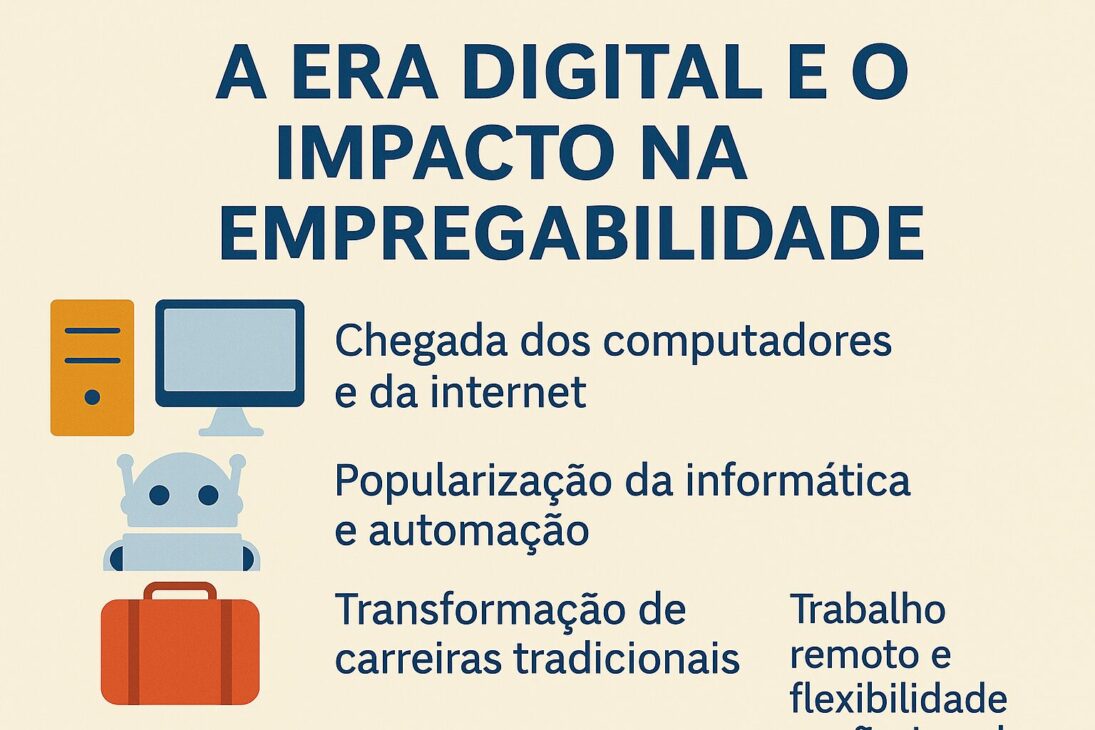
With the arrival of computers and the internet in the 1980s and 1990s, a new revolution began. As a result, professions related to IT, digital communication, and automation became popular.
This technological transformation reshaped the market and, consequently, required new knowledge from workers.
In the 21st century, digital technology, artificial intelligence, and remote work have further modified the professional dynamic. Many traditional careers have been transformed. Others have simply disappeared.
The COVID-19 pandemic, for example, accelerated processes that were already underway, such as home office.
Thus, companies that resisted remote work had to adapt quickly. This adaptation directly impacted market demands, which began to value even more the flexibility and autonomy of professionals.
According to the World Economic Forum, by 2030, it is expected that 170 million new jobs will be created globally, driven by trends such as technology, economy, demography, and green transition.
New Demands and Skills of the Future
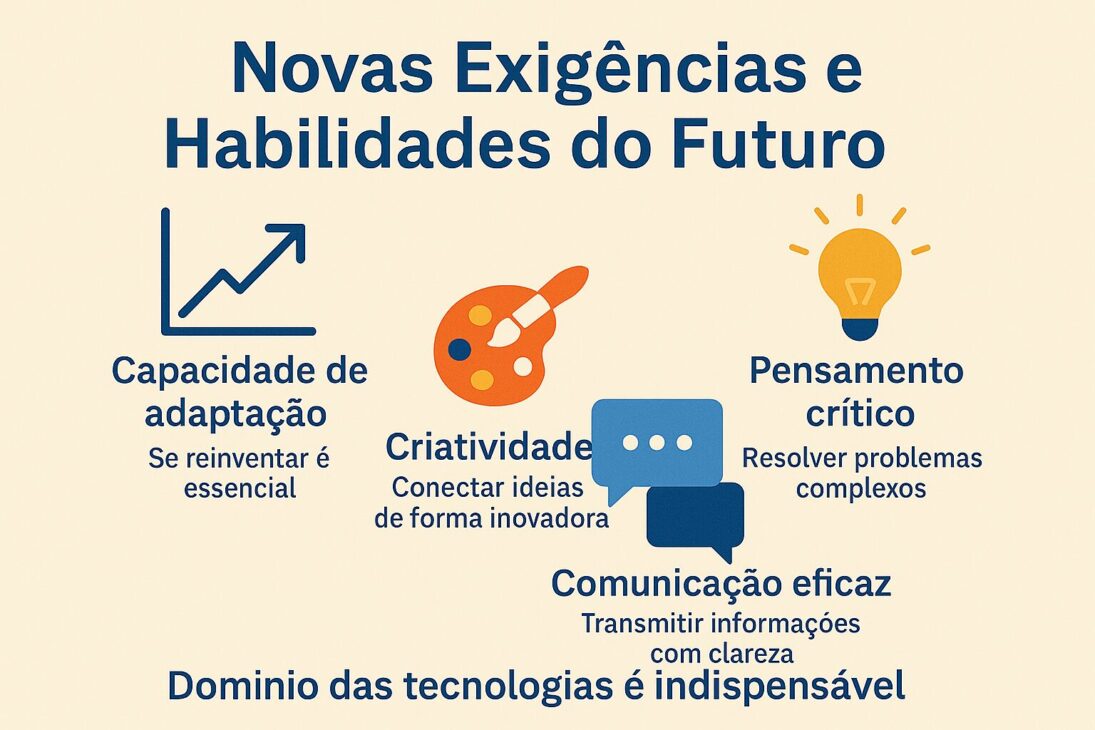
In this constantly changing scenario, so-called skills of the future emerge. The ability to adapt, critical thinking, creativity, effective communication, and proficiency in technology have become indispensable.
Although the academic degree retains value, it has ceased to guarantee success. Job market trends show that the ability to learn continuously and reinvent oneself is, in practice, what truly makes the difference.
Fields such as green technology, sustainability, artificial intelligence, data analysis, and cybersecurity have grown rapidly.
Professionals specializing in these fields find more opportunities and, as a consequence, build promising careers.
According to a report by LinkedIn released in January 2025, among the 15 most sought-after skills in Brazil are knowledge in artificial intelligence, effective communication, and strategic vision.
Flexibilization and New Work Models
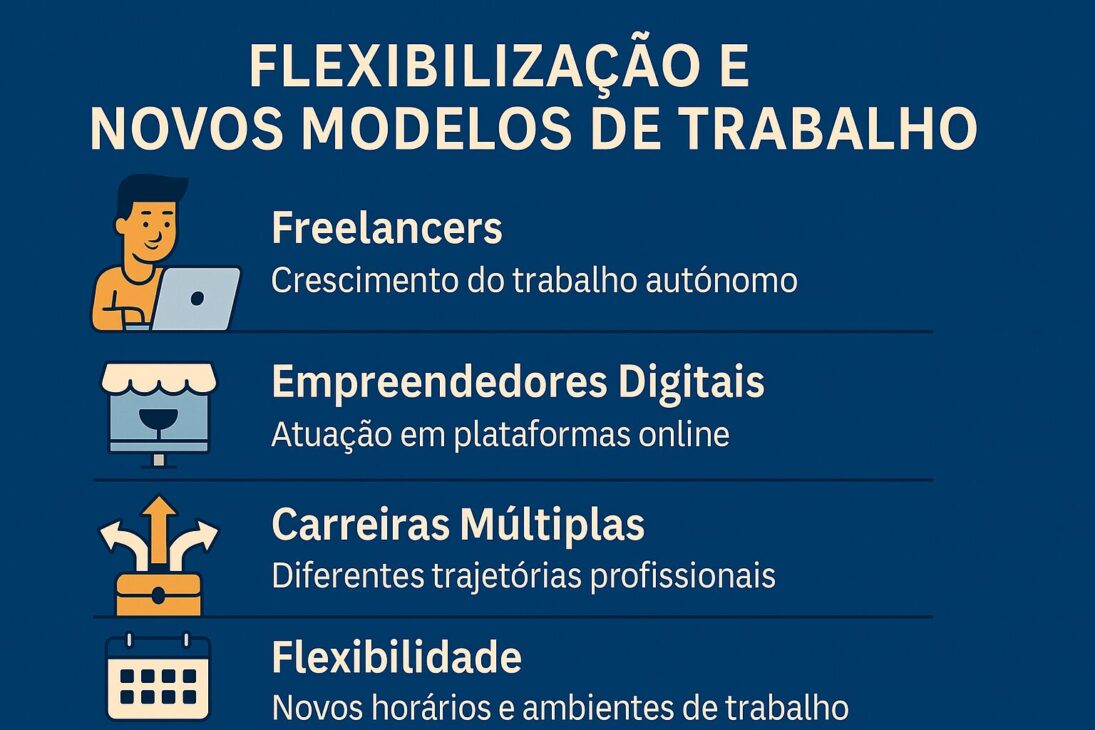
Currently, flexibilization of work is a consolidated trend. Increasingly, people choose to work as freelancers, digital entrepreneurs, or service providers on online platforms.
In this new model, the old idea of spending an entire lifetime at a single company loses strength. Instead, dynamic and multiple professional paths arise, often mixing different areas of expertise.
Therefore, those who follow the job market trends understand the importance of constantly updating themselves.
Participating in courses, events, and professional networks, in addition to being attentive to the sector’s news, has become a competitive differential.
According to the global trends report 2025 by ManpowerGroup Brazil, the gig economy — characterized by short-term contracts and freelance work — is expanding, currently representing 12% of the job market.
The Value of Continuous Learning
Considering the accelerated pace of changes, continuous learning has never been more necessary. The speed at which innovations emerge forces professionals to constantly update themselves.
What is learned today can become obsolete in a few years.
Thus, cultivating the habit of seeking new knowledge and developing technical and human skills is essential.
The traditional education, therefore, needs to evolve to prepare professionals capable of dealing with complex and unpredictable problems.
According to Forbes Brazil, the future of work demands not only mastery of emerging technologies but also human skills such as empathy, active listening, and lifelong learning.
Education and Technology as Allies
Educational institutions are already beginning to adapt their curricula. Topics such as innovation, programming, sustainability, and entrepreneurship are increasingly entering classrooms.
On the other hand, online education also facilitates access to new knowledge.
Today, it is possible to specialize in high-demand areas without leaving home. This democratizes opportunities and brings more people closer to the ever-evolving job market.
Technology, in addition to creating new professions, transforms the way activities are carried out. Thus, professionals who know how to use digital tools to their advantage can stand out even in more traditional fields.
According to the Sebrae, skills such as cloud computing, product management, and social media are among the most valued in the future job market.
The job market trends are formed from the interaction of historical, social, technological, and cultural factors.
Therefore, understanding these movements requires attention to the past, the present, and an openness to the future.
Although there is no single formula for professional success, those who cultivate continuous learning, develop human and technical skills, and keep an open mind for innovation will be better prepared to face the challenges ahead.
The job market will continue to evolve. And those who adapt to these transformations will not only survive but also build a solid, relevant, and meaningful career over the years.










Seja o primeiro a reagir!