





 Portuguese
  English
  Spanish
  5 min of reading
  0 comments


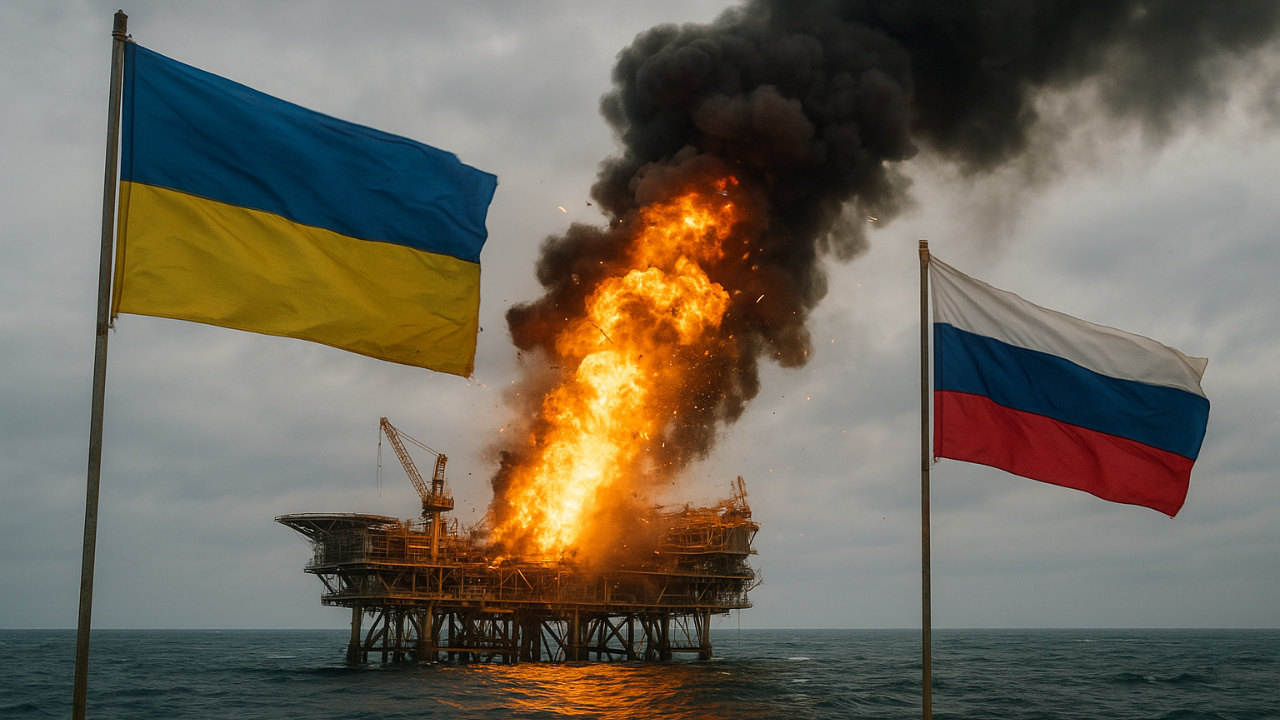
Ukraine Hits Oil Platform in Caspian Sea and Intensifies Campaign to Reduce Russian Energy Revenues. Attacks on Refineries, Pipelines, Tankers, and Terminals Show New Phase of Energy War.
The war between Russia and Ukraine has entered a new phase. Now, in addition to the traditional battlefield, an offensive is emerging that directly targets the Kremlin’s economic heart: oil.
A Ukrainian attack on an oil platform in the Caspian Sea revealed an increasingly bold strategy. Kiev aims to disrupt the flow of energy revenue that sustains the Russian military machine, rapidly expanding its list of targets.
Although the conflict has multiple fronts, the energy war has become central to the future of the dispute. And, as recent data shows, this movement is not just growing — it is intensifying month after month.
-
Offshore industrial demand in Macaé skyrockets with the recovery of oil and gas and could grow by up to 396% by 2026 in the Campos Basin.
-
Offshore industrial demand in Macaé surges with the recovery of oil and gas and could grow by up to 396% by 2026 in the Campos Basin.
-
Brazilian giant expands borders in the Southeast: Petrobras confirms new oil discovery in ultra-deep waters in the pre-salt of the Campos Basin.

-
Alert in the global energy market: Severe tropical cyclone hits the coast and disrupts gas production at major plants in Australia, threatening global supply.


First Ukrainian Attack in Caspian Sea Puts Russian Oil Production on Alert
This week, Ukraine confirmed that its long-range drones hit the Filanovsky oil platform in the Caspian Sea, one of the key assets of the Russian company Lukoil. The operation, previously kept secret, was disclosed by a source from the Security Service of Ukraine.
“This is the first Ukrainian attack on Russian oil production-related infrastructure in the Caspian Sea,” the source stated, classifying the action as “yet another reminder to Russia that all of its companies working for the war are legitimate targets.”
The Filanovsky field is considered the largest in Russia in the region, highlighting the symbolism of the offensive. With this, Kiev is extending the range of its drones to distances that once seemed improbable.
Expansion of the Campaign: More Targets and Investments in the Energy War
The offensive that began timidly in early 2024 has transformed, since August, into a robust campaign.
The Ukrainian sanctions commissioner, Vladyslav Vlasiuk, defined the strategy as the start of “long-range sanctions” — an effort to directly target Russia’s main source of income.
The targets, previously concentrated on refineries, now include:
- oil and gas export infrastructure;
- strategic pipelines;
- tankers;
- terminals in the Caspian Sea, Black Sea, and Baltic Sea;
- offshore drilling platforms.
According to the ACLED project and CNN analyses, November recorded the highest number of attacks on energy facilities since the start of the war. And the pace shows no signs of slowing down.
This escalation occurs at a critical moment. U.S.-led negotiations have failed in the face of Moscow’s maximalist demands, and Russian troops are advancing in several areas along the front line.
At the same time, the global market is facing an oversupply of oil, which prevents the attacks from causing significant price spikes. In light of this scenario, Western countries are reinforcing support for Ukrainian tactics.
Economist Helima Croft from RBC Capital Markets summarizes the rationale: “I think the overall strategy since the summer has been the idea that Russia cannot be allowed to retain a large portion of its crucial energy revenue.”
According to her, Russian energy revenues fund salaries and enlistment bonuses that bolster Moscow’s advantage in the war. Therefore, cutting this flow has become a priority.
Repeated Attacks and Cumulative Damage: The New Dynamic of the Energy Offensive
Data reveals that Ukraine has doubled its intensity. From August to the end of November, there were at least 77 attacks — almost twice as many as in the previous seven months.
Several strategic points have been hit repeatedly. The Saratov refinery, owned by Rosneft, has been attacked at least eight times since August, with four of those attacks occurring in November alone.
According to Nikhil Dubey, an analyst at Kpler, the tactic has changed: “What were once occasional attacks aimed at causing damage has turned into a continuous effort to prevent the refineries from fully stabilizing.”
Furthermore, Ukraine has started to target not only visible structures but “the main bottleneck points in the refining system that produce the final fuels,” amplifying the economic impact.
Despite the intensification of attacks, some analysts note that the short-term effects are still manageable for Moscow. However, experts warn that the long-term damage could be much greater.
Sergey Vakulenko, a researcher at the Carnegie Russia Eurasia Center, points out that the fires caused by the attacks compromise sensitive metal structures: “Metals do not tolerate this type of treatment well, and no one knows for sure how many of these heating and cooling cycles these columns could survive.”
This indicates that some facilities may face irreversible failures in the future, reducing Russia’s ability to process oil steadily.
Export Infrastructure Becomes Priority Target and Increases International Tension
Since August, Ukraine has intensified attacks on export facilities, increasing risks in the Black Sea and the Baltic Sea.
Among the targets are:
- Ports of Novorossiysk and Tuapse (Black Sea);
- Port of Ust-Luga (Baltic Sea);
- Druzhba pipeline, essential for European countries;
- Caspian Pipeline Consortium infrastructure.
The Druzhba has already been hit five times, prompting protests from Hungary. The Caspian Consortium reported two attacks in four days — a sign that the offensive is extending further.
Vakulenko assesses that the strategy aims to instill “fear” in Russian oil transport. However, he warns that Kiev may “not gain sympathy” if it causes excessive instability in the market.
Tankers Are Also in the Crosshairs and Trigger Reaction from the Kremlin and Turkey
The attacks are not limited to fixed infrastructure. At the end of November, Ukraine carried out two actions against sanctioned tankers in the Black Sea. The attacks prompted a rare response from President Vladimir Putin, who classified the actions as “piracy.”
Turkey, concerned about the risk of regional escalation, summoned the ambassadors of Russia and Ukraine in protest.
Even so, Kiev maintained the pace. On Wednesday (10), maritime drones attacked another cargo ship en route to Novorossiysk, reinforcing that tankers are now a central part of the offensive.
For the director of the Energy Industry Research Center in Kiev, Oleksandr Kharchenko, there is no alternative: “We have no other tool but to cut off the flow of money to Russia to avoid this war for survival.”
For him, the continuous presence of sanctioned ships in the Black Sea shows that Western sanctions are not being enforced. “So, folks, if you can’t enforce your sanctions, maybe someone can help you,” he stated.
These statements reflect Ukraine’s increasingly firm position: the energy war is not just a tactic. It is part of the central strategy to weaken Russian military power.









-

2 pessoas reagiram a isso.