





 English
  Francês
  Alemão
  Italiano
  Japonês
  Norueguês
  Portuguese
  Spanish
  7 min of reading
  0 comments


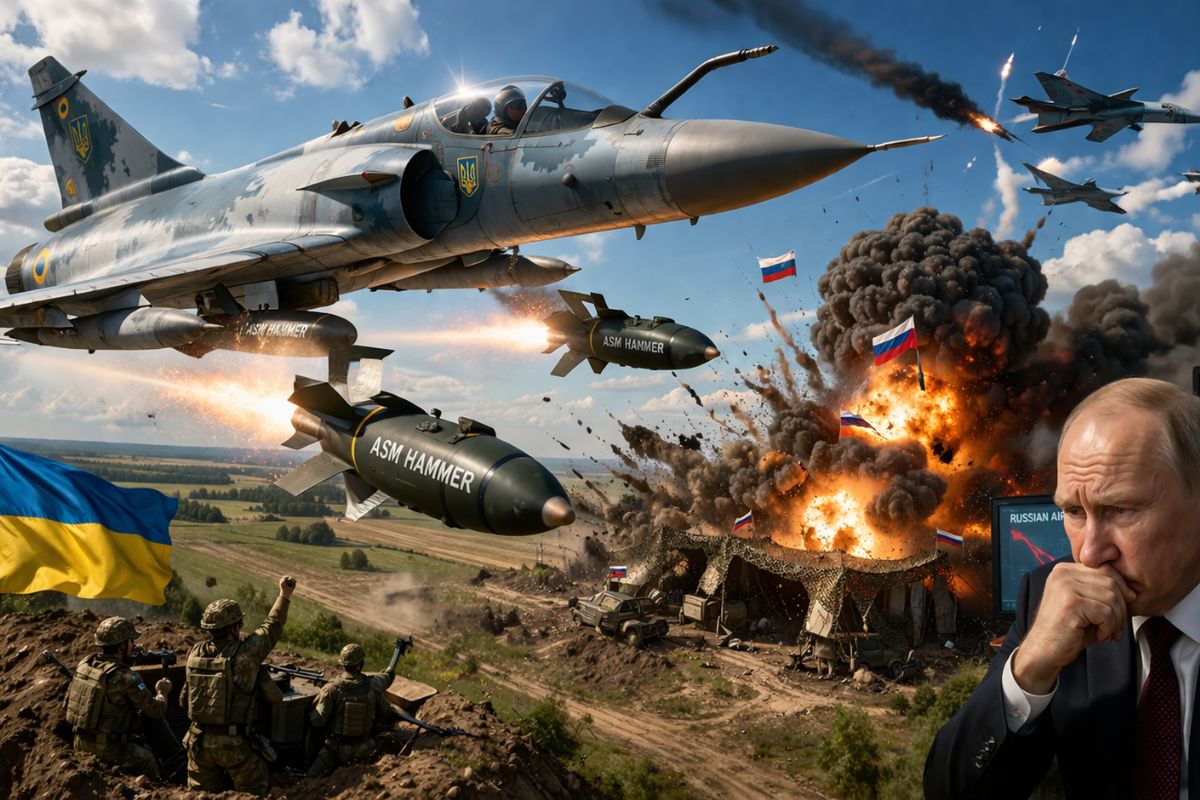
Ukraine took Mirage 2000 and AASM Hammer gliding bombs to the front line and started to pressure Russia in a new phase of the war.
The Ukraine had already been accumulating signs of increasing pressure on Russia in the early months of 2026. According to the provided data, Ukrainian long-range attacks increased in both quantity and damage, while a counteroffensive on the border between Zaporizhia and the Dnipropetrovsk region reportedly reclaimed over 400 km² of critical territory.
Now, however, the focus shifts to the air. By using the Mirage 2000 to launch AASM Hammer bombs, Ukraine enters a terrain that until now primarily favored the Russians, altering the logic of the battlefield and putting into question an advantage that Moscow has intensely exploited since the beginning of the war.
Ukraine removes the Mirage 2000 from defense and takes the fighter to attack

For much of the initial period, the Mirage 2000s of Ukraine were primarily used in defensive missions.
-
Brazil presents the first national F-39 Gripen fighter and redefines air defense with technological advancement, job creation, and strengthening of the defense industry on the global stage.
-
The construction of the Polar Ship Almirante Saldanha is progressing ahead of schedule and strengthens Brazil’s presence in Antarctica; the vessel will be 93 meters long, have a two-month autonomy, and technology to face ice.

-
The United States Army has an armored vehicle that reaches speeds of up to 100 km/h, capable of operating normally on different types of terrain and also on asphalt without causing damage; equipped with a 350 hp engine, it can transport up to 9 soldiers — meet the Stryker.
-
Gepard 1A2: the armored vehicle that fires 1,100 rounds per minute and became a shield against drones in Brazil.

Their role was to protect cities and critical infrastructure, helping to intercept cruise missiles and attacks coming from Russia.
The change now is significant because it shows that these fighters are also being employed in offensive missions. Images that emerged at the end of February 2026 reportedly showed a Ukrainian Mirage 2000 launching AASM Hammer gliding bombs at Russian positions.
This marks a relevant operational shift, as it is the first confirmation of the offensive use of these aircraft at the front line within the provided data.
The movement partially repeats the path already seen with the F-16s. First, Ukraine employed these fighters in defensive tasks.
Only later, with more aircraft available, did the F-16s begin to appear in offensive missions with cruise missiles and precision gliding bombs.
AASM Hammer gives Ukraine a new pressure tool
The center of this new phase lies in the AASM Hammer, a French munition presented as a long-range, all-weather smart air-to-ground weapon.
The system has been described as modular, capable of combining guidance by inertial navigation, GPS, laser, or infrared, depending on the variant used.
In practice, this means that Ukraine now has a gliding bomb that can hit targets with high precision and be launched from a distance sufficient to keep the aircraft out of part of the range of Russian defenses.
This combination of range and precision greatly changes the tactical value of the Mirage 2000, even in a small fleet.
The data also indicates that the most likely variant in use would be the 250 kg version, especially against stationary targets.
This aligns with the type of objective mentioned in the text, which includes Russian positions at the front and areas just behind it, where logistical structures and troop concentrations are located.
Near rear became an increasingly vulnerable target
One of the most important points of the report is the change in the concept of near rear. With the proliferation of FPV drones and fiber-optic guided drones, the separation between the front line and safe area has become much more diffuse.
According to the data, positions up to 32 km from the forward lines have become unsafe. This means that the area where Russians store ammunition, fuel, and supplies or concentrate troops before attacks is no longer just support but directly integrates the battlefield.
It is precisely here that the Mirage of Ukraine with the AASM Hammer comes into play. These bombs allow for attacks on logistical and support points that were previously relatively protected, weakening Russia’s ability to sustain offensives, supply units, and organize local attacks quickly.
Russian bombs gave Moscow a difficult-to-neutralize advantage
To understand why this novelty weighs so heavily, it is necessary to look at the weapon that gave Russia a persistent advantage: the FAB gliding bombs, also referred to in the data as CAB. They transform unguided Soviet bombs into precision weapons with wings and correction kits.
Russia began using them on a large scale to demolish fortified positions, destroy infrastructure, and pressure cities.
The data states that since 2022, the Russians have launched over 51,000 guided aerial bombs against Ukraine, primarily of this type, and that the pace continued to grow in 2026.
Just in January 2026, according to the provided material, 5,717 Russian gliding bombs were reportedly used. On February 27, the cited daily volume was 328 guided aerial bombs in a single day.
This scale shows why Moscow built such a difficult aerial advantage to counter, even without fully dominating the airspace.
The problem for Ukraine was never just to take down bombs


The Ukraine has managed to destroy some of these bombs with air defense, but the central difficulty lies in the relationship between cost and volume.
The data emphasizes that the Russian FABs are relatively cheap, while the missiles used to intercept them cost much more.
This imbalance makes pure defense a less sustainable path. Even if there were a budget, the problem would still be the stock.
There are not enough missiles available to respond indefinitely to thousands of gliding bombs per month, which forces Kiev to seek other paths.
That is why Ukraine has begun trying to eliminate the threat at its source, attacking depots, production facilities, and, when possible, Russian aircraft before launch.
The offensive use of the Mirage with AASM Hammer fits exactly into this logic of attacking the weapon’s employment chain, rather than just trying to intercept it in flight.
Mirage 2000 may start to return to Russia the same type of pressure
The most sensitive aspect of this change is both symbolic and operational. For much of the war, Russia was the one with the capability to launch gliding bombs at Ukrainian positions with devastating impact.
Now, Ukraine begins to have at least a start of an equivalent response. Not yet on the same scale, but with the potential to hit vulnerable Russian areas at the front and just behind it. This means that an advantage that was previously almost exclusive to Moscow is beginning to be contested.
If the gaps in Russian air defenses are indeed growing at the front, as suggested by the data, this capability may become even more relevant.
The effect is not only in direct damage but in the operational cost imposed on Russia, which may be forced to disperse stocks, retreat logistical points, and reconsider troop concentrations.
Ukraine still faces serious limits to expand this impact
Despite the potential, the data makes it clear that Ukraine still faces two major obstacles. The first is the size of the fleet. Russia can launch bombs with various types of aircraft, while Kiev operates with a few dozen F-16s and a much smaller number of Mirage 2000s.
This limit directly affects tactics. As Western fighters also have an important defensive role, Ukraine tends to be more cautious when employing them near the front line. The range of the AASM Hammer helps, but does not eliminate the risk of exposure to Russian defenses.
The second obstacle is the quantity of bombs available. The data shows that French production of the AASM Hammer has grown significantly since 2022, but still remains far below the Russian volume. In 2024, the French parliament committed the government to regular deliveries of 600 bombs per year to Ukraine. This helps, but is far from creating parity with the Russian industrial scale.
The dispute is now also industrial
The comparison with Russian production is harsh. According to the data, Moscow is reportedly producing about 3,500 gliding bombs per month, while the Western supply for Ukraine remains much more limited, partly due to international competition for similar munitions.
The text also mentions the competition for GBU-39B, which could theoretically enhance Ukraine’s offensive capability, but whose demand also involves other countries and other conflicts. This reduces Kiev’s maneuvering margin in the short term.
Therefore, the most solid solution may involve self-production. The data itself suggests that Ukraine may end up trying to develop and manufacture its own gliding bombs, repeating the pattern of innovation it has already demonstrated in other areas of the war. If this happens, the impact on the dynamics of the conflict could be even greater.
Putin sees the air advantage beginning to be questioned
In the overall picture, the most important thing is that Russia no longer appears alone in this type of attack. Ukraine has not achieved full equivalence, but has shown that it can use Western fighters and precision bombs to hit targets that were previously more protected.
This disrupts one of the pillars of Russian pressure on the battlefield. By taking the Mirage 2000 to the offensive with AASM Hammer, Ukraine begins to attack the logic that sustained much of the Russian advantage in recent years, based on volume, range, and relatively low cost of gliding bombs.
There are still evident limitations in fleet, risk, and scale. But the simple fact that Ukraine has put this capability into operation already changes the psychological and military equation of the war.
And for Putin, this type of change may be especially difficult to neutralize if accompanied by more deliveries, more gaps in Russian defense, and more Ukrainian adaptation.
Do you think Ukraine will be able to turn the Mirage 2000 and AASM Hammer into a real response to Russian gliding bombs?








Seja o primeiro a reagir!