





 Portuguese
  English
  Spanish
  4 min of reading
  0 comments


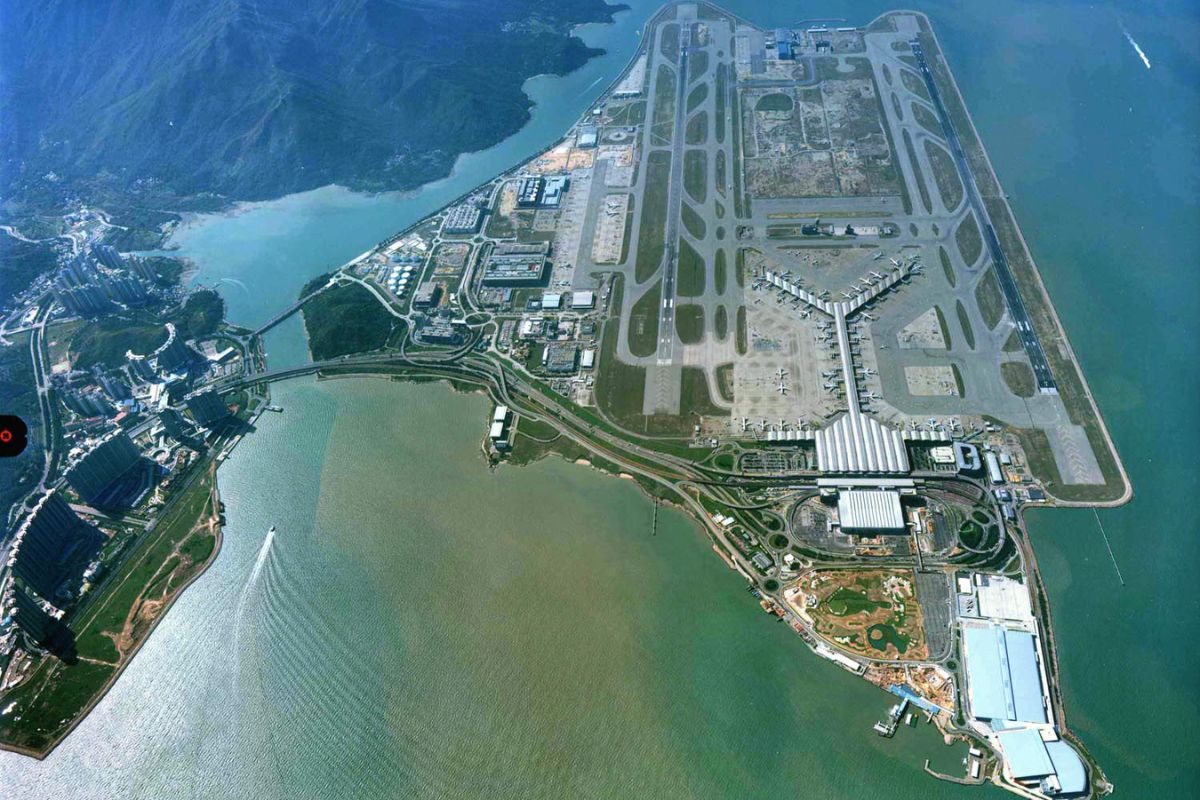
A $20 Billion Airport, Built on 12.48 km² of Landfill, Redrew the Map of Hong Kong and Increased Its Capacity to 120 Million Passengers and 10 Million Tons of Cargo.
The $20 billion airport of Hong Kong was born from a bold decision: to move away from the city’s scarce land and create an entire artificial island to accommodate a global aviation hub. Inaugurated in 1998, the complex replaced the old Kai Tak and ushered in an era of unprecedented logistical efficiency and international connectivity for the region.
At the center of the project is Chek Lap Kok, an island expanded four times to reach 12.48 km², upon which stands a 516,000 m² terminal designed by Norman Foster. With the three-runway system completed in 2024, the infrastructure was scaled for 120 million passengers and 10 million tons of cargo per year, a level worthy of an aerotropolis.
Why a New Airport and Why in the Sea
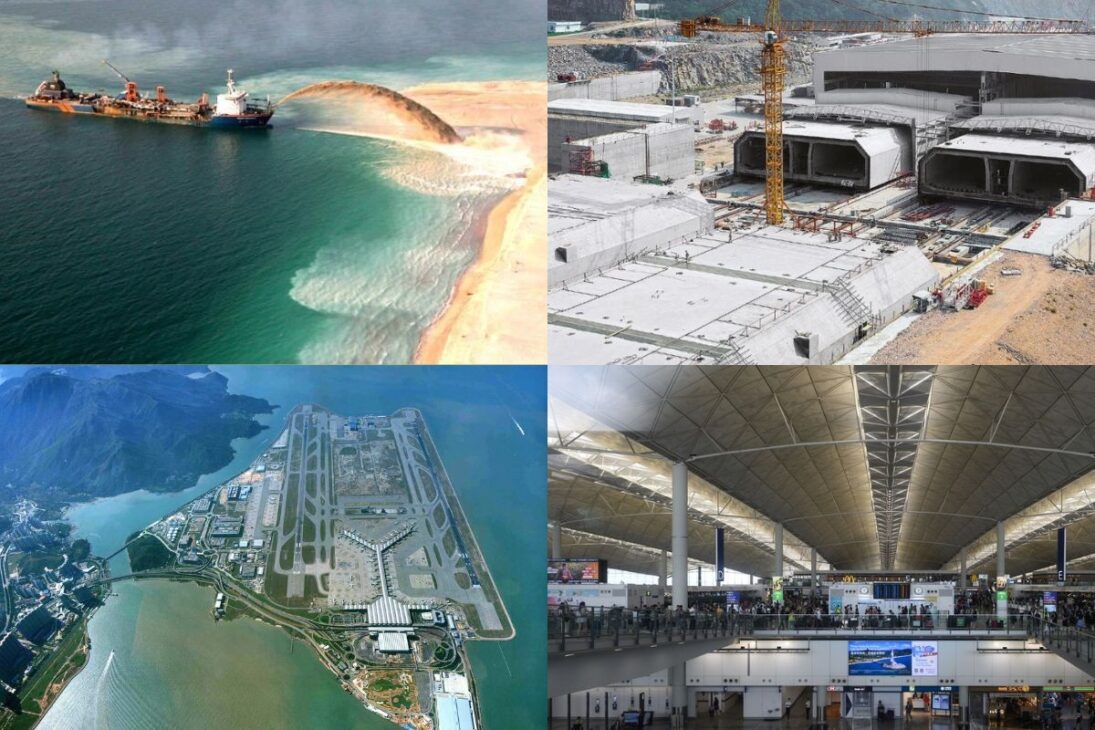
The choice to build the $20 billion airport in the sea responds to a historical dilemma of Hong Kong: limited urban space and noise restrictions in one of the planet’s densest areas.
-
A couple buys an old chalet, breaks the kitchen floor for renovation, and finds over a thousand coins of gold and silver hidden since the English Civil War over 4 centuries ago.

-
Rigid bags with their days numbered: new trend prioritizes comfort in 2026.

-
YouTuber creates an excavator equipped with a giant 4.5-meter sword to challenge his brother to a rematch, and the invention quickly goes viral on social media.

-
The U.S. Army surprises the world by presenting the UH-60MX Black Hawk helicopter capable of flying without pilots, controlled by a tablet, featuring the MATRIX system, smart sensors, and full autonomy in real combat and rescue missions.


The old Kai Tak, nestled between buildings and mountains, limited growth and required dramatic approaches, incompatible with the increasing demand for long-haul flights.
By migrating to Chek Lap Kok, the city gained expansion room, more favorable wind corridors, and a modern operational envelope.
The new geography literally created allowed for thinking of the airport as a 24/7 hub, aligned with high-value cargo operations and quick connections between Asia, Europe, and the Americas.
Engineering of the Artificial Island of 12.48 km²
The heart of the project was to transform a mountainous island into a flat and stable platform. To achieve this, the original land was leveled and integrated with extensive landfills, multiplying its area by four.
Marine works, retaining structures, and soil improvements created the foundation for long runways, wide yards, and light, modular buildings.
The timeline was another achievement. Commissioning an airport from scratch in open sea required synchronizing dredging, transporting materials, sediment containment, and simultaneous advancement of terminals, runways, and systems.
The scale and speed set a new standard for infrastructure megaprojects at the end of the 20th century.
Terminal and Operation: Architecture in Service of Flow
Designed by Norman Foster, the original terminal of 516,000 m² combines monumental spans, clear orientation, and natural lighting to reduce distances and facilitate connections.
The clean architectural language is not just aesthetic: it supports operational peaks, improves wayfinding readability, and simplifies maintenance.
On the airside, wide yards and contact positions expedite boarding and disembarking; on the landside, integration with railways and expressways reduces “door-to-door” time.
Result: faster turnarounds, safer connections, and a smoother passenger experience are the pillars of a competitive hub.
Three Runways for 120 Million Passengers and 10 Million Tons
With the third runway operational since 2024, the $20 billion airport achieves the design capacity for 120 million passengers/year.
The taxiway network and slot management have been redesigned to minimize conflicts and maintain high movement rates per hour, a critical element for long-haul flights.
In terms of cargo, the airside design connects directly with warehouses and sorting facilities. This shortens the handling chain and allows for quick connections in short windows, an essential condition for high-value logistics (electronics, fashion, pharma) and for Hong Kong’s role as a regional redistribution platform.
Aerotropolis: When the Airport Becomes an Economic Engine
The complex is not just a gateway: it operates as an “aerotropolis”, with logistics parks, hotels, convention centers, and corporate services anchored in air connectivity.
Every minute saved in the cargo–runway–road–port cycle adds competitiveness to the supply chain of Southern China and East Asia.
This drag effect translates into stronger tourism, more agile foreign trade, and high-value jobs.
By shifting the accessibility axis to an island connected by bridges and rail lines, Hong Kong solidified its role as a global hub, even in a highly competitive scenario among major Asian airports.
Challenges, Maintenance, and Legacy
Building a megaproject in open sea has high maintenance costs and requires continuous management against corrosion, salinity, and adverse weather.
Operating with predictability, even during peak demand periods, involves slot planning, energy resilience, and contingency protocols.
The legacy, however, is undeniable: a world-class airport ecosystem that redefined the city’s map and boosted its economy.
The $20 billion airport demonstrates how well-planned infrastructure can overcome historical limits and create new growth frontiers.
In one generation, Hong Kong transformed an urban challenge into a competitive advantage, creating an island, an airport, and a new economic engine. The question for readers is straightforward: if you could prioritize one aspect of this project, would you choose the boldness of building in the sea, the 516,000 m² terminal, or the third runway that elevates capacity? Let us know in the comments what impresses you the most about this project.






Seja o primeiro a reagir!