





 Portuguese
  English
  Spanish
  4 min of reading
  0 comments


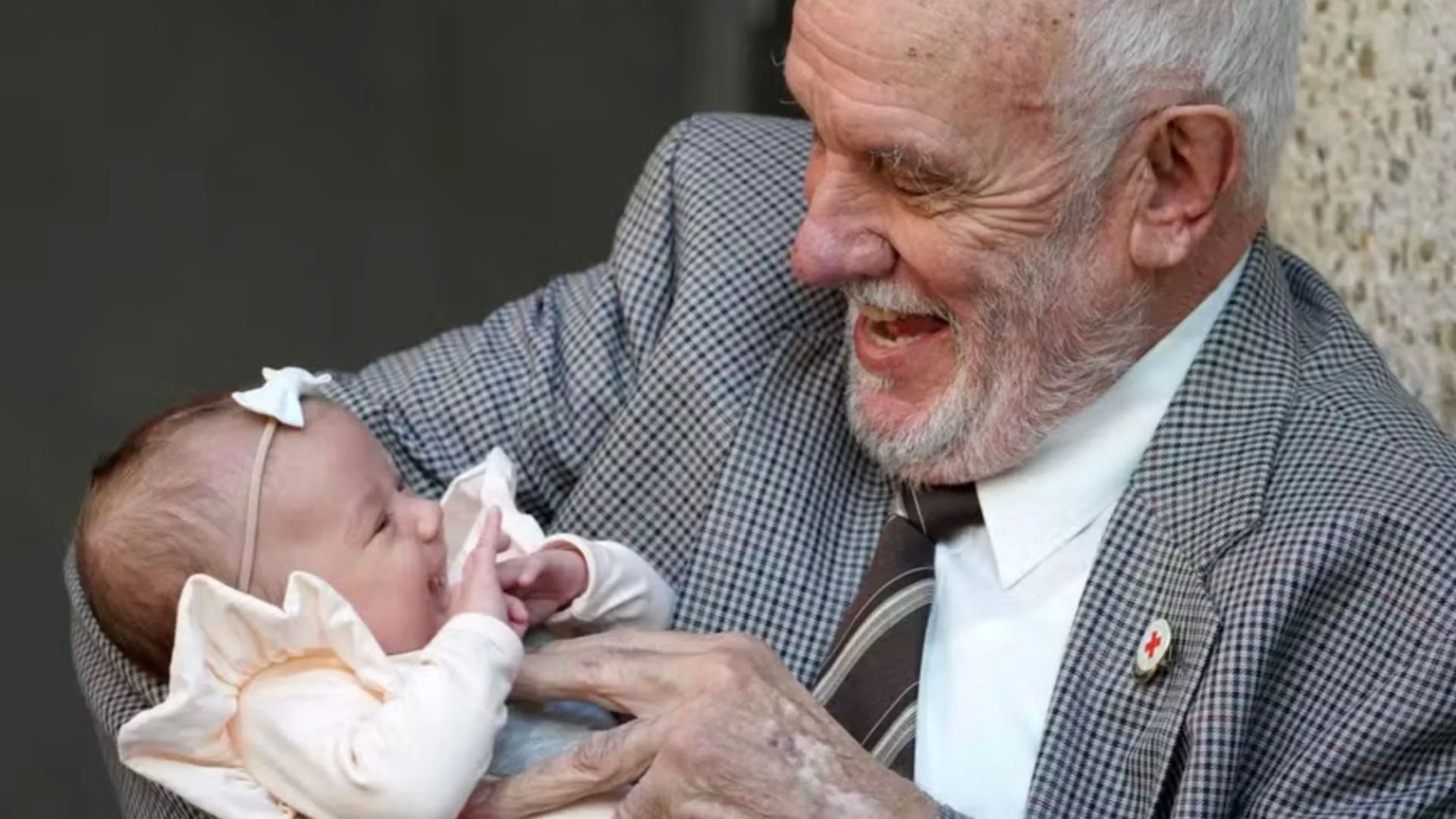
A Weekly Commitment That Spanned Generations and Changed the Fate of Millions of Families
Since he was 18, Australian James Harrison transformed a simple gesture into one of the most impactful stories in modern medicine. Today, at 78, he has accumulated 60 uninterrupted years of blood donations, a feat that, according to medical estimates, directly contributed to saving about 2 million newborns. The information was released by the channel Fox 13 Now, which detailed the global relevance of this quiet journey.
Throughout this period, Harrison attended donation centers weekly. As a result, he surpassed the mark of 1,000 donations made, a number that is extremely rare even among frequent donors. Additionally, his blood contains unusual antibodies, essential for the production of the Anti-D vaccine, used in the prevention of a serious pregnancy complication.
For this reason, doctors began using his antibodies continuously for decades. In this way, Harrison’s personal story crossed borders and began to directly impact health systems in various countries.
-
A “silent skill” is allowing Brazilians to earn up to R$ 22,000 per month without a degree and become indispensable for companies that rely on millions of data to survive.

-
Researchers at the Toyota Research Institute found that if a human uses robotic arms to flip a pancake 300 times in an afternoon, the robot learns to do it on its own the next morning, and this is currently the most promising method to solve the biggest bottleneck in modern robotics.

-
Goodbye iron: a common item in households is starting to lose space to technology that smooths clothes in minutes without an ironing board and with less energy consumption.

-
Antarctica reveals an unusual clue high in the Hudson Mountains, and what appeared to be just an isolated rock began to expose a secret hidden under the ice for ages.


Why Harrison’s Antibodies Became So Valuable for Medicine
The Anti-D vaccine works to prevent fetal erythroblastosis, also known as Rhesus disease, a serious hemolytic condition that affects newborns. This condition arises when a woman with Rh negative blood becomes pregnant with a baby who has Rh positive blood inherited from the father.
In this context, the mother’s body recognizes the Rh factor of the fetus as a foreign element. Consequently, the mother begins to produce anti-Rh antibodies that attack the baby’s red blood cells. Initially, this process may not cause severe effects. However, in a second pregnancy, the antibodies already present in the bloodstream cross the placenta and destroy the fetus’s red blood cells.
Therefore, before the creation of the Anti-D vaccine, thousands of women faced miscarriages, complicated deliveries, and babies with irreversible brain damage. As explained to CNN by Jemma Falkenmire, a representative of the Australian Red Cross Blood Service, until 1967, doctors did not fully understand the origin of these problems. “Women had recurrent miscarriages, and babies were born with severe sequelae without a clear explanation,” she reported.
With the introduction of the Anti-D vaccine, this scenario changed radically. Since then, the antibodies present in Harrison’s plasma have played a central role in this medical advancement.
A Surgery in Adolescence Gave Rise to a Historic Contribution
The origin of James Harrison’s rare antibodies dates back to his youth. At 14 years old, he underwent a high-risk thoracic surgery, during which doctors had to remove one of his lungs. During the procedure, Harrison received several blood transfusions, which ensured his survival.
Subsequently, doctors identified that it was precisely this episode that stimulated the development of rare antibodies in his body. Understanding that unknown people had saved his life, Harrison made a definitive decision. As soon as he reached the minimum age allowed in Australia, at 18, he began his journey as a regular donor.
“My dad told me that those donations saved my life. So I thought I needed to give back,” Harrison said. From then on, he maintained a strict weekly routine, always motivated by the idea of helping other families.
The Global Impact of Donations and the Silent Recognition
Over the years, Harrison’s antibodies have supplied the production of the Anti-D vaccine not only in Australia but also in other countries. For a long time, he remained the only known donor with this specific profile, which further increased his relevance to medicine.
Despite this, Harrison never sought public recognition. In an interview with CNN, he stated that he does not consider himself a hero. “It just makes you feel good about yourself,” he said. Nevertheless, health professionals recognize that his contribution has become irreplaceable.
Currently, Harrison faces an inevitable limit. In Australia, legislation allows donations only up to 81 years. Therefore, he has three more years to continue contributing directly. According to Falkenmire, the Australian Red Cross Blood Service is working to identify new donors with similar antibodies. “All we can do is hope there are people as generous as he is, and that some of them also have these antibodies,” she explained.
A Legacy That Goes Beyond Medicine
Although James Harrison’s journey is linked to impressive numbers and scientific advancements, his greatest legacy may be another. Over six decades, he has demonstrated that the consistency of a single gesture can create immeasurable impacts.
As medicine advances and seeks new pathways, stories like this reinforce that individual actions continue to play an essential role in preserving life.
Do you believe that small gestures, repeated throughout life, can still change the world in an era dominated by large technologies?







Seja o primeiro a reagir!