





 Portuguese
  English
  Spanish
  9 min of reading
  4 comments





Arctic Ice Management Proposes Using Wind Pumps in the Arctic to Pump Seawater to Ice in Winter, Freeze, and Thicken the Layer at a Cost of Up to US$ 50 Billion/Year.
The Arctic Ocean has a characteristic that, for decades, has acted as the planet’s “shield”: sea ice. It reflects much of the sunlight, helps keep the region cold, and influences atmospheric and oceanic patterns. However, this ice has been diminishing at a well-documented rate by satellites. NASA, based on data from the NSIDC, points out that the average ice extent in September (when the Arctic usually reaches its annual minimum) has been decreasing by about 13.4% per decade compared to the 1981–2010 average.
It’s against this backdrop — rarer, thinner, and more vulnerable ice — that a group affiliated with Arizona State University (ASU) presented an idea that seems industrial yet straightforward in physical logic: use the Arctic winter to make more ice, pulling seawater up and letting the cold do the rest. The proposal has a formal name, Arctic Ice Management (AIM), and was published in an article in Earth’s Future with DOI 10.1002/2016EF000410.
Below is what the study describes: what the devices would be like, how much water would need to be pumped, how much additional thickness the ice could gain, the estimated scale for a significant intervention, and the practical limits highlighted in analyses associated with the concept.
-
Scientific studies indicate that drought may be strengthening a much greater silent threat: more resistant superbugs.
-
Man builds functional 5-meter submarine in his garage using gas cylinders, PVC pipes, and a refrigerator motor, and navigates with the vessel on a lake in Colombia.
-
Millions of people have been eating yam for centuries without knowing that this humble tuber contains a compound called diosgenin, which scientists have now discovered can improve memory and help control blood sugar levels.

-
Scientists from an international project drill 1,800 meters of ice in Antarctica using hot water and discover details about one of the most intriguing places on planet Earth.

What Is Arctic Ice Management and Why Does It Focus on Winter
AIM starts from an observational realization: in summer, ice loses area and thickness; in winter, it grows back, but it doesn’t always “recover” enough to survive the next cycle. The proposal does not rely on directly cooling the planet but on artificially increasing ice thickness during winter, in areas where summer survival is considered “marginal” (that is, places where a few additional centimeters can make the difference between whether the ice withstands the warm season or not).

The described mechanism is thermodynamic. In extremely cold conditions, exposed water freezes. If seawater is brought to the surface of the ice during the polar night and peak winter, it can freeze and add volume to the ice sheet.
In the article, the authors model this process and report that pumping about 1.3 meters of seawater upwards (over the winter) equals about 1.4 meters of ice, resulting in an additional thickness of about 1 meter by the end of the season.
What the “Wind Pumps” in the Arctic Ice Would Look Like
The proposal describes a device designed to operate in the polar environment: a floating structure (buoy) with a wind-catching system and a pump. The energy would come from the Arctic wind, with a turbine connected to a mechanism capable of pulling seawater from below the ice and releasing it above the surface.
In the article text (and in the descriptions associated with the project), there is a sizing reference: a turbine with blades approximately 6 meters in diameter would be sufficient, in principle, to pump the necessary volume to cover a target area with a layer of water that would freeze over the winter.
The operational logic is not to “dump a lake” of water all at once. The concept relies on repeated pumping throughout the cold season, creating layers that freeze and integrate with the existing ice. The study uses a simplified model of winter freezing and summer melting to assess how much thickening would be achieved and how this could affect the ice’s survival in the following season.
The Headline Number: 10 Million Units
A central part of AIM is that it does not describe a “isolated prototype” as a solution. It discusses a scale that, if taken literally, falls into the category of megaproject.
The article and communications linked to ASU state that each unit could operate on about 0.1 km² of ice over the winter. With this productivity per unit, the presented calculation indicates that around 10 million devices would be needed to operate over a relevant fraction of the ocean — in the discussion, the target of ~10% of the Arctic Ocean is mentioned.
This scale is not random. It derives from geometry and area: 0.1 km² per unit is a “small blot”; to reach hundreds of thousands to millions of km², you quickly enter the millions of devices range.
Why “1 Meter More” Matters in the Physics of Sea Ice
In the article, the authors contextualize the average annual thickness of ice. The text mentions that the average annual thickness is close to 1.5 meters and that adding about 1 meter represents a significant increase, on the order of ~70% under certain conditions considered in the model.
The study also compares this thickening with thinning trends. In the PDF excerpt, an estimate appears suggesting that the average annual thickness has been decreasing at an approximate rate of 0.58 m per decade, and that “adding 1 meter in one year” would be a rate much higher than the average loss estimated during the period analyzed by the model.
In volume, the article presents orders of magnitude: it mentions ~104 km³ of ice per year as the equivalent of thickening over the treated area and cites a loss rate of volume around ~3200 km³ per decade (depending on the scope and data set considered).
These numbers exist in the text as part of the argument of “physical scale”: the plan attempts to show that, theoretically, the volume of ice “manufactured” could be comparable (or greater) than the loss rates discussed in the paper itself, provided that the deployment was extensive.
The Role of Albedo: Light Ice Versus Dark Ocean
The study and the reports explain the main climatic motivation: the albedo effect. Ice and snow reflect more radiation; liquid water, especially in the ocean, absorbs more. The ASU communication summarizes this contrast with a number that often circulates: ice reflects much of the sunlight, while the ocean absorbs a large part.
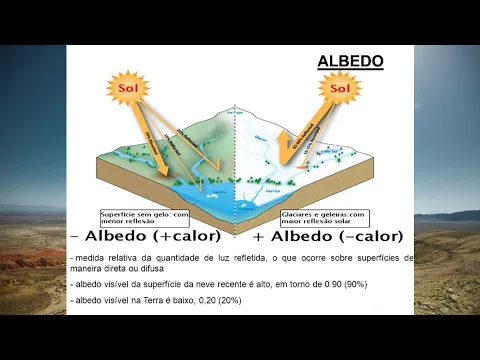
The physical consequence of the ice retreat is known: more exposed ocean in summer means more energy absorbed, which warms the water and makes subsequent freezing difficult, feeding a feedback cycle. This mechanism is cited as part of the context to explain why the Arctic is treated as a “sensitive” region within the climate system.
Where AIM Aims: “Marginal” Ice and Areas of the Ocean with Greater Vulnerability
The article emphasizes that thickening would be most relevant “where the ice barely survives” summer. This points to areas where seasonal ice dominates and the average thickness is below more stable levels. The ASU communication describes that half of the Arctic Ocean can be characterized by ice with an average thickness below ~1.5 m in certain cuts, and that increasing 1 m in part of the area could offset loss trends.
In narrative terms, this means targeting places where the ice is not “the most protected,” but where there is still enough ice to receive the intervention and, in theory, might last longer.
How Much Would It Cost: Why “US$ 50 Billion” Appears as a Reference
Your title mentions “up to US$ 50 billion,” which appears in project descriptions as annual cost in a scenario of distributed implementation over a decade.
The ASU communication describes the following calculation: about 10 million units, estimated cost of US$ 50,000 per unit, implementation over 10 years, resulting in something like US$ 50 billion per year in that timeframe.
Other journalistic pieces associated with the theme have also reflected orders of magnitude in the hundreds of billions range, with variations depending on framing (annual cost versus total cost of a multi-year program).
What is consistent among the sources linked to the paper is: the order of magnitude comes from multiplying “number of units” by “unit cost” in a deployment timeline.
Materials and Industrial Capacity: What the Paper and Communication Mention
The proposal also enters the realm of industrial capacity, as manufacturing millions of structures to operate in the Arctic is not just “an idea”: it depends on supply chains, materials, and maintenance.
Some reports that covered the topic mentioned the mass of materials needed (e.g., steel) and the scale of manufacturing as part of the debate about industrial viability.
In the paper, the focus is on the physical model (freezing and melting), on sizing for pumping, and on the area covered per unit, but ASU’s framing makes it clear that it is a project thought out on an “approximately million scale.”
The Practical Challenges Surrounding the Concept
The study presents a proposal and modeling; the analyses and repercussions add operational questions that arise immediately when talking about deploying millions of devices into an ocean with moving ice.
Some recurring points in the public discussion of AIM include: how these units would withstand compression and fracturing of the ice, how they would cope with storms and ice drift, how mass installation would be carried out, and how maintenance would be performed in a remote environment. The ASU communication itself mentions the need for prototypes and tests to assess what would work “in the real world.”
This aspect is important because AIM, as published, is an engineering proposal with modeling: it describes a physical path to increase ice but does not present itself as technology already ready and installed.
Arctic Ice in Numbers: What Historical Series Show
The discussion of AIM fits within long-term observational data showing declines in ice, particularly at the end of summer.
The NASA Earth Observatory, based on NSIDC data, highlights a decline of ~13.4% per decade in September extent since 1979, compared to the 1981–2010 average.
The NOAA/Arctic Report Card also discusses negative trends and anomalies in extent, reinforcing that September behavior is one of the core indicators tracked by historical series.
Recent updates (such as the annual analyses from NSIDC published via NOAA Climate.gov) continue to place annual minima at low levels in the satellite record, with year-to-year variation but a documented long-term trend.
This data set serves as the basis for the problem AIM seeks to address: less ice and thinner ice are initial conditions that make any summer more “sensitive” to winds, currents, and warming.
Current Situation of Arctic Ice Management: Published Proposal, No Large-Scale Implementation
Information available from sources linked to the paper and ASU describes AIM as a published and discussed proposal, calling for the development of prototypes and subsequent evaluations. The institutional communication from ASU does not describe a program in operation in the Arctic at an industrial scale; it presents the work as an article and an engineering concept to be evaluated.
As publicly described, AIM exists as: a reviewed/published article with DOI, a physical model of freezing and melting, a sizing of turbine/pump, and a scale/cost calculation associated with the number of units and the area covered.
What the Paper Puts at the Center: Volume, Area, and Thickness as Key Variables
To understand why this proposal is treated as “billion-dollar” and “millions of pieces,” the key lies in the tripod of the article itself: area covered per unit, additional thickness per winter, and total volume of equivalent ice.
The paper states that a turbine with specific dimensions could pump enough water to freeze and thicken ice over about 0.1 km², resulting in approximately 1 meter of additional thickness. From there, it scales reasoning to millions of units and a target of ~10% of the Arctic in suitable regions.
The internal conclusion of the model is: if thickening occurred on the indicated scale and in the right “marginal” areas, the physical impact on annual thickness could be significant enough to compete with thinning trends discussed in the article.
Arctic Ice Management is a formally published proposal in Earth’s Future that describes a method for thickening sea ice in winter through wind-powered pumps. The concept estimates that pumping about 1.3 m of water over the winter could result in around 1 m of thickening, and that each unit could operate over about 0.1 km², leading to a number of ~10 million units to operate across about 10% of the Arctic Ocean.
The cost “up to US$ 50 billion” appears in the context of a decade-long deployment estimated annually based on unit cost and total number of proposed devices.
And the underlying motivation is supported by historical series showing persistent declines in sea ice, especially at the end of summer, with numbers widely reproduced by scientific institutions and satellite monitoring.






E lá se vão 50 bilhões de dólares para as mãos da vagabundagem que inventa problemas para vender soluções.
A natureza tem seu curso. Ninguém consegue interferir.
Que plano sem pé nem cabeça. Isto se parece mais com o intuito de lavar dinheiro público, pois mesmo com trilhões nao haveria de dar certo devido ao fato da evaporação acelerada no superfície e, claro, vai sempre resultar no delelo constante. Até uma passoa id**ta saberia disto