





 Português
  Inglês
  Espanhol
  3 min de leitura
  0 comentários



Despite Its Grandiosity, the Great Wall of China Is Invisible from Space! Understand Why Other Smaller Structures Can Be Seen and What Factors Influence This Spatial Curiosity
The Great Wall of China, one of the most impressive human creations, stretches for an astonishing 13,000 miles, crossing mountains, valleys, and ravines.
Its grandiosity is indisputable, but there is an intriguing revelation that few know: this colossal structure cannot be seen with the naked eye from space!
Despite being one of the largest works ever constructed, the wall remains mysteriously invisible when viewed from outside our planet. But why, then, are other smaller constructions visible?
-
A bright yellow mushroom imported from Asia escaped from a cultivation farm in the United States in 2010 and is now aggressively spreading across 25 states, destroying entire communities of native fungi in American forests.

-
Buried under China, a colossal machine weighing 20,000 tons began operating as the largest neutrino detector on the planet and, in just 59 days, surpassed results that science took half a century to achieve.

-
Iran enters the center of a climate alert after the war emitted 5.6 million tons of CO2 in two weeks, surpassing the annual pollution of entire countries.

-
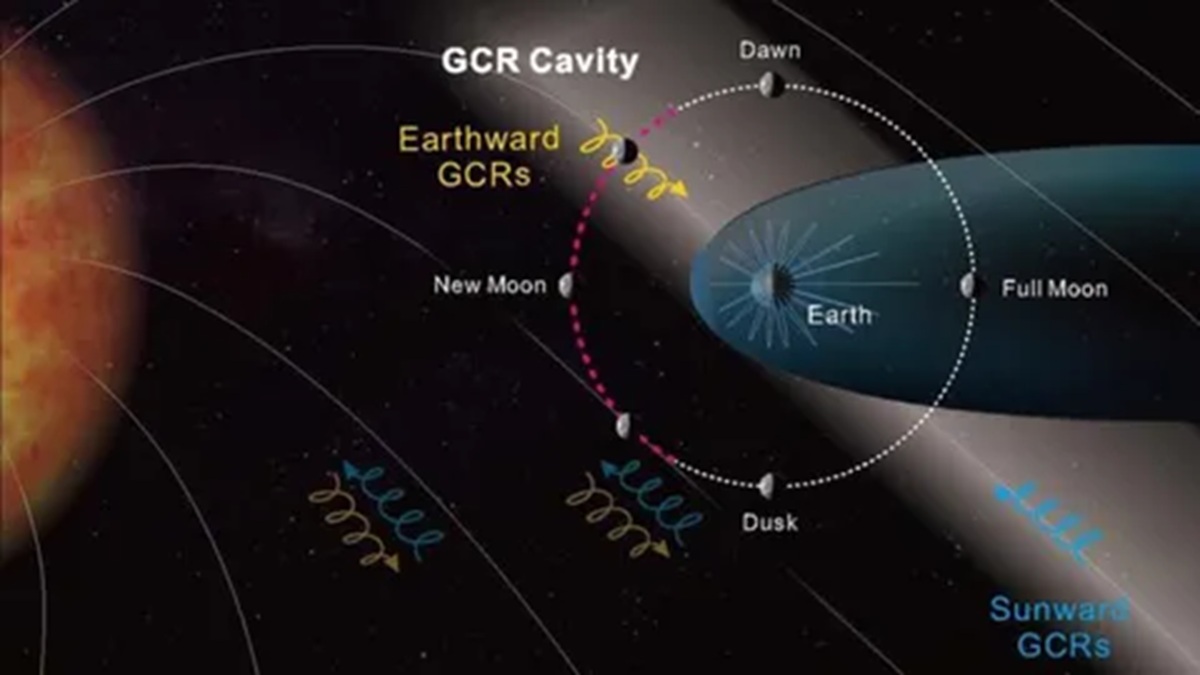
Lunar exploration may change after a Chinese probe finds a “cavity” of radiation that reduces the impact on astronauts by up to 20% at certain times on the Moon.

According to experts, such as astronomer and science communicator Phil Plait, the reason the Great Wall of China is not visible from space lies in how our eyes perceive distant objects.
Even though it is extensive, the wall is relatively narrow, which drastically reduces its visibility, even in a low orbit, such as that of the International Space Station (ISS).
On the other hand, other constructions, such as the Three Gorges Dam, are visible due to their size, contrast, and strategic location.
The Wall and the Myth of Space
For decades, it was believed that the Great Wall of China would be one of the few human works visible from space.
However, this idea has been debunked by scientists who explain that, due to its average width of only 13 feet, the wall becomes imperceptible at a great distance.
The observation with the naked eye from space is limited by the resolution of the human eye, which cannot distinguish the wall at one arc minute, an angular measurement unit used in astronomy.
The Science Behind Invisibility
As Plait explained in his column in Scientific American, the resolution of the human eye, even in ideal conditions, is not sufficient to see the wall.
To be able to see it from the Moon, for example, it would be necessary to distinguish a line with a thickness of one-hundredth of an arc minute. With the Moon about 240,000 miles away from Earth, this task becomes impossible for the human eye.
Comparison with Other Visible Structures
According to NASA, some human constructions are visible from space, such as the Three Gorges Dam, also located in China.
With more than 1.2 miles long and 607 feet high, this dam is much larger in width and height than the Great Wall of China, and is situated in a region with high visual contrast, which makes it easier for astronauts to see.
Myths and Truths About What Is Visible from Space
According to NASA, the ability to visualize objects from space depends not only on size but also on contrast and lighting conditions.
Ships at sea, for example, can be seen because they contrast sharply with the deep blue of the ocean.
Roads in deserts are also easily visible due to the color difference between asphalt and sand. In the case of the Great Wall of China, its color similar to the surrounding soil contributes to its invisibility.
The Legacy of the Great Wall of China
Although it is not visible from space, the Great Wall of China remains a symbol of resilience and extraordinary engineering.
Constructed to protect the Chinese empire from invaders, the wall stretches for thousands of miles, and its architectural complexity fascinates millions of tourists every year.
The Greatness That Hides
Even though we cannot see it from afar, the Great Wall of China remains one of the largest and most significant structures ever built by humanity.
Its spatial invisibility, instead of diminishing its importance, only adds a new level of mystery and fascination to this monumental work.
And you, did you imagine that the largest wall in the world could not be seen from space? Do you think other constructions would surprise astronauts more?






Seja o primeiro a reagir!