





 Portuguese
  English
  Spanish
  6 min of reading
  0 comments


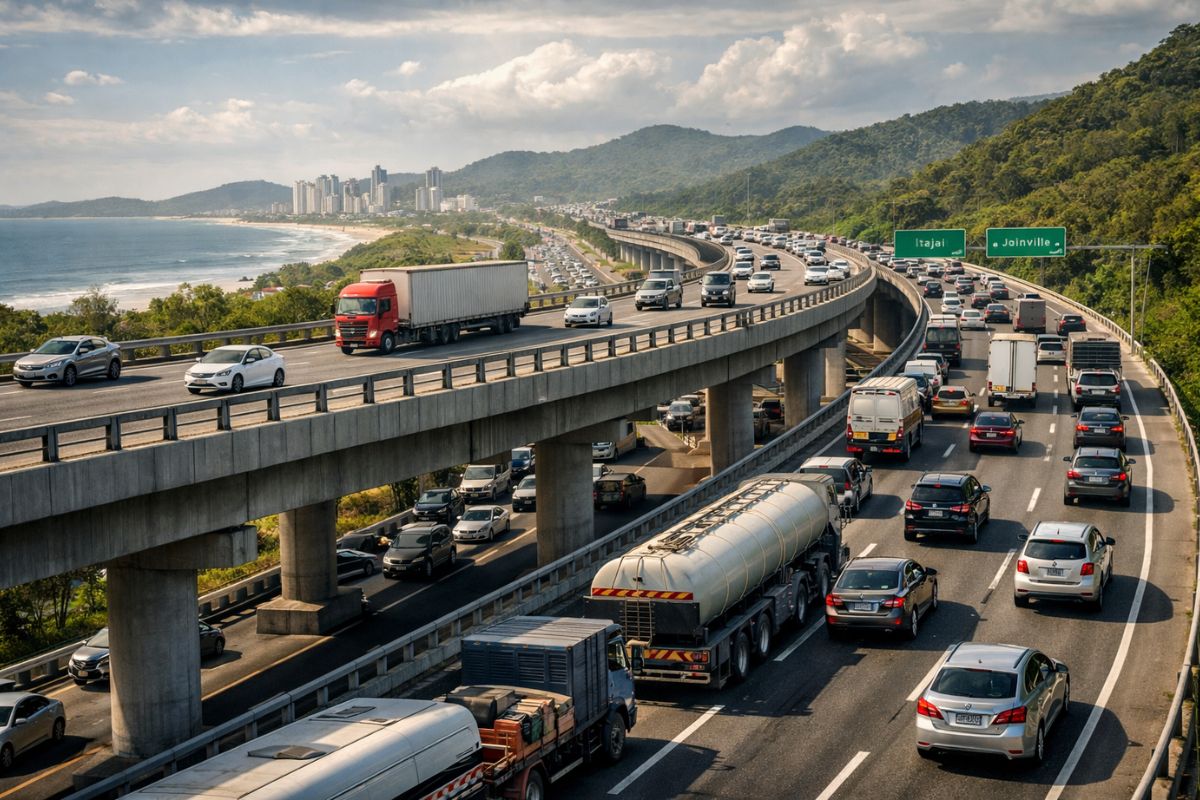
Presented to Address the Bottlenecks of BR-101 Between Itapema and Barra Velha, the Idea Proposes Elevated Lanes Over the Current Highway as a Suspended Parallel Route and Raises the Question of Whether Santa Catarina Should Invest in an Unprecedented Structural Intervention in the Most Critical Section of the Santa Catarina Coast in the Coming Years.
BR-101 is back at the center of debate in Santa Catarina with an unusual proposal: to build a two-level road over the current layout between Itapema and Barra Velha, creating elevated lanes to try to relieve congestion in one of the most pressured stretches of the coast. The suggestion was presented by state deputy Ivan Naatz, who advocates for opening a technical discussion on the feasibility of the idea.
Instead of proposing a new path outside the existing highway, the proposal leverages the corridor already occupied by BR-101, with a suspended structure functioning as a parallel route. The idea is still in the field of political and technical debate, with no official study released so far regarding cost, execution or real impact of the solution in the cited stretch.
What the Two-Level Road Over BR-101 Would Look Like
The concept presented for BR-101 resembles a continuous viaduct raised over the current highway. In practice, the proposal imagines elevated lanes following the existing layout, creating a second level of circulation over the stretch between Barra Velha and Itapema.
-
Unemployment rises again to 5.8% at the beginning of 2026, raising alarms about the end of temporary positions and its impact on the Brazilian job market.

-
Document organization can cut invisible costs in small businesses, a simple step that prevents waste, rework, and losses in daily operations.

-
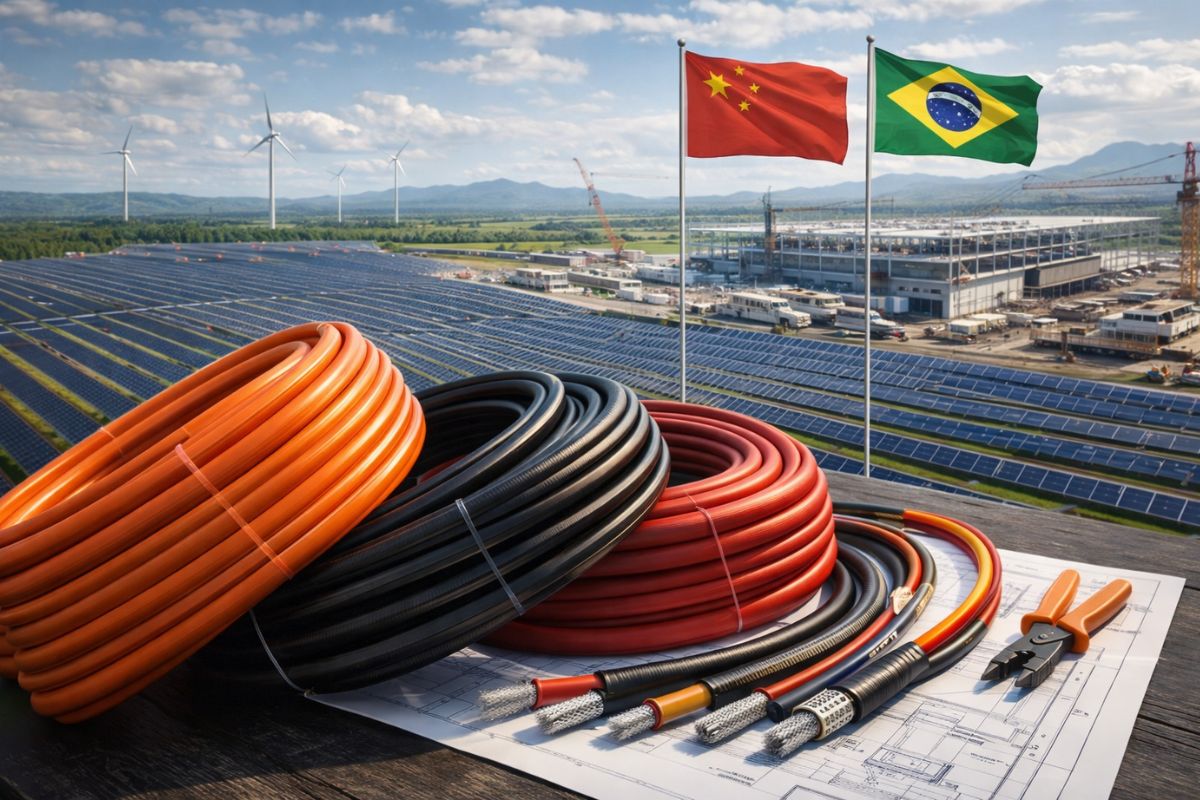
Chinese giant worth nearly R$ 4 billion that manufactures cables for electric cars, solar energy, and robotics wants to open a factory in SC.
-
Many employers do not know, but the law guarantees domestic workers a 25% increase in salary during trips, 50% for overtime, 20% for night shifts, and 17 additional benefits that can lead to labor lawsuits if not paid.


The logic is simple to understand: expand the capacity of the road without theoretically depending on the opening of a new roadway corridor.
In defending the idea, Ivan Naatz stated that he intends to call engineers, architects, urban planners, and professionals linked to road infrastructure to discuss whether this model could work in Santa Catarina.
This shows that the proposal has not yet been born as an executive project, but as a provocation for a broader debate on non-traditional solutions for BR-101.
Why the Stretch Between Itapema and Barra Velha Became the Focus of the Discussion
The stretch of BR-101 between Itapema and Barra Velha appears as the central point of the proposal because it is treated as one of the most critical areas of the highway on the Santa Catarina coast. It is precisely there that the problem of intense flow gains greater visibility and puts pressure on residents, transporters, tourists, and economic activities that depend on quick connections along the coast.
When the discussion focuses on this segment, the political reasoning behind the proposal becomes clearer: attack first the point where congestion has become most sensitive and most easily perceived by the population.
The choice of the stretch is not random, but linked to the image of strangulation that BR-101 has come to represent in this stretch of the coast, especially when the volume of vehicles increases and the highway loses efficiency.
The Central Argument of the Proposal and What It Promises to Avoid
One of the main arguments used in defense of the two-level road on BR-101 is that, by utilizing the current layout, the solution could reduce common obstacles to large roadworks. According to the deputy, this configuration would eliminate expropriations, avoid the need for a new route, and reduce barriers related to licensing a new path.
This is a politically strong point because it addresses three delicate fronts at the same time: time, cost, and territorial conflict. Whenever a new road requires the removal of properties, purchase of land, and reconfiguration of the right-of-way, the debate tends to become slower and more expensive.
The promise of the proposal is precisely to shorten this path, although this still depends on more in-depth technical and legal verification, as it is not enough for the idea to seem simple on paper for it to become simple in execution.
What Is Known About Costs and What Has Not Yet Been Presented
So far, the proposal for the two-level road for BR-101 has not come with an official investment estimate. This is a crucial detail because any discussion about feasibility necessarily goes through concrete numbers.
What was mentioned by the parliamentarian was the estimated cost for Via Mar, cited by him at around R$ 9 billion, as a way to compare the financial dimension of alternatives considered to ease traffic in the region.
The comparison with Via Mar reveals the political sense of the proposal: to show that, in the face of a large-scale and costly project, there could be a different path to be studied over BR-101 itself.
At the same time, this comparison also exposes the main gap in the debate at this moment. How much the elevated solution would cost has not yet been informed, and without this data, the proposal remains stronger as a public impact idea than as a closed engineering plan.
The Relationship with Via Mar and the Dispute for a Solution to Congestion
The two-level road emerges as an alternative to the Via Mar project, which studies the creation of a new highway of about 145 kilometers to alleviate the pressure on BR-101. This means that the discussion is not just about a structural design but about two different paths to tackle the same problem: opening a new route or increasing the circulation capacity over the existing axis.
This difference completely changes the type of decision that public authorities would need to make. A new highway presupposes a new corridor, new territorial occupation, and a more expansive logic of mobility. The elevated proposal over BR-101 seeks to intensify the use of the current layout.
In other words, the debate is not just about construction but about the model of intervention, about what type of response the State intends to give to a congestion that has already become a structural problem.
International Examples and the Limits of the Catarinense Case
When presenting the proposal, the deputy mentioned examples of elevated roads in cities like Miami, New York, and Seoul. The reference serves to support the idea that overlapping circulation structures are not an impossible or purely theoretical concept. In complex urban environments, such solutions have already been used to distribute flows, reorganize movements, and increase traffic capacity in densely populated areas.
However, bringing international examples to BR-101 does not automatically resolve the local issue. Each road corridor has its own characteristics of terrain, demand, operation, maintenance, safety, and integration with existing access.
For this reason, the fact that the idea exists elsewhere does not automatically mean it is viable on the Santa Catarina coast. Without an official study released, the proposal still depends on concrete analysis regarding structure, impact on traffic during construction, final cost, and practical results for those using the highway.
What Is at Stake for BR-101 From Now On
At this stage, the proposal for the two-level road places BR-101 at the center of a discussion that mixes urgent need for flow, political pressure for a quick response, and search for visually strong solutions. It draws attention because it breaks with the most common type of road proposal and attempts to transform an already saturated stretch into a base for vertical circulation expansion.
At the same time, the absence of an officially released study keeps the discussion in a territory that requires caution. There is an important difference between opening a debate and proving feasibility. BR-101 needs a solution, but a lasting solution depends on more than just political impact or visual appeal. It depends on project, calculation, operation, safety, and clarity about the real benefit for those facing congestion daily.
The proposal to transform BR-101 into a kind of corridor with two levels repositions the debate on mobility on the Santa Catarina coast and forces an uncomfortable question: is it better to insist on new routes or try to reinvent the road that already concentrates the problem? Between boldness and feasibility, the discussion is just beginning.
And you, do you believe that a two-level road would be a real solution for BR-101 or do you think the solution lies in another path?









Seja o primeiro a reagir!