





 Portuguese
  English
  Spanish
 4 min of reading
  28 comments


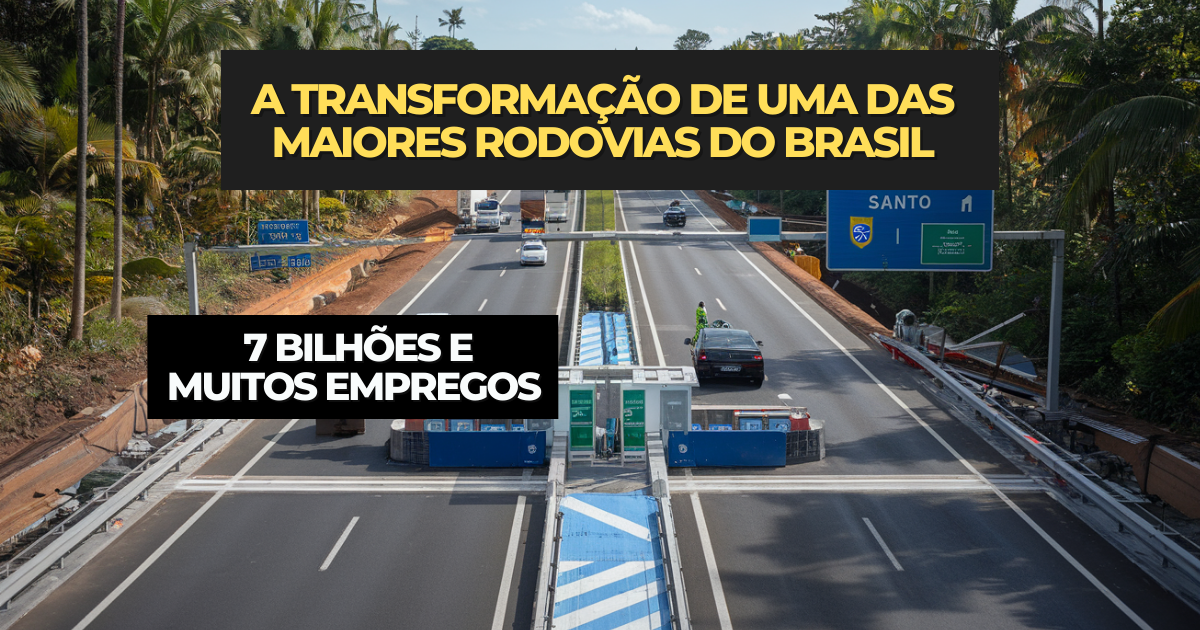

BR-101 Will Be Modernized with R$ 7 Billion in Investments. The Project Promises to Generate Over 100,000 Jobs, Improve Infrastructure and Safety, but Will Also Bring Higher Tolls, Generating Controversies.
One of the most ambitious projects in Brazilian road infrastructure is about to become reality.
With an estimated investment of R$ 7.07 billion, the duplication of 221 kilometers of BR-101 in Espírito Santo promises to revolutionize transportation in the state and generate more than 100,000 direct and indirect jobs.
Despite the promises of improvements, the initiative brings challenges, including higher tolls and criticism regarding the concession model.
-
50 viaducts, 4 tunnels, 28 bridges, and 40 kilometers of bike paths: BR-262 in Espírito Santo will receive 8.6 billion reais for the largest engineering project in the state’s history, inspired by the Immigrant Highway in São Paulo.

-
Brazil produces too much clean energy and doesn’t know what to do with it: over 20% of solar and wind capacity was wasted in 2025 while investors flee and 509 renewable generation projects were abandoned in the last year.

-
Piauí will produce a new fuel that replaces diesel without needing to change anything in the truck’s engine and reduces pollutant gas emissions by half: truck drivers from all over the Northeast are already celebrating the news that will arrive later this decade.
-
A new Brazilian shopping center worth R$ 400 million will be built in an area equivalent to more than 4 football fields, featuring 90 stores, 5 cinemas, a supermarket, a college, and parking for 1,700 cars, potentially generating 3,000 jobs.


Strategic Duplication to Alleviate Traffic
BR-101 is one of the country’s main highways, connecting Espírito Santo to neighboring states and serving as a vital axis for the transport of goods and passengers.
Since 2013, the section in the state has been under the responsibility of the concessionaire Eco101, which has now received authorization from the Tribunal de Contas da União (TCU) to proceed with the duplication project.
The project will include 96 kilometers of duplication in the first three years, in addition to 125 kilometers more throughout the contract.
Strategic sections will receive special attention, such as the road bypasses of Ibiraçu and Fundão, which total 15.6 kilometers and aim to divert urban traffic, improving safety and reducing travel time.
Although the original plan foresaw the duplication of 376 kilometers, 155 kilometers were excluded due to technical and environmental infeasibility.
However, 41 kilometers of additional lanes have been added, which promises to ease traffic flow at critical points.
Economic Impact and Job Creation
The BR-101 project is not limited to transportation improvements. According to estimates from the TCU, the duplication will be responsible for creating 100,464 jobs, comprising:
- Direct Jobs: 34,026
- Indirect Jobs: 16,046
- Multiplier Effect: 52,392 (generated by increased local consumption).
Additionally, the modernization of the highway is expected to boost sectors such as construction, logistics, and commerce, strengthening Espírito Santo’s economy.
Direct jobs range from construction workers to engineers and technicians, while indirect jobs include suppliers and other services.
Billions in Investment and Contract Extension
To make the project feasible, Eco101’s contract has been extended by 10 years, potentially totaling 40 years of concession.
The investment of R$ 7.07 billion includes not only the duplication works but also the maintenance of the highway and improvements in safety, such as the construction of pedestrian bridges and shoulders.
However, the decision to extend the contract has drawn criticism, especially among drivers and infrastructure experts, who question whether the private concession model is the best solution for such important highways.
The Price of Progress: Higher Tolls
With the duplication, toll rates are set to increase as well.
Currently, the cost per kilometer for single lanes is R$ 0.05525, but it is expected to rise to R$ 0.071 starting the sixth month of construction.
As duplicated sections are delivered, the rate will be adjusted to R$ 0.156 per kilometer, equivalent to about R$ 16.55 for every 100 kilometers traveled.
This change raises concerns for frequent users, such as truck drivers and residents of cities traversed by BR-101, who rely on the highway for daily activities.
Despite this, Eco101 argues that the increase is necessary to sustain highway maintenance, ensure the quality of work, and provide more safety for drivers.
Controversies and Criticism of the Highway Concession Model
Although the project brings evident benefits, it is not free from controversies.
One of the main criticisms is the removal of the Contorno de Linhares, a project considered essential for traffic in the region.
According to the TCU, the exclusion occurred due to environmental licensing issues, but future inclusion is not ruled out.
Another point of contention is the high cost for users, especially for truck drivers who already face challenges with high fuel prices and toll rates on other privatized highways.
Experts point out that the lack of robust public alternatives for infrastructure creates excessive dependency on the private sector, resulting in higher rates for the population.
The Vision for the Future: Modernization or Burden?
The duplication of BR-101 represents a milestone for Espírito Santo and Brazil.
With significant improvements in safety and traffic, modernization promises to transform drivers’ experiences and stimulate economic development.
However, the associated costs, including higher toll rates and the extension of the concession contract, raise questions about accessibility and the financial impacts on users.
Does modernization outweigh the costs? Or does the current concession model need to be rethought to ensure a better balance between investments and benefits for the population?
Leave your opinion in the comments: will drivers be able to afford the costs of a road that, although modern, will become increasingly expensive to use?









No brasil virou moda o cidadão paga uma mega contribuição em impostos e não lhe é revertido nada de benefício aí no caso de rodovias ainda tem de pagar pedágio muito caros
Eu sou de Ribeirão Preto-SP, 99% dos comentários é a realidade…meu Deus!
como pode esses corruptos vir com esses papos nojentos de Obras …lógico deveriam fazer as obras sem roubar, mas não é isso ; só enganam o povo.
Só Deus para devolver o troco para esses malandros que vivem na mordomia às custas do pobre trabalhador. Se não pagarem aqui vão queimar no inferno qdo morrer.
Temos que ajoelhar e orar para Deus nos livrar desse inferno , nosso salário está cada dia desvalorizado.
Povo ! Não dê crédito a eles 😡
.
INFELIZMENTE VAMOS PAGAR, ACHO INJUSTO COM USUÁRIO DA RODOVIA ARCAR COM TODOS OS CUSTOS, AONDE ENTÃO RECURSOS ESTADUAL E FEDERAL?
Cadê o dinheiro dos impostos , principalmente o imposto goela a baixo, vulgo ” IPVA “