





 Portuguese
  English
  Spanish
  7 min of reading
  0 comments


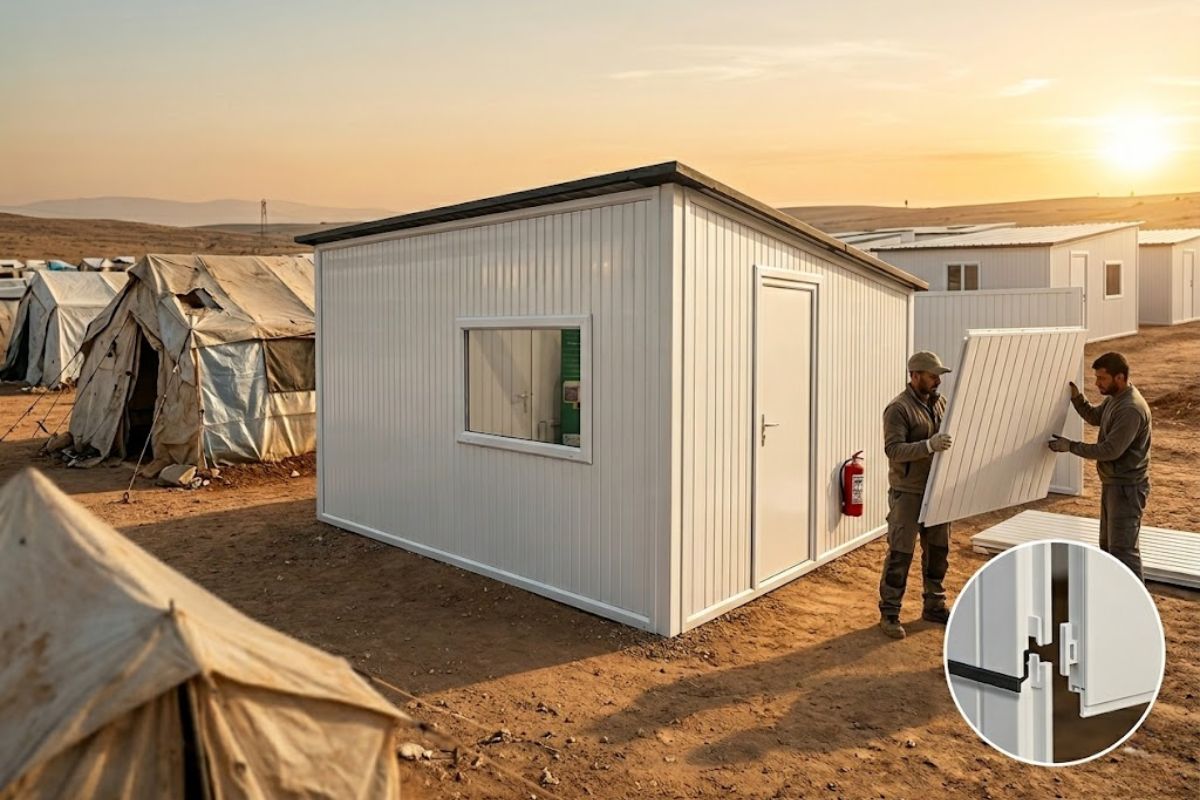
Created By Researchers From The University Of Birmingham With Suscons UK, The “Flatpack” Modular House Uses Recycled uPVC To Replace Tents In Emergencies. Assembles Without Specialized Team, Measures 3.5 M X 4.0 M, Has Locked Doors And Withstood 30 Minutes In Fire Test, And Also Comes With A 10-Year Warranty.
The modular house developed by the University of Birmingham with Suscons UK arises from an uncomfortable and practical question: why, in extreme situations, does the response still have to be a tent that tears, degrades, and offers little privacy? The proposal is to replace makeshift solutions with a collapsible shelter that arrives “flat-packed,” fits quickly, and provides more safety for vulnerable people.
Behind the promise of assembly in about an hour is an entire chain of technical, logistical, and circular economy decisions: transforming plastic waste into structural components, reducing disposal, and creating a housing standard that works in both refugee camps and natural disaster scenarios, where time and protection are extremely valuable.
Where Did The ‘Suscons’ House Come From And What Problem Does It Try To Solve

The Suscons Emergency Relief Shelter arose from the collaboration between the Birmingham Plastics Network, linked to the School of Engineering at the University of Birmingham, and Suscons UK Ltd. The initiative began within a six-year research project called Low Impact Alternative Resources (ARLI), aimed at converting waste into useful materials and developing new innovative materials.
-
New CCR concrete paving technology promises roads up to 3x more durable, less maintenance, and cost reduction in Brazil.

-
Made from recycled plastic, plastic wood is gaining space in the construction industry because it does not rot, resists moisture, and reduces maintenance costs over the years.
-
Florianópolis will receive a million-dollar BRT that will begin construction in 2026 with nearly 400 million in funding from the federal government and the Inter-American Development Bank, and the map already shows the routes for the exclusive bus corridors.
-
Without a blueprint, without an engineer, and using scrap from the dump, a father spends 15 years building an 18-room castle for his daughter, featuring tram tracks, 13 fireplaces, and over 700 m², which may now be demolished.

The emergency modular house emerges as a result of 18 months of research and development focused on a straightforward objective: providing safer protection than tents, following a circular economy logic.
The solution targets uses in refugee camps and emergencies, with a humanitarian and operational justification to serve people displaced by wars and natural disasters, cited as over 14 million per year.
How The “Flatpack” Modular House Is Assembled And What Does “No Tools” Mean

The “flatpack” concept is not just a catchy name: it describes a modular dismountable system in which the pieces arrive ready for fitting, reducing typical construction stages.
The modular house is assembled by unskilled labor in about an hour, without the need for fasteners, tools, or additional equipment, fundamentally changing the “cost of complexity” in the field, where there is often a lack of structure, energy, and tools.
In practice, the fitting logic reduces reliance on technical teams and speeds up response in situations where every hour matters.
The fewer failure points in assembly, the greater the chance of standardization, especially when multiple units need to be erected in sequence and under pressure, such as in rapid displacements, emergency shelters, or temporary relocations.
Materials And Safety: Why Recycled uPVC Became Central To The Project
To choose the material, different plastics were considered, and others may still be evaluated in the future to improve structure and insulating properties.
For now, rigid PVC (uPVC) was selected as a base for a straightforward reason: it is readily available, and by being repurposed, it prevents window and door frames from ending up in landfills or illegal dumps. Here, the raw material is not “new”: it is an urban problem transformed into a shelter component.
The described chain involves the collection of rigid PVC by Suscons in West Midlands, London, Staffordshire, and Shropshire, at minimal or no cost.
Then, the plastic is shredded, melted, and mixed with a percentage of virgin plastic to ensure chemical quality, and then extruded to form the necessary pieces. There is also an important point of circularity: rigid PVC can be recycled up to ten times before losing integrity, and materials from discarded shelters can return to the process.
The glass collected along with the frames can also be sold to recycling companies, helping to reduce costs and improve the circularity of the system.
Comfort, Dimensions And Adaptation Possibilities In The Field
When talking about shelter, “size” and “height” are not details; they are real limits for living with dignity.
The modular house is described with a minimum height of 2 m and internal dimensions of 3.5 m x 4.0 m, allowing for minimal circulation and organization of the space. It also includes a significant difference in contexts of vulnerability: locked doors and windows that help reduce risk and restore privacy, something rare in makeshift solutions.
In addition to the basic “shell,” the design allows for coupling and adaptation possibilities: solar panels, extra private rooms for medical facilities, and rainwater collection systems.
This transforms the shelter from “roof” into infrastructure, with the potential to operate as a semi-permanent transitional housing, depending on the scenario, logistics, and the length of stay of families.
Fire, Winter And Real Risk: What Tests And Requirements Indicate
Fire safety is a critical issue in temporary settlements, where structures are close together, and the spread can be rapid.
Rigid PVC is presented as fire-resistant and “does not catch fire” in the sense of reducing ignition and spread; tests were reportedly conducted in a fire chamber, and the shelter maintained its integrity for 30 minutes, a time considered sufficient for evacuation. Thirty minutes, in a panic scenario, can be the difference between getting out and getting trapped.
There is also the aspect of guidelines: the solution is described as meeting all UNHCR guidelines and comes with a 10-year warranty. This decade horizon is significant when compared to the operational reality of tents, which are noted to be subject to degradation during storage and potentially unviable after 18 months of use.
The economic point is carefully presented: the shelters are more expensive to acquire than tents, but they can become more economical over ten years precisely because they last longer, provided buyers adopt a long-term investment perspective.
Who Has Shown Interest And What This Changes In The Volume Of Waste Removed
The interest mentioned does not come from just one type of organization: humanitarian aid agencies including those from the UN, Red Cross, ICRC (Red Crescent), as well as OXFAM, WHO, Christian Aid, and other local agencies, have reportedly shown attention to the shelter for actions worldwide. There is specific mention of Ukraine, where a tent would be inadequate in harsh winters, reinforcing the argument that the “tent standard” does not serve all climates and risks.
When these organizations talk about thousands of units, it points to a dual effect: more people protected and a significant amount of post-consumer plastic removed from the waste stream.
At the same time, the modular house opens up space for uses outside the classic refugee circuit: temporary constructions in the oil industry, military installations, and shelters for homeless individuals are appearing as possibilities being explored.
In parallel, the project has circulated in events and technical showcases like AidEx and DIHAD, as well as a parliamentary reception from the British Plastics Federation, and received awards related to innovation and design in plastics, with mention as a finalist for the GRIPS award for innovative use of polymers and social engagement.
Next Steps: Local Manufacturing, Carbon And Jobs Around Plastic Waste
A recurring challenge in humanitarian solutions is the dependence on long supply chains. For this reason, there is a future intention to investigate alternative plastics derived from other waste, such as packaging, bags, and bottles, which tend to be locally available where the shelters are needed.
The idea is to mix these plastics with uPVC, or even use them alone to form sections of the shelter, increasing raw material flexibility.
The final described objective goes beyond the product and into strategy: to create in situ facilities, in affected or nearby countries, using local plastic waste to reduce financial and carbon costs, as well as generating job opportunities in collection and production.
When the shelter also becomes a local production chain, the response to the crisis stops being solely imported and begins to be built with what already exists in the territory.
The proposal for the flatpack modular house tries to solve, at the same time, a shelter problem and a waste problem: it takes 460 kg of recycled plastic, transforms it into a fitting system, and delivers quick assembly with locked doors and windows, adaptation possibilities, and a promise of durability for 10 years, looking beyond the typical short-term emergencies.
If you were deciding for an entire community, what would weigh more in choosing between a tent and a modular shelter assembled in 60 minutes: privacy with a lock, thermal comfort, or fire safety for evacuation time?
And, in your view, does it make sense to pay more upfront to reduce replacement and disposal over the years, or does the immediate cost always win out in practice?









-

-

-

-

-

24 pessoas reagiram a isso.