





 English
  Francês
  Alemão
  Italiano
  Japonês
  Norueguês
  Portuguese
  Spanish
 3 min of reading
  0 comments


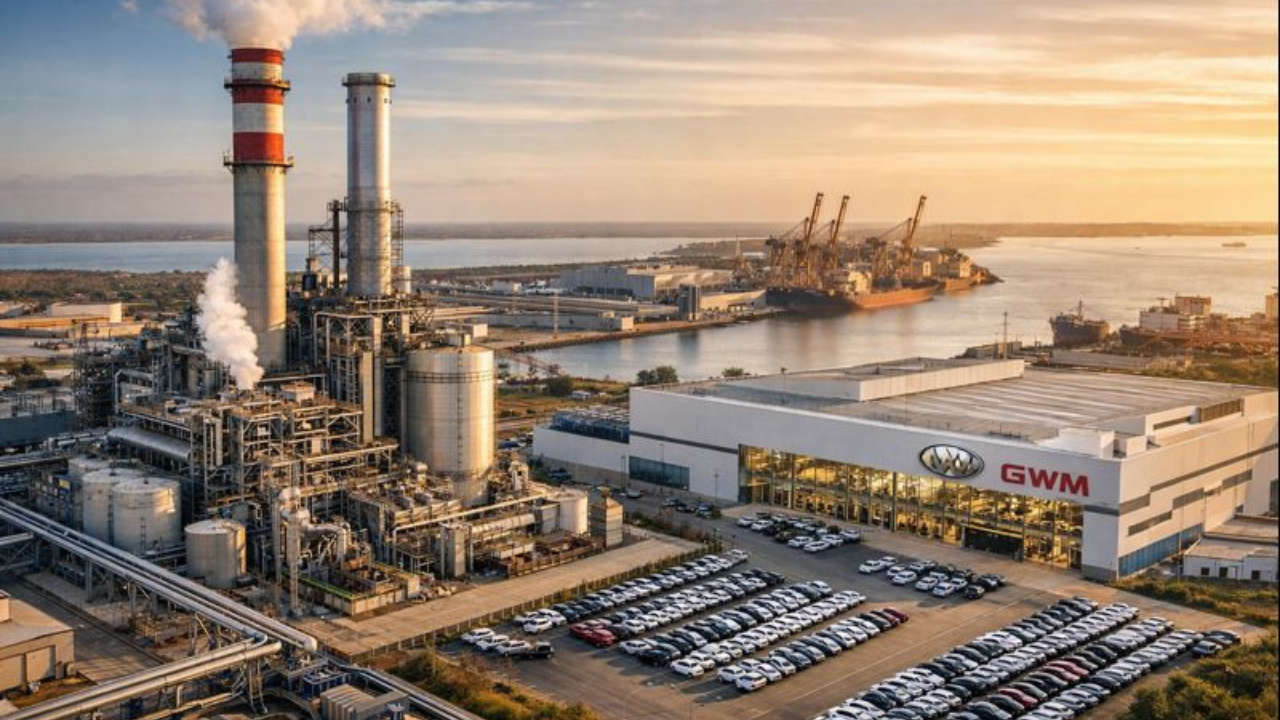
Natural Gas Thermoelectric Plant Project Advances In RS And Becomes Decisive For Enabling Industrial Investment By Auto Manufacturer GWM.
The thermoelectric plant planned for the municipality of Rio Grande, in Rio Grande do Sul, has returned to the center of the economic and energy debate in the State after a Federal Court decision that unlocked the project.
The initiative involves the use of natural gas, the involvement of the Spanish group Cobra, and has a direct impact on the state strategy to attract the factory of the Chinese auto manufacturer GWM, representing one of the most relevant movements of recent industrial investment.
The project gained new momentum after the Court ruled that the National Electricity Agency should return the plant’s grant, allowing construction to proceed.
-
Petrobras Expands Refining in Brazil, Increases Production of Diesel S-10 and Gasoline, Enhances Operational Efficiency, and Reduces Import Dependence Between 2023 and 2025
-
Petrobras’ Refap Sets Historic Records for Gasoline and S-10 Diesel Production in Canoas in Q4 2025, Surpassing Previous Figures
-
Revap Starts Operation of Modernized HDT and Petrobras Expands S-10 Diesel Production by 80% at the Refinery, Boosting Supply of Less Polluting Fuel in Brazil
-
Petrobras Refinery (Refap) Sets New Record: Production of 274.8 Million Liters of S-10 Diesel in November Boosts Supply of Clean Fuels

Judicial Decision Places Energy Project At The Center Of State Strategy
The resumption of the project comes after the Federal Court decided that Aneel should return the authorization for the plant’s implementation.
With this, the Spanish group Cobra regains legal support to carry out the work.
This movement is considered strategic because energy infrastructure is seen as one of the main factors to enable new industrial hubs.
Furthermore, the continuous supply of energy is essential for large-scale projects, such as that of the Chinese auto manufacturer.
Natural Gas Is A Key Factor For GWM Attraction
The presence of a thermoelectric plant powered by natural gas is treated as a central condition for GWM to assess the establishment of its factory in the State.
The manufacturer demands a reliable energy matrix capable of sustaining intensive industrial operations.
Therefore, the advancement of the project in Rio Grande strengthens the position of Rio Grande do Sul in the competition with other states.
Meanwhile, the state government is working to demonstrate that it has energy infrastructure compatible with the Chinese company’s requirements.
Industrial Investment Surrounded By Secrecy
Despite its economic relevance, the project remains shrouded in confidentiality.
State authorities avoid disclosing details about values, deadlines, and countermeasures.
Governor Eduardo Leite has publicly emphasized that he cannot comment on aspects of the investment.
According to him, secrecy is part of the ongoing negotiations, especially when involving large international groups.
Thermoelectric Plant Strengthens Competitiveness Of Rio Grande Do Sul
From an economic perspective, the plant represents more than energy generation. It enhances the State’s competitiveness by providing energy security for new industrial projects.
Moreover, the industrial investment associated with the thermoelectric plant can generate direct and indirect jobs, stimulate the supply chain, and consolidate Rio Grande do Sul as an attractive hub for global companies.
Role Of The Cobra Group In The Execution Of The Project
With the return of the grant, the Spanish group Cobra resumes prominence in the construction of the plant.
The company specializes in large-scale energy infrastructure projects and becomes a key player in realizing the thermoelectric plant.
This technical and legal advancement reduces uncertainties and conveys greater confidence to investors interested in the State’s industrial environment.
Therefore, the project shifts from being merely a promise to being part of a concrete planning for economic expansion.
Energy, Industry, And Development Walk Together
The resumption of the thermoelectric plant highlights how energy and industry go hand in hand.
Without a stable supply of natural gas, large-scale industrial projects become unfeasible.
Thus, the advancement of the thermoelectric plant in Rio Grande reinforces the state’s development strategy.
At the same time, it creates objective conditions for GWM to see Rio Grande do Sul as a priority destination for its next major investment in Brazil.









Seja o primeiro a reagir!