





 Portuguese
  English
  Spanish
 4 min of reading
  0 comments


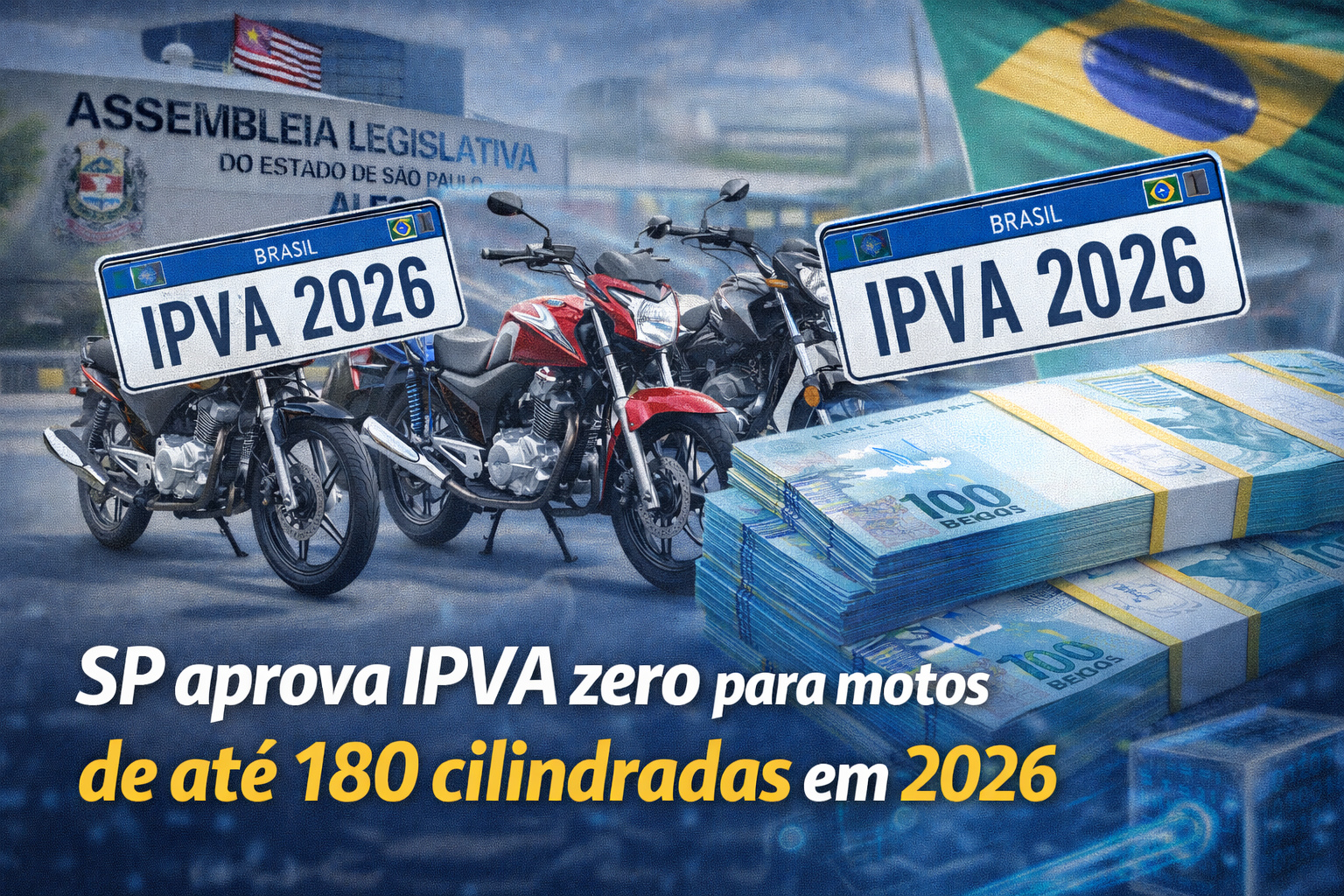
SP Approves IPVA Zero For Motorcycles Up To 180Cc In 2026, Expanding Exemption And Benefiting Most Motorcyclists.
Approval Of IPVA Zero For Motorcycles Up To 180Cc Changes Automotive Landscape In SP
The State of São Paulo approved, in record time, the exemption of IPVA for motorcycles up to 180cc, effective from January 1, 2026. The approval occurred at the São Paulo Legislative Assembly (ALESP) and directly benefits most of the two-wheeled automotive market in the state.
The measure corrects the original text of the project and expands the reach of the fiscal policy aimed at urban mobility and work involving motorcycles.
The decision impacts a segment that represents more than three-quarters of national motorcycle sales. With this, the São Paulo government seeks to reduce costs for those who depend on the vehicle in their daily lives.
-
The Senate approves a bill that criminalizes misogyny, hatred, or aversion towards women, and includes the crime in the Racism Law with a penalty of up to 5 years.

-
Chamber Approves Bill That Allows Pepper Spray for Women Over 16 and Imposes Strict Rules for Purchase, Possession, and Use as Self-Defense
-
Chamber Approves Law to Combat Leucaena, Fast-Growing Plant That Dominates Land and Threatens Native Species in Various Regions of the Country

-
Asset Division: Know What Cannot Be Divided in Case of Divorce


Correction In The Project Expands Reach Of IPVA Zero
Initially, the project stipulated an exemption from IPVA only for motorcycles up to 150cc. However, after discussions and adjustments to the text, the final approval raised the limit to 180cc, including models that dominate the Brazilian market.
With this change, motorcycles such as the Honda CG 160, historically a best-seller in the country, are now included in the exemption. Thus, the new wording avoids distortions and ensures greater coherence with the reality of the automotive sector.
Who Will Be Entitled To The IPVA Exemption In 2026
According to the approved project, all motorcycles with engines up to 180cc, registered in the State of São Paulo, will be exempt from IPVA starting in 2026. However, the rule applies only to vehicles that are in regular status.
Motorcycles with previous debts will still be required to settle outstanding amounts. Therefore, the exemption does not forgive past debts but eliminates the future tax charge.
IPVA Zero Affects Most Motorcycles Sold In Brazil
Data from the automotive sector show that small displacement motorcycles dominate the market. Nationally, models with less than 200cc account for over 76% of new registrations.
For this reason, the approval of IPVA zero for motorcycles up to 180cc has a significant impact. Although the tax amount is lower than that charged for cars, the volume of vehicles makes the fiscal renunciation significant for the São Paulo budget.
Government Affirms That Exemption Does Not Violate The Fiscal Responsibility Law
The approved text was submitted to ALESP by Governor Tarcísio de Freitas (Republicans) on December 15. According to the state government, the exemption from IPVA does not violate the Fiscal Responsibility Law.
The justification is included in the project itself and states that the measure was planned within the legal limits. Thus, the approval occurs without compromising public account balance.
Use Of Motorcycles As A Work Tool Influences The Decision
In the official justification of the project, the governor emphasized the social role of motorcycles in large cities. According to the text, these vehicles have become essential as they are more accessible and faster in urban traffic.
“The use of motorcycles is a reality in large cities, especially because they are more accessible and faster in traffic, providing greater personal mobility. Exempting the IPVA for these vehicles will help prevent disproportionate burdens on those who rely on them, often used entrepreneurially, as a work and income-generating tool.”
This perspective reinforces the social character of the approval, especially for delivery riders, motorcycle taxi drivers, and self-employed workers.
Impacts On The Automotive Sector And Urban Mobility
Experts believe that the exemption of IPVA may further stimulate the sales of motorcycles up to 180cc. Additionally, the measure tends to reduce delinquency and formalize the fleet, as the annual maintenance cost of the vehicle decreases.
On the other hand, the growth in the number of motorcycles also requires attention to road safety policies. The automotive sector highlights that tax incentives should be accompanied by investments in traffic education.
When The IPVA Exemption Comes Into Effect
The new rule comes into effect on January 1, 2026. Until then, owners remain subject to the current IPVA collection rules.
The expectation is that, by the effective date, the state government will publish complementary guidelines to clarify doubts about the application of the exemption.










-

Uma pessoa reagiu a isso.