





 Portuguese
  English
  Spanish
  6 min of reading
  0 comments


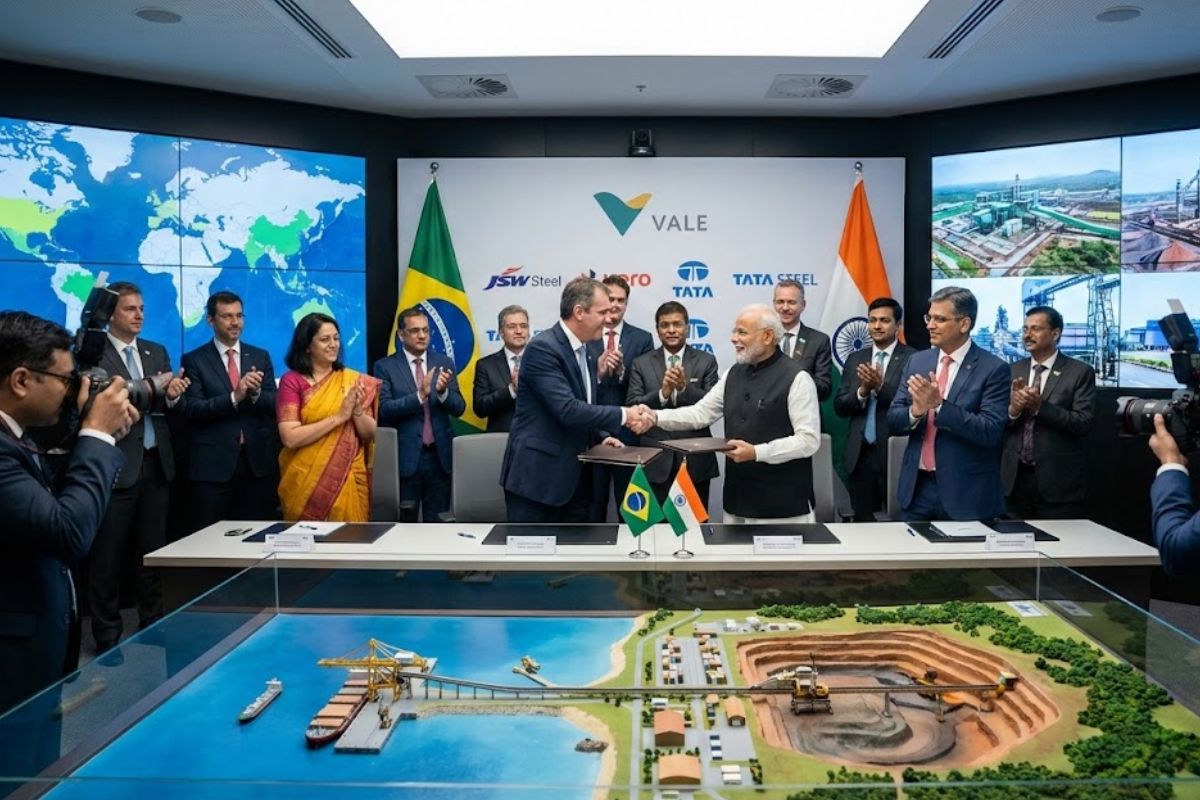
In a memorandum signed on February 21, 2026, Vale highlighted a special economic zone at the Port of Gangavaram to blend iron ore fines, combining high-grade Brazilian ore with low-grade Indian ore and testing an export corridor with NMDC and Adani ahead.
Vale signed a memorandum of understanding to set up a blending and selling facility for iron ore fines in India, with an estimated investment of around US$ 500 million, roughly R$ 2.5 billion. The central idea is to combine high-grade ore supplied by Vale with locally offered low-grade ore, creating a “blended” product within a port arrangement designed to provide scale.
The move draws attention because it’s not just about selling ore: it involves logistics, licenses, storage yard, unloading and loading operations, and, above all, the proposal for a special economic zone at a port considered strategic for this type of operation. At the same time, the chosen format makes it clear that the path is still open, as memorandums do not, by definition, carry the same weight as a definitive contract.
What Was Signed and Why a Memorandum Changes the Pace of Negotiations
The agreement signed by Vale takes the form of an MOU, a common acronym in the sector for memorandums of understanding: an instrument that records intentions, delineates roles, and organizes what each party needs to study, negotiate, and eventually execute.
-
The government requests the Federal Revenue Service for a new system to automate the income tax declaration, reducing errors, time, and bureaucracy for millions of Brazilians.

-
Pix in installments, international Pix, and contactless payment without internet: the Central Bank revealed the new features coming to the tool that is already used by almost every adult in Brazil.

-
Mercado Livre has just started selling medications with delivery in up to three hours to your door, and this move could completely change the way Brazilians buy medicines on a daily basis.

-
In Dubai, rising tensions from the war in the Middle East are causing super-rich individuals to leave the Gulf and direct their fortunes to a new financial refuge in Asia.


The decisive point is that the MOU is not a binding commitment, so either company can choose not to proceed to the final signature.
This helps explain why the document sets an initial timeframe of 12 months, with the possibility of renewal for another 12.
In practice, this period serves as a window to unlock technical and commercial discussions, such as product quality standards, flow design at the port, license feasibility, and operational governance, without Vale and its partners needing to “lock in” everything before testing the project’s logic.
Why Blending Iron Ore Fines Became a Strategy and Not Just a Technical Detail
Iron ore fines are the more granular fraction of the material, often sold for industrial routes that can handle smaller particles, either through sintering or other forms of preparation before use in blast furnaces.
When talking about blending, the goal is to obtain a final product with more stable characteristics, reducing quality variations from batch to batch and bringing the material closer to a standard that the buyer can use predictably.
In this context, combining high-grade with low-grade is a way to adjust essential attributes for steelmaking, such as iron content and the presence of impurities, without relying on a single source.
Vale provides the high-grade ore, while the local offer adds volume and creates a direct bridge to Indian demand, opening space for a “tailored” product for clients operating within different realities of cost, supply, and specification.
Who Does What: Vale, NMDC, and Adani and the Port Machinery Behind the Announcement
The division of responsibilities in the arrangement was designed to tackle the point that usually stalls projects of this kind: logistical execution and operational control on-site.
NMDC, the Indian company involved in the agreement, appears as the supplier of the low-grade ore. Vale, in turn, is the supplier of the high-grade ore that goes into the blend and provides the “quality ballast” for the final product.
Adani takes on a heavier package: port infrastructure, blending area, unloading and loading operations, yard management, and the search for licenses, in addition to executing the blending according to jointly defined technical requirements.
In simple terms, Adani is responsible for putting the project on the ground in the port, where turnaround time, storage, and pile control often determine whether the numbers work out.
What a Special Economic Zone Could Mean for a “Trade Corridor” for Ore
The proposal to create a facility under a special economic zone adds an institutional layer to the project.
In general, special economic zones are formats used to organize productive and logistical activities in areas with specific rules, aiming to facilitate operations, reduce bureaucratic friction, and provide predictability for importing, processing, storing, and re-exporting, depending on the adopted design.
In Vale’s case, the embedded intention is clear: to maintain the blending and commercialization of fines within a defined routine environment, with flow control and licensing addressed from the outset.
When the port becomes part of the product, and not just a “means of transport,” the strategy shifts: the value is not only in the shipped ore but in the ability to deliver a standardized material, on time, with less operational uncertainty.
How Much, Where, and Why: What the Numbers Reveal About the Indian Market’s Appetite
The estimated value of the project, around US$ 500 million (R$ 2.5 billion), helps gauge the plan’s ambition.
This is not a marginal adjustment in a supply contract: it is an investment associated with infrastructure and continuous operation, exactly the kind of step usually taken when the company believes that the commercial route has room to grow and sustain over the years.
Export data reinforces the backdrop. In 2025, Brazil exported US$ 441.9 million in iron ore to India, accounting for 6.4% of the product’s import market that year.
And there’s a significant leap in the recent period: from 2021 to 2025, Brazilian sales of iron ore and concentrates to India grew by 1,100%.
Even without dominating the market in double digits, this type of growth tends to trigger alerts of opportunity for those who can operate with scale and quality.
Between Diplomacy and Business: Political Timing and What Still Needs to Happen
The memorandum was signed during President Luiz Inácio Lula da Silva’s visit to India, a detail that often influences the pace of business discussions when there’s interest in strengthening bilateral relations and unlocking investment agendas.
On the same day, Vale also signed an MOU with TCS aimed at formulating strategies to combat extreme poverty, signaling that there was a broader rapprochement schedule beyond ore and logistics.
Still, caution is warranted: memorandums are a step, not the end of the road. To become a reality, the project needs to go through commercial negotiations, technical validations, blending operational design, governance structure, definition of final product standards, and the sensitive issue of licenses.
The announcement creates expectations, but the definitive contract is what transforms intention into obligation, and this only appears when all parties accept the final terms.
Vale has put India at the center of a strategy that blends ore, logistics, and institutional arrangements, trying to transform iron ore fines into a product with more predictability and a more stable commercial path.
At the same time, the format of the agreement reminds us that there is an important step between “planning” and “executing,” especially when the port becomes a critical part of the process.
I want to hear from you directly: in your view, is Vale’s bet on local blending and a special economic zone a smart step to gain market share or an unnecessary risk due to reliance on too many operational and licensing variables? If you work in steelmaking, logistics, or foreign trade, what matters more in the decision to purchase “blended” ore: price, quality stability, or delivery reliability?









-

2 pessoas reagiram a isso.