





 English
  Francês
  Alemão
  Italiano
  Japonês
  Norueguês
  Portuguese
  Spanish
  6 min of reading
  0 comments


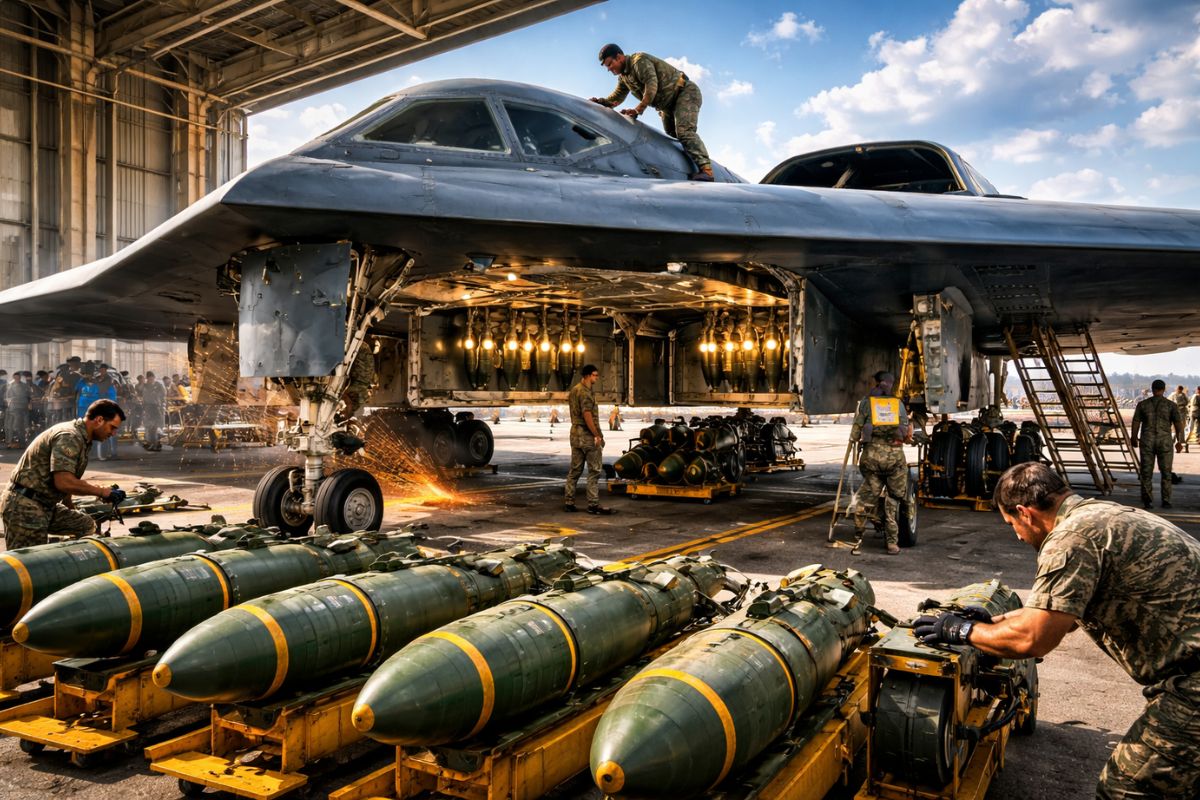
The B-2 Spirit undergoes bomb calibration in a controlled environment, centimeter-by-centimeter review of the stealth surface, and rigorous checks before disappearing from radar and attacking with precision
The B-2 Spirit is one of the most expensive, complex, and secretive aircraft ever put into operation. Valued at over $2 billion per unit, the stealth bomber goes far beyond the image of an almost invisible aircraft to radar, as each mission depends on a chain of procedures so sensitive that a minimal error can compromise the entire outcome.
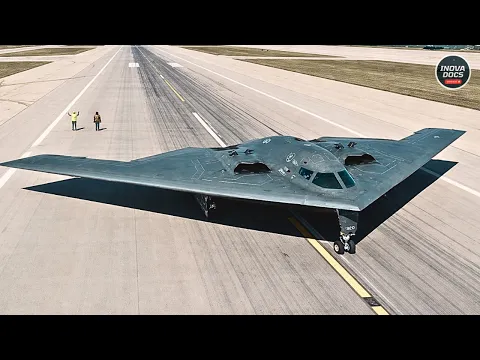
Before taking off, the B-2 Spirit undergoes a process that involves a controlled environment, millimeter adjustments, detailed inspections of the fuselage, internal bomb loading, and precise calibration of systems that must function without margin for error. It is not just about getting an aircraft in the air, but preparing a war machine that depends on perfection to fulfill its function.
What makes the B-2 Spirit so different

The B-2 Spirit is regarded as the most advanced stealth bomber ever built. Its development began during the Cold War, and it entered service in the late 1990s, maintaining an almost unique status within military aviation to this day.
-
Brazil presents the first national F-39 Gripen fighter and redefines air defense with technological advancement, job creation, and strengthening of the defense industry on the global stage.
-
The construction of the Polar Ship Almirante Saldanha is progressing ahead of schedule and strengthens Brazil’s presence in Antarctica; the vessel will be 93 meters long, have a two-month autonomy, and technology to face ice.

-
The United States Army has an armored vehicle that reaches speeds of up to 100 km/h, capable of operating normally on different types of terrain and also on asphalt without causing damage; equipped with a 350 hp engine, it can transport up to 9 soldiers — meet the Stryker.
-
Gepard 1A2: the armored vehicle that fires 1,100 rounds per minute and became a shield against drones in Brazil.

The aircraft draws attention for its size, with a wingspan of over 50 meters, and also for its rarity. Only 20 units exist in the world.
But what really sets the B-2 Spirit apart is not just the billion-dollar price tag or the size, but its ability to penetrate advanced air defenses with very low detection.
It all begins before the aircraft even appears
The preparation of the B-2 Spirit begins far from the runway. Before any flight, the bombs to be loaded undergo assembly and calibration in a controlled environment, with temperature maintained around 20 °C.
This care exists because the guidance systems are extremely sensitive. Internal sensors, connections, and antennas need to function with absolute precision for the weapon to maintain accuracy throughout the flight.
Even a small variation can alter the behavior of the bomb and compromise the final result of the mission.
Bombs are adjusted with extreme precision

Each bomb intended for the B-2 Spirit receives its own guidance section, with sophisticated components that include GPS antennas and sensors capable of detecting very small movements.
The technicians perform the work manually, tightening each connection to the exact measure. After that, control systems with fins correct the trajectory in the air. A minimal deviation can already represent dozens of meters off target.
Before proceeding to the aircraft, everything is tested, stimulated, and verified to ensure that the response is exactly as expected.
Invisibility depends on a perfect surface
If the bombs require accuracy, the aircraft itself also needs an extreme level of attention. The surface of the B-2 Spirit does not function like the fuselage of a common aircraft.
It is coated with special materials that help absorb radar waves and reduce reflected energy.
In addition, the shape of the aircraft is designed to deflect signals and make detection more difficult. The problem is that this coating is sensitive.
Heavy rain, hail, or small impacts can damage critical areas. In the logic of stealth, an almost invisible flaw can already increase the chance of the B-2 Spirit being detected.
Centimeter-by-centimeter inspection is mandatory

Before each mission, the entire aircraft is reviewed with millimeter attention. Technicians look for cracks, bubbles, microscopic unevenness, and imperfections, especially at the wing edges, where interaction with radar can be more sensitive.
When they find any flaw, the work becomes even more delicate. Special layers are reapplied, surfaces are corrected, and everything needs to dry at the appropriate temperature.
At the same time, other systems also undergo checks, such as hydraulics, flight controls, and electrical systems. In the B-2 Spirit, every technical detail directly influences the ability to disappear from radar.
Internal loading is an essential part of stealth
Another decisive point is how the B-2 Spirit receives its bombs. Unlike other aircraft, it cannot carry anything externally, as any visible element on the outside would increase its radar signature.
Therefore, all armament is installed in closed compartments with the help of hydraulic platforms.
The bombs rise slowly until they align with the internal system. An error the size of a coin can already prevent the correct connection.
The stealth of the B-2 Spirit depends as much on the material of the aircraft as on the discipline with which everything is maintained within the structure.
A rotating launcher moves almost a ton at a time
Inside the aircraft, the bombs are organized in a rotating launcher that functions like a large drum, repositioning each weapon with precision.
This system is designed to handle bombs weighing almost a ton, keeping each unit locked in hooks robust enough to withstand forces much greater than the weight of the load itself. This is necessary because turns, turbulence, and G-force multiply the pressure on the components.
In the B-2 Spirit, the structural safety of the armament needs to match the same level of precision required for stealth.
Fuel and balance also define the mission

After the armament, comes the refueling. In the B-2 Spirit, this stage does not involve just filling the tanks, but correctly balancing the aircraft. Since the bomber does not have a conventional tail, weight distribution is critical for stability.
The fuel also acts as a counterweight. If the balance is not perfect, the aircraft’s behavior can be affected.
This shows that mission preparation does not depend on a single factor, but on a sum of interconnected adjustments. Each phase of the process needs to communicate with the others for the B-2 Spirit to fly as designed.
The computer keeps the aircraft stable in the air
When the pilots enter the cockpit, the process is still far from simple. The system needs to be initialized, and the inertial instruments calibrate the aircraft’s position based on the Earth’s rotation. If something interrupts this procedure, everything needs to start again.
Once in flight, the B-2 Spirit‘s computer makes constant real-time corrections to maintain stability.
This is essential because the aircraft relies heavily on digital control to maintain ideal operating conditions. Without this embedded intelligence, the bomber would quickly lose stability.
Attack depends on precise data until the last instant
When it reaches the target area, the B-2 Spirit opens its doors only for the necessary time. The bomb receives extremely precise data, such as wind, altitude, and pressure, processes everything in milliseconds, and heads for the target.
During the descent, it makes continuous corrections until the final adjustment. The result is an impact with precision of a few meters, launched by an aircraft that is extremely difficult to detect.
The effectiveness of the B-2 Spirit arises precisely from the combination of stealth, precision engineering, and obsessive preparation before each mission.
More than a bomber, a machine of absolute detail
The B-2 Spirit is not just an expensive or rare warplane. It represents a level of engineering that pushes the limits of the possible, supported by thousands of hours of maintenance, specialized teams, and a technical standard where perfection is not a luxury, but a requirement.
Everything in the process, from bomb calibration to fuselage coating, exists to ensure that the mission occurs without failure.
Behind the image of an almost invisible aircraft, there is a gigantic, silent, and extremely detailed operation to make each flight work.
What impresses you most about the B-2 Spirit: the stealth or the level of preparation before each mission?






Seja o primeiro a reagir!