





 Portuguese
  English
  Spanish
  4 min of reading
  0 comments


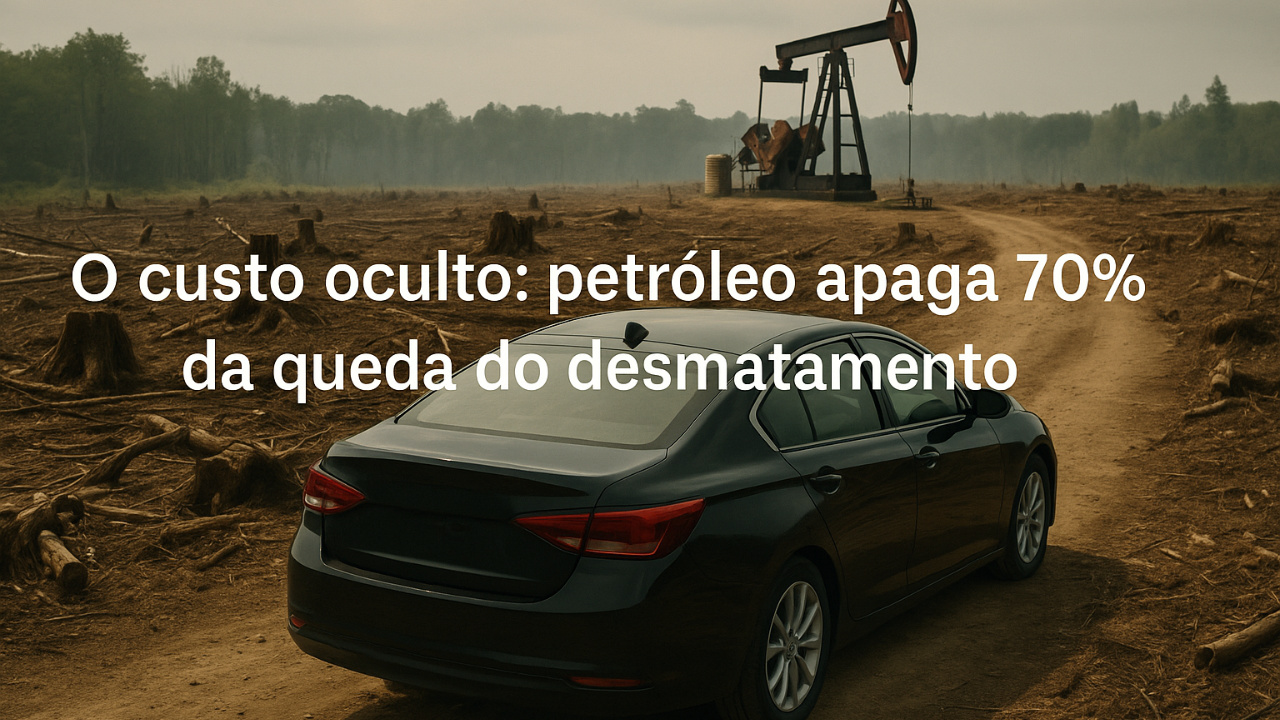
Drop In Deforestation Is Obscured Because Brazil’s ‘Hidden’ Oil Emissions Cancel Almost 70% Of The Result, Points IEMA.
The “hidden” emissions from Brazil’s oil cancel almost 70% of the reduction in deforestation and rekindle the debate about the country’s real contribution to combating climate change.
This conclusion comes from calculations by the Institute of Energy and Environment (IEMA), presented just as the government arrived at COP30 in Belém, celebrating the third consecutive year of decline in deforestation.
The survey shows that, despite Brazil having drastically reduced forest loss between 2022 and 2025, oil exports increased to the point of offsetting much of this environmental achievement.
-
Offshore industrial demand in Macaé skyrockets with the recovery of oil and gas and could grow by up to 396% by 2026 in the Campos Basin.
-
Offshore industrial demand in Macaé surges with the recovery of oil and gas and could grow by up to 396% by 2026 in the Campos Basin.
-
Brazilian giant expands borders in the Southeast: Petrobras confirms new oil discovery in ultra-deep waters in the pre-salt of the Campos Basin.

-
Alert in the global energy market: Severe tropical cyclone hits the coast and disrupts gas production at major plants in Australia, threatening global supply.


This phenomenon occurs because the exported oil, although not burned in Brazil, will be used in other countries, and since the planet functions as a closed system, the climate impact falls on everyone.
Thus, despite internal advances, part of Brazil’s contribution to the climate crisis continues to be indirectly exacerbated.
Climate Contradiction: Drop In Deforestation Vs. Oil Price Increase
The data collected by IEMA indicates that Brazil’s ‘hidden’ emissions from oil cancel almost 70% of the reduction in deforestation, highlighting a “short blanket effect.”
According to the organization, the record decline in Amazon destruction generated an estimated saving of 371 million tons of CO₂ in 2024.
However, the oil exported during the same period represents 260 million tons—equivalent to 70% of that gain.
President Lula has used the reduction in deforestation as a climate showcase, claiming that the country is experiencing “the lowest rate in 11 years.” Between August 2021 and July 2025, deforestation was halved, according to Inpe.
However, in the same period, Brazil also increased its oil exports by 138%.
Experts point out that much of this increase stems from the expansion of pre-salt production.
What The Ministries and Environmentalists Say
According to the Ministry of the Environment, emissions generated outside national territory cannot be attributed to Brazil, as determined by the Paris Agreement. “There is no basis to attribute responsibility (…) for emissions due to its oil exports,” stated the ministry.
The Ministry of Mines and Energy emphasizes that Brazilian oil is one of “the least carbon-intensive in the world” and advocates for the continuation of exploration to ensure revenue and energy security.
The ministry calculates that, without replenishing reserves, Brazil would become a net importer again by 2040, losing up to R$ 3.8 trillion by 2050.
However, environmentalists warn that Brazil’s ‘hidden’ oil emissions cancel almost 70% of the reduction in deforestation and undermine the country’s narrative on the global stage.
According to IEMA researcher Felipe Barcellos, even though they do not officially enter the national account, the country is “co-responsible” for global impacts.
“If we compare the emissions from exports with what we’ve reduced in deforestation, we are at very close levels,” he states.
How The Emission Rule Works And Why It Matters
The emissions used in climate commitments are measured by NDCs, which only account for what is emitted within each country’s borders. This prevents double counting but limits the real assessment of global impact.
Today, Brazil aims to reduce its emissions by 59% to 67% by 2035, based on 2005 levels.
However, by advocating new exploration fronts, such as in the mouth of the Amazon, the country increases its participation in the global fossil fuel supply, which contradicts the spirit of climate negotiations.
The Brazilian Paradox At The Center Of COP30
During COP30, Lula admitted that the country lives with “contradictions,” but argued that the world needs to build “road maps” to progressively abandon fossil fuels.
The statement was interpreted as a response to criticisms following the granting of licenses for oil exploration in the mouth of the Amazon.
Barcellos notes that oil remains crucial for federal revenue, exceeding R$ 200 billion per year. Therefore, many governments hesitate to reduce production, even while advocating for energy transition in speeches.
Meanwhile, neighboring countries are taking the opposite approach: Colombia announced it would prohibit oil exploration in the Amazon region.
The Future Of Energy And Pressure On Brazil
The International Energy Agency classifies Brazil as the eighth-largest oil producer in the world.
The government’s goal, however, is to reach fourth place. For experts, this expansion puts the country in an uncomfortable position in the global climate debate.
The MME states that the activity generates 600 thousand jobs and that this number will reach 900 thousand by 2030.
Despite this, researchers warn that the country cannot sustain its narrative of environmental leadership while boosting the fossil market.










-

Uma pessoa reagiu a isso.