





 Portuguese
  English
  Spanish
  4 min of reading
  0 comments


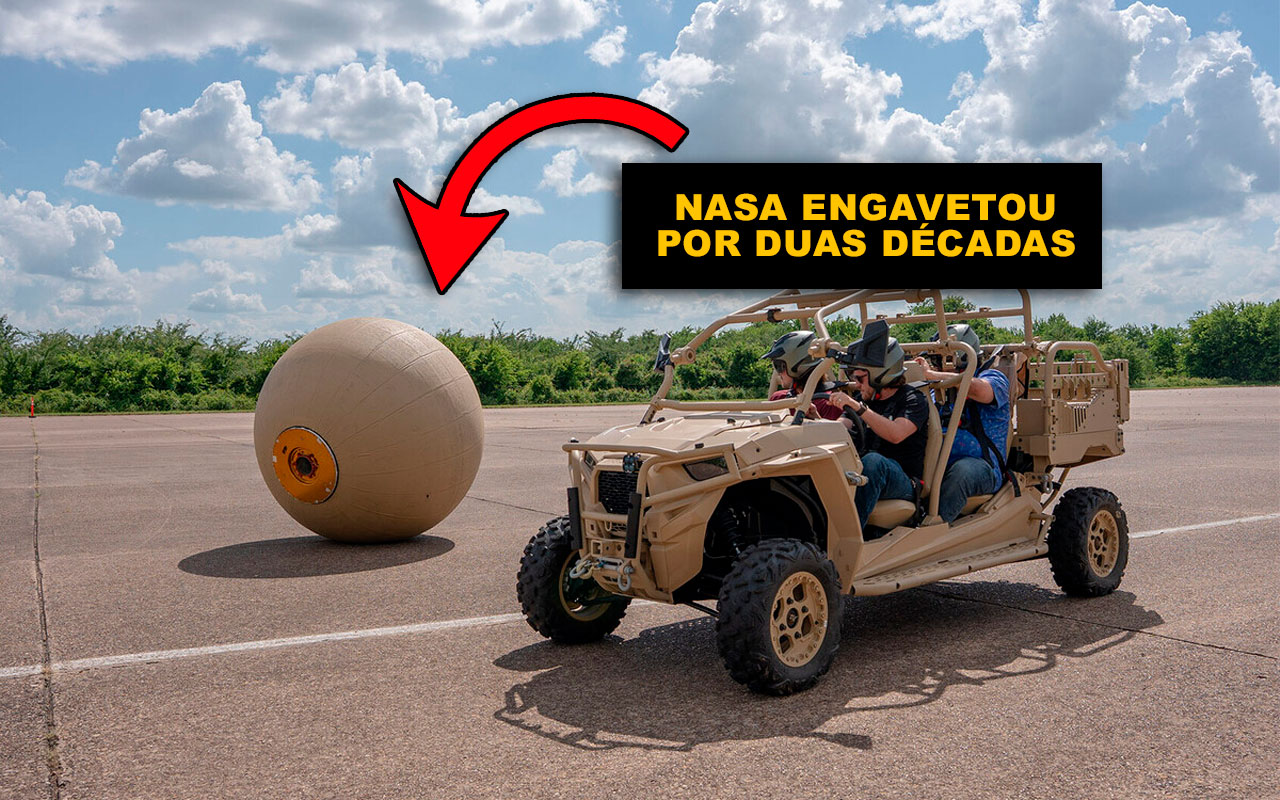
Two PhD Students from Texas A&M Revived a Concept Created at NASA and Built the RoboBall, a Spherical Robot That Does Not Tumble, Inflates and Deflates to Gain Traction, and Has Already Reached 32 km/h in Tests. The Project Aims at Lunar Craters and Search and Rescue Missions in Disasters.
The RoboBall is a robotic sphere with a pressurized soft shell, designed to access areas where wheels and legs fail, such as steep crater walls and unstable terrain. The idea originated in 2003 within NASA when engineer Robert Ambrose sought a system that did not have a “right side” and therefore could not tip over. Two decades later, the concept was revived by Ambrose at Texas A&M, in partnership with PhD students Rishi Jangale and Derek Pravecek.
The university details that the project gained new momentum starting in 2021, with support from state research initiatives, and today advances as a platform for exploration robotics designed for extreme environments, from the Texas coastline to lunar dust.
Instead of complex suspensions or legs, the spherical geometry and airbag-style shell absorb impacts and simplify mobility. The declared goal is for the RoboBall to roll where other robots stop, expanding scientific reach and reducing risks to human teams. Watch the video:
-
Motorola launched the Signature with a gold seal from DxOMark, tying with the iPhone 17 Pro in camera performance, Snapdragon 8 Gen 5 that surpassed 3 million in benchmarks, and a zoom that impresses even at night.

-
Satellites reveal beneath the Sahara a giant river buried for thousands of kilometers: study shows that the largest hot desert on the planet was once traversed by a river system comparable to the largest on Earth.

-
Scientists have captured something never seen in space: newly born stars are creating gigantic rings of light a thousand times larger than the distance between the Earth and the Sun, and this changes everything we knew about stellar birth.

-
Geologists find traces of a continent that disappeared 155 million years ago after separating from Australia and reveal that it did not sink, but broke into fragments scattered across Southeast Asia.


How the “Robot Ball” Moves: Internal Pendulum, Pressurized Shell, and Adaptable Traction
At the heart of the system is a motorized pendulum attached to an internal axle. By oscillating the pendulum, the robot transfers momentum to the shell and rolls in the desired direction. This architecture eliminates the need to define “front” or “back.” In real conditions, the RoboBall has traversed grass, gravel, sand, and even water, proving its versatility.
Another advantage is the inflatable shell. The robot can inflate and deflate to change traction according to the surface, reducing wear and gaining grip where needed. It is a simple and robust solution for unpredictable environments, from dunes to beaches.
The team also reports that everything remains sealed inside the sphere, which protects electronics and actuators, but complicates maintenance: if a sensor fails, it’s necessary to disassemble the entire ball, a true “surgical procedure” in the workshop.
Two Prototypes, Two Missions: The Laboratory and the “Cargo” Model
There are two active versions. The RoboBall II is the laboratory platform, with a diameter of approx. 61 cm, used to refine control algorithms and validate power.
The RoboBall III is the giant at 1.83 m in diameter, designed for practical use with an internal cargo bay. According to RAD Lab, it accommodates up to 16U of payload for sensors, cameras, and sampling tools, targeting scientific and operational missions.
Texas A&M itself reports that the team is preparing field tests on the beaches of Galveston to demonstrate the water-land transition, validating buoyancy and traction on real terrain.
Performance So Far: Speed, Terrain, and Next Steps
In tests, the RoboBall II reached 20 mph (about 32 km/h), a level that surprised researchers and opened new performance goals. This mark was cited by both Texas A&M Engineering and specialized outlets. For lunar exploration, speed helps cover area quickly, while the spherical shape keeps the robot stable.
The technical press also highlighted that the “does not tip over” shape is ideal for steep slopes in craters and that the traction adjustment by inflation can reduce the wear of the shell in long traversals. New Atlas and Interesting Engineering emphasize the potential for rough terrain scenarios and for search and rescue in floods and hurricanes.
In the pipeline, in addition to validation on the beach, there are autonomous navigation, integration of scientific modules, and protocols for drone launches or lunar modules, aiming to map slopes and safely return terrain data.
From the Moon to Earth: Science, Civil Defense, and Resilience
The long-term vision includes swarm RoboBalls in natural disasters, mapping flooded areas, locating survivors, and transmitting essential information without risking teams. For public managers, this could mean a quicker response, less human exposure, and lower operational costs than complex platforms.
In space exploration, the RoboBall aims at crater walls and shadowed regions of the lunar south pole, where incline and loose regolith complicate traditional rovers. The RAD Lab’s academic literature has already described pressurized soft shells, trajectory control, and scalability of the RoboBall family at conferences such as ICRA 2024 and IEEE RA-L 2025, indicating a solid scientific base.
If plans materialize, the project could complement wheeled and legged rovers, acting as a scout in high-risk and difficult-to-access areas.
In your opinion, should the RoboBall replace wheeled rovers in craters, or should it work together as a scout to reduce risks and costs? Leave your comment and tell us what you think about this robot that does not tip over.








Seja o primeiro a reagir!