





 Portuguese
  English
  Spanish
  4 min of reading
  0 comments


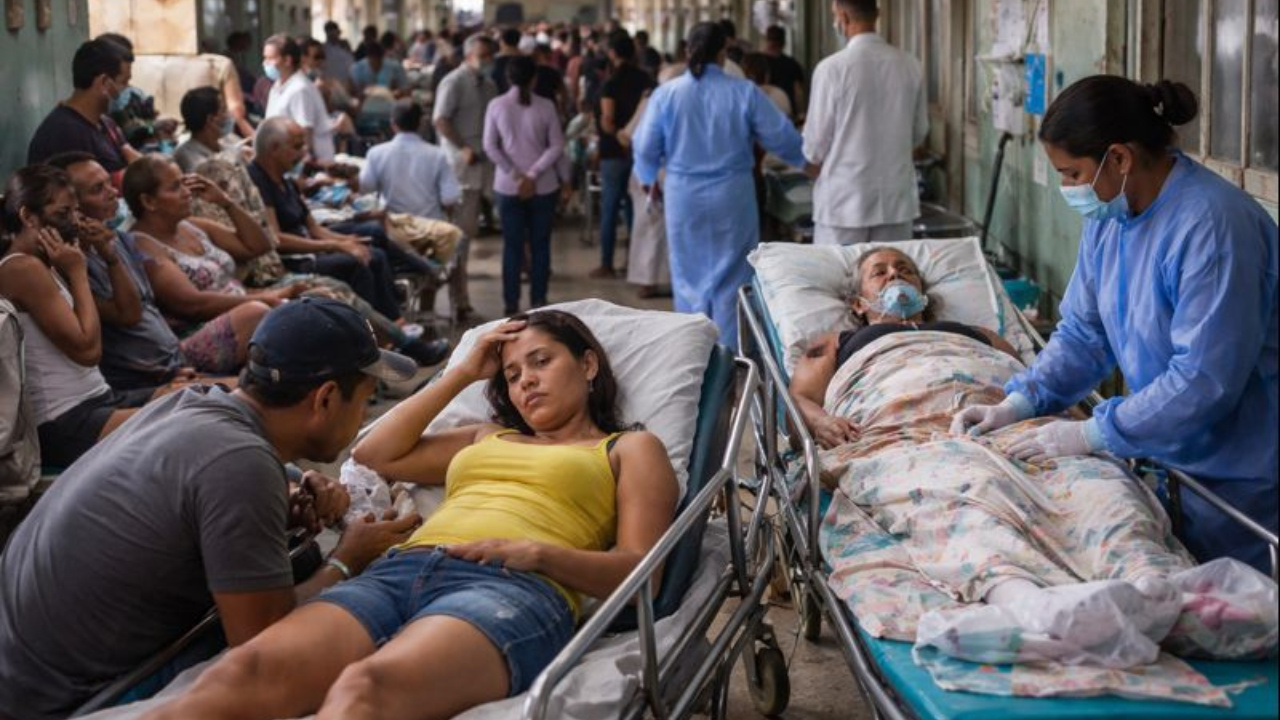
Dengue, Chikungunya Outbreak in Cuba and Oropouche Fever Advance and Expose the Crisis in the Cuban Health System
A simultaneous combination of dengue, chikungunya in Cuba and oropouche fever has spread fear among the Cuban population, further exacerbating the crisis in the Cuban health system.
The advance of the so-called “virus in Cuba” has occurred in recent months across various regions of the island, affecting thousands of people, overloading already weakened hospitals, and exposing structural failures amid shortages of medication, blackouts, and difficulties accessing medical care.
According to health authorities and international organizations, the situation is intensifying due to the proliferation of mosquitoes, underreporting of cases, and the deterioration of basic hygiene conditions.
-
If the USA were to go to war with Brazil, Washington’s greatest fear would not be the attack itself, but facing a vast territory, prolonged resistance, and a costly, chaotic, and unpredictable occupation.

-
In 2013, Nicaragua sold the concession for a canal to rival Panama to a Chinese billionaire who lost 85% of his fortune, disappeared, and was declared bankrupt. Now the project resurfaces with a new route, a new Chinese partner, and a cost of $64.5 billion.

-
The USA announces a mysterious billion-dollar vault project to store critical minerals, but what intrigues experts is not just the plan itself, but why Latin America, including Brazil, has entered the center of this global dispute against China.

-
Trump Announces Bombing of U.S. Military Targets on Iranian Island Responsible for About 90% of Iran’s Oil Exports, Warns of Further Attacks if Navigation in Strategic Strait of Hormuz Is Threatened


Virus in Cuba Spreads Amid Multiple Epidemics
The term “virus in Cuba” has become common in popular vocabulary to describe a broader phenomenon.
In practice, it refers to the simultaneous circulation of three arboviral diseases transmitted by mosquitoes that are advancing at the same time throughout the country.
According to the Cuban government and the World Health Organization (WHO), in conjunction with the Pan American Health Organization (PAHO), the country is facing an outbreak of dengue, the accelerated growth of chikungunya in Cuba, and the reemergence of oropouche fever.
Additionally, respiratory viruses, such as that of COVID-19, are also circulating, which complicates diagnosis and increases the sense of insecurity among the population.
Intense Symptoms and Reports of Suffering
High fever, severe joint pain, inflammation, vomiting, diarrhea, and skin irritations are recurring symptoms.
Many patients remain with sequelae for weeks or months, especially persistent joint pain.
Journalist Yirmara Torres Hernández described the impact in Matanzas in a post that went viral on social media:
“Matanzas today looks like a city of zombies… that’s how we walk, hunched over, in pain. Just go out on the streets and see”.
Similar reports are repeated in various provinces, with people hunched over, febrile, and having difficulty moving.
Chikungunya in Cuba Grows Rapidly
Official data indicates that new cases of chikungunya in Cuba increased by 71% in just seven days, according to the Ministry of Public Health.
PAHO estimates 25,995 cases, although experts warn that the actual number may be much higher.
This occurs because a large number of the sick avoid seeking medical care, especially when symptoms are not considered severe.
Oropouche Fever Concerns Authorities
Oropouche fever, less known to the public, is also part of the current virus situation in Cuba. First identified in 1955 in the Caribbean, the disease has already caused over 30 historical outbreaks in Brazil.
Experts warn that climate change and deforestation increase the risk of urban expansion of this virus, just as it occurs with dengue and chikungunya.
Crisis in the Cuban Health System Pushes Patients Away from Hospitals
The crisis in the Cuban health system is a central factor in the advance of the diseases.
The lack of medications, laboratory tests, and basic care conditions leads many Cubans to choose to stay at home.
Sivia, a resident of Pinar del Río, reported to BBC News Mundo:
“There are no conditions to receive people. Everything is collapsed. They only recommend hydration and paracetamol”.
Another professor from Havana reinforces:
“Almost no one I know goes to the hospital. There is no reliable diagnosis or medications”.
Deaths, Underreporting, and Fear
The government officially recognizes 47 deaths associated with arboviral diseases.
However, independent experts believe that the actual number is higher, due to underreporting and attributing deaths to other causes.
“I know two people who died, both elderly”, said a professor interviewed by BBC News Mundo.
Lack of Sanitation Favors the Advancement of the Virus in Cuba
PAHO highlights that the precariousness of hygiene conditions directly contributes to the proliferation of mosquito transmitters. Frequent blackouts, garbage accumulation, and lack of water exacerbate the problem.
Hansel, an engineer from Havana, explains:
“If the power goes out, you can’t use fans or air conditioning. The mosquitoes come in and bite”.
Sequelae Can Last Months
Even after the acute phase, many patients continue to suffer. Pain in the hands, shoulders, and spine hinders simple daily activities.
“I still feel pain in my fingers and have trouble opening jars”, reports Hansel.
Situation Remains Critical
As the virus in Cuba continues to advance, the country faces difficulties in containing the outbreak of dengue, chikungunya in Cuba, and oropouche fever.
Moreover, the crisis in the Cuban health system, combined with adverse socioeconomic conditions, creates a scenario of high sanitary vulnerability, with impacts that are still difficult to measure.










-

2 pessoas reagiram a isso.