





 Portuguese
  English
  Spanish
 6 min of reading
  24 comments


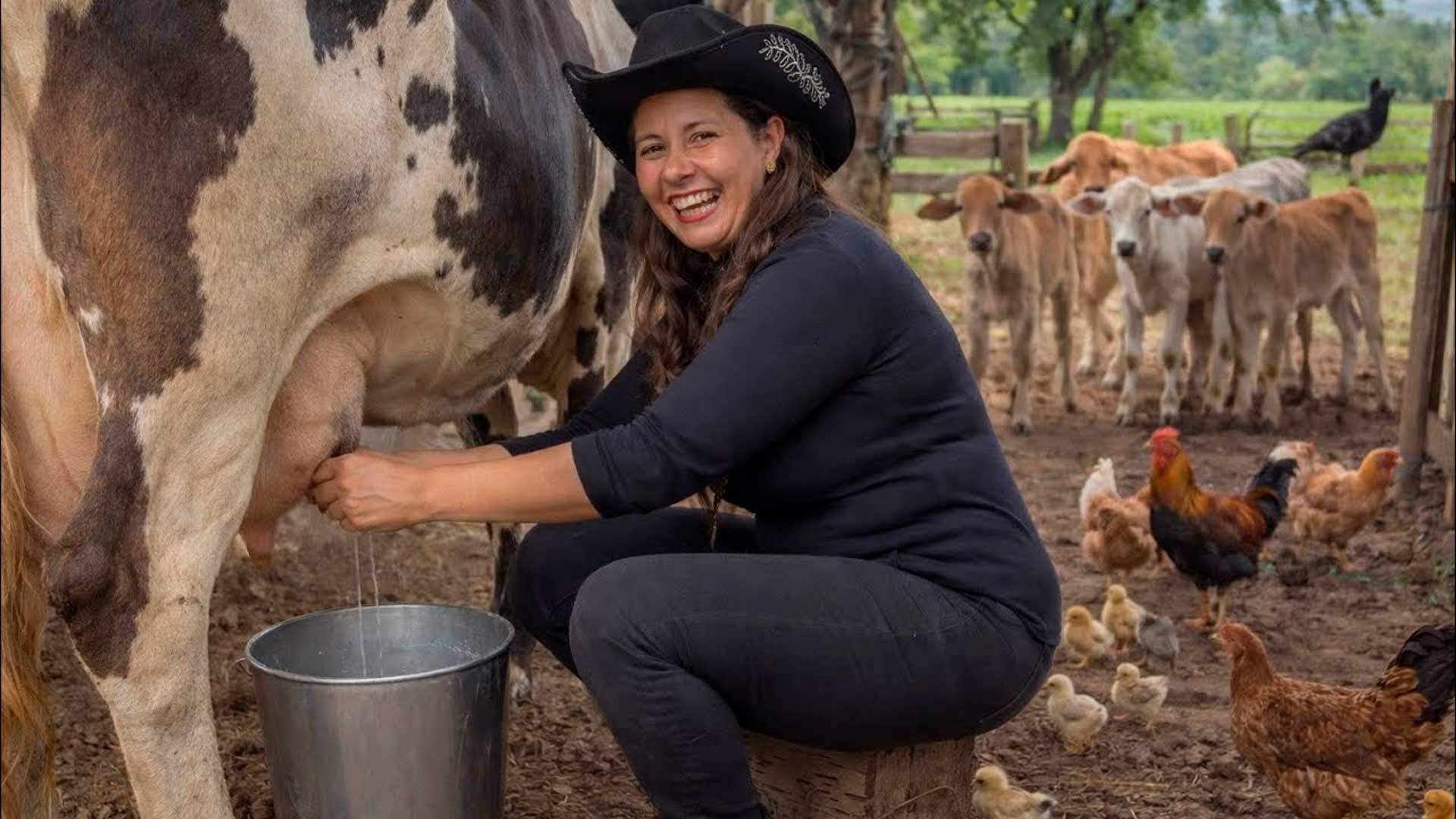


Luziélia Lost Her Husband and Faced the Challenge of Taking on Milk Production and Caring for Animals Without Ever Having Worked in the Barn, and the Story Moves People on Social Media Showing the Reality of Brazilian Rural Women
The journey begins at 4:30 in the morning. Before the sun rises, Luziélia is already up preparing her daughters for school and getting organized for another day of intense work on the one-hectare farm in Jaraguá, Goiás. A widow for a few years, she has taken on the responsibility of managing the farm alone, milking cows, caring for calves, and maintaining the production that sustains her family.
The story gained visibility through a video published on Lucas Pereira Lima’s channel, which documented the routine of the rural producer. In the footage, she shares the challenges she faced since losing her husband. “I was lost, you know? At the same time, I wanted to stay; at the same time, I wanted to leave,” she recalls in the video, remembering the first days after the mourning period.
According to data from the 2017 Agricultural Census by IBGE, women are responsible for more than a quarter of rural properties in Brazil, representing 19% of agricultural establishments. According to information from the Brazilian Confederation of Agriculture and Livestock (CNA), there was a 38% growth in women leading rural enterprises between 2006 and 2017.
-
Son of a seamstress from the rural area of Ceará who did not speak English wins a scholarship of over 2 million reais at Williams College, one of the top 10 universities in the United States, covering everything including dormitory, meals, and annual trips to Brazil.

-
Bill Gates revealed that the true secret behind every great achievement is not a brilliant leap but rather small improvements repeated over the years, and the data from his own career and the fight against climate change prove that he is right.
-
With 22 thousand tons of steel, a height nearly three times greater than the Eiffel Tower, and a cost of R$ 1.6 billion, China is building the highest bridge on the planet over a colossal canyon, reducing a crossing time of over 2 hours to just over 2 minutes.

-
With more than 635,000 doctors, Brazil sees competition increasing in large cities, and recent graduates are competing for shifts at an accelerated pace while the countryside still faces shortages.






Luziélia’s reality mirrors that of thousands of women in family agriculture who face triple burdens: caring for production, the house, and the children, often without support. In her case, the situation was worsened by the social isolation she faced after becoming a widow.
Solitary Learning and Overcoming in the Barn

When she decided to stay on the farm, 30 days after losing her husband, Luziélia had never worked in the barn. “I didn’t even know the names of the cows,” she says. It was her eldest daughter, Laila, who helped her identify the animals in the first few days.
The learning process was painful and solitary. On her first day in the barn, out of the eight cows available, she managed to milk only five. “They weren’t used to me. I wasn’t used to them either,” she explains in her testimony.
Today, the daily production ranges from 10 to 14 liters of milk, sold to the local dairy at prices that, according to her, did not increase during the drought of 2025 as in previous years. According to an analysis by the Brazilian Association of Milk Producers (Abraleite), milk prices significantly dropped in 2025, reaching average values between R$ 2.20 and R$ 2.41 per liter, depending on the region.
The income from the property comes from the sale of milk and calves. Each weaned calf can be worth up to R$ 1,800, she reported, although the ones she currently raises are still small and worth around R$ 1,000.
Social Isolation and Prejudice in the Rural Environment
One of Luziélia’s most impactful reports concerns the prejudice she faced as a widowed woman in the fields. “Since I am a widow, the women there didn’t want to let the men help,” she revealed, referring to the isolation she experienced from neighbors after her husband’s death.
This phenomenon is not exclusive to her reality. As research on rural women in Brazil indicates, they face challenges that extend beyond the operational difficulties of agriculture, including gender discrimination, lack of access to resources, and cultural barriers.
According to the Food and Agriculture Organization of the United Nations (FAO), women produce about half of the world’s food and represent 43% of the global agricultural workforce, but still face difficulties accessing land, credit, and value chains.
In Luziélia’s case, the abandonment by neighbors meant facing alone tasks that require considerable physical strength. She herself carries sacks of feed and corn, takes care of the cows’ nutrition with cotton hulls and bran, and plants silage for the dry period.
Triple Burden and Search for Supplementary Income
In addition to milk production, Luziélia balances domestic responsibilities and caring for her three daughters. Her routine includes preparing the girls for the school van that passes at 5 am, taking care of the animals, grocery shopping in town, paying bills, and seeking cleaning jobs on neighboring farms to supplement her income.
“Just the income from here isn’t enough,” she admits. She receives a widow’s pension from her husband, but the amount is also insufficient to cover all family expenses. “Right now, I’m feeling a bit pinched,” she confesses.
The situation reflects the scenario of many small milk producers in Brazil. According to the Agricultural Economic Institute (IEA), family farmers rely heavily on milk production, but face tight margins due to low prices paid by dairies and rising production costs.
Data from Embrapa indicates that Brazil produced 25.375 billion liters of milk in 2024, with a growth of 2.38% compared to the previous year. However, despite the increase in national production, small producers continue to face financial difficulties.
Social Networks as a Safety Valve and Source of Income
In light of the difficulties, Luziélia found in social networks a way to cope with sadness and create prospects for future income. With the profile @luzielia_ on TikTok, she posts videos of dancing and her routine milking cows.
“When I started making the videos, it took away a bit of the sadness,” she says. “I made the dance video, I made the milk-milking video, it took my mind to another place.” The initiative paid off: she reached 10,000 followers, the necessary milestone to start monetizing content on the platform.
The digital presence has become an important strategy for rural women to gain visibility and supplementary income. Additionally, it allows them to connect with others in similar situations, reducing isolation.
Luziélia says she is inspired by other producers, like Camila, a content creator who was also widowed and milks cows. “She is a warrior, hard-working person,” she says. The identification with similar stories demonstrates the importance of female representation in agribusiness.
Challenges of Milk Production in Small Properties
The property of one hectare (about 2.4 acres) that Luziélia manages is considered small for dairy farming. She currently keeps two milking cows, as well as some calves, including two orphaned ones that are fed by a “wet nurse.”
To maintain productivity, she provides feed to the cows during milking and plants corn silage—she uses about one and a half bags of seeds per year. Complementary feeding is essential, especially during the dry period when grass is scarce.
According to information from the Ministry of Agriculture and Livestock (MAPA), Brazil is the third largest milk producer in the world, with production in 98% of Brazilian municipalities. The activity employs about 4 million people, with a predominance of small and medium-sized properties.
However, as pointed out by the National Supply Company (Conab), many producers of family agriculture face difficulties in maintaining the activity due to low prices, lack of technology, and limited access to resources.
Perspectives and Public Policies
The federal government launched the Milk Production Development Strategy in Family Agriculture in 2024, aiming to strengthen the sector. The initiative provides special support to cooperatives and encourages consumption through programs like the National School Feeding Program (Pnae) and Food Acquisition Program (PAA).
For women like Luziélia, specific public policies are crucial. According to studies on gender equality in agriculture, it is necessary to ensure access to land, credit, technology, and technical training so that rural women can fully develop their productive potential.
Law 14.660/2023 amended the PNAE, determining that when food is purchased from individual rural families, at least 50% of the purchase must be made in the name of the woman, an important advance for recognizing the female role in food production.
Despite the challenges, Luziélia remains firm in her decision. After the first 30 days of adaptation, she no longer wanted to leave the farm. “I started to find my rhythm,” she recalls. The determination and resilience she has shown represent the strength of thousands of women in Brazilian agriculture who, even in the face of adversity, continue to sustain their families and contribute to the country’s food security.
And you, do you know of any similar stories of overcoming in the fields? Rural women face unique challenges ranging from prejudice to an overload of work. Does society adequately value the role of these workers in producing the food that reaches our table? Leave your opinion in the comments and help bring visibility to these stories of struggle and resistance.






Nós mulheres somos guerreiras sim, nada nos assusta.
Somos e seremos mulheres de fibra.
Hoje em dia ,as mulheres estão se superando mais e mais .Parabéns a todas as mulheres guerreiras do nosso Brasil.
Parabéns mulher! Vc.está deixando um grande legado para futuras gerações femininas e com isso mostrando a suas filhas o verdadeiro valor quê tem a mulher.