





 Portuguese
  English
  Spanish
  5 min of reading
  31 comments


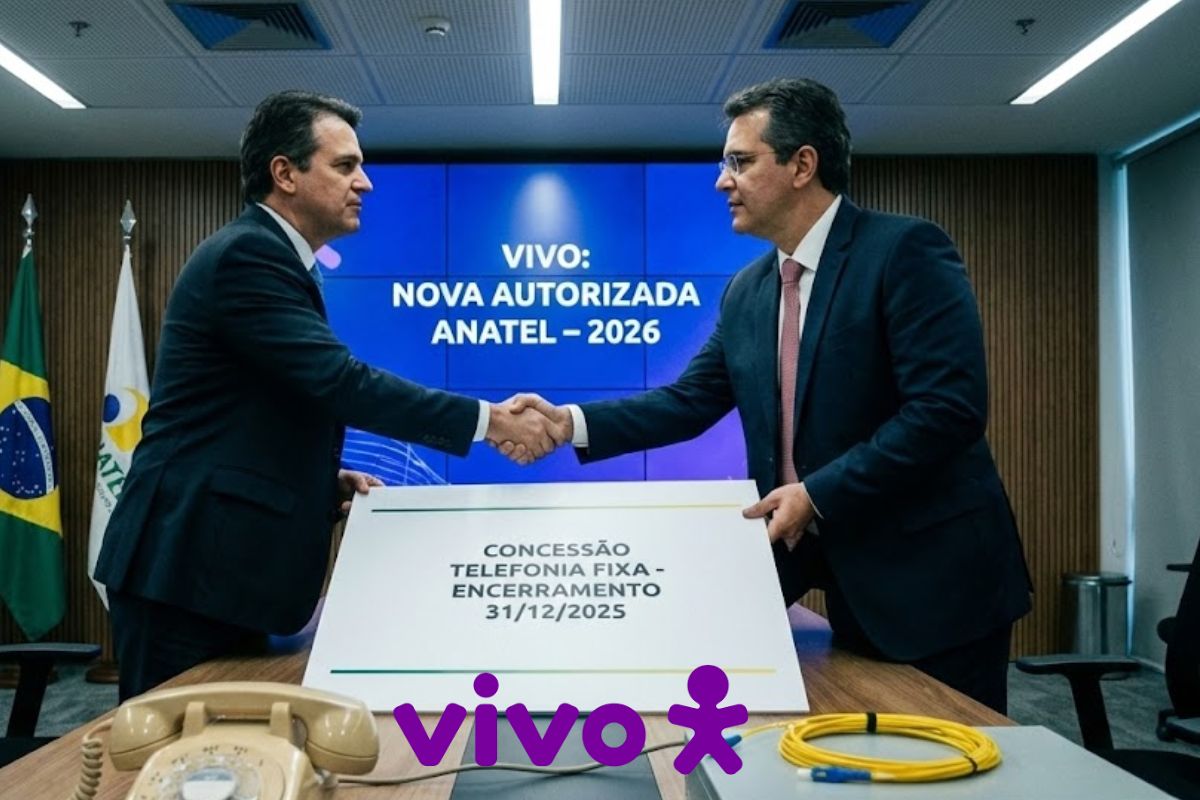


Vivo Marks December 31, 2025 as the End of Fixed-Line Telephony Concession in Brazil, Switches to Authorized Regime with Anatel, Promises to Invest R$ 4.5 Billion in Fiber Optics and Mobile Expansion, but is Charged by Procon After Failures in Alvorada, in the Interior of Tocantins.
Vivo has decided to end its fixed-line telephony concession in Brazil on December 31, 2025, the date it will leave the public regime and start operating as an authorized provider for Anatel across the country. The change follows the continuous decline in the use of fixed-line phones and the rise of digital services based on high-speed internet.
Under the agreement with the regulatory agency, Vivo commits to invest R$ 4.5 billion in fiber optic and mobile network expansion, while also maintaining fixed-line service where there is not enough competition until 2028, at the same time it must respond to Procon notifications for recent service failures in Alvorada, in Tocantins.
Vivo Ends Concession and Assumes Authorized Regime
Vivo’s move represents a structural change in the fixed-line telephony service model in Brazil.
-
Larger than entire cities in Brazil: BYD is building a 4.6 km² complex in Bahia with a capacity for 600,000 vehicles per year, but the discovery of 163 workers in conditions analogous to slavery has shaken the entire project.

-
With an investment of R$ 612 million, a capacity to process 1.2 million liters of milk per day, Piracanjuba inaugurates a mega cheese factory that increases national production, reduces dependence on imports, and repositions Brazil on the global dairy map.

-
Brazilian city gains industrial hub for 85 companies that is equivalent to 55 football fields.

-
Peugeot and Citroën factory in Argentina cuts production by half and opens a layoff program for more than 2,000 employees after Brazil drastically reduced purchases of Argentine vehicles.


With the end of the concession on December 31, 2025, the operator leaves the public regime and begins operating under a private authorization regime, in line with the regulatory framework led by Anatel.
In practice, this means more contractual flexibility for Vivo, which will begin adapting its offerings to the new technological demands of consumers, which are now much more focused on broadband and mobile telephony than on traditional fixed lines.
The transition is part of a national effort to modernize the telecommunications sector, reducing the burden of obligations typical of the fixed-line era.
At the same time, the company will have to show that the model change does not reduce user protection.
The expectation is that Vivo will use the new regime to accelerate investments and not to retreat in quality, especially in regions where fixed lines still play a significant role in basic connectivity.
R$ 4.5 Billion for Fiber in 121 Municipalities and Maintenance of Fixed-Line Service
With the end of the concession, Vivo presented an investment plan of R$ 4.5 billion in telecommunications infrastructure.
A central part of this package is the construction of fiber optic networks in 121 municipalities, increasing access to high-speed internet and reinforcing the brand’s presence in cities where coverage is still limited.
In addition to fiber expansion, the company commits to maintain fixed-line telephony where there are no competitive alternatives until 2028.
This means that, even abandoning the concession model, Vivo remains obligated to ensure that more vulnerable or isolated areas are not left completely without service.
According to the announced plan, this resource allocation aims to improve accessibility to broadband and strengthen Vivo’s position in various regions of Brazil, adjusting operations to consumer behavior that demands more speed, stability, and integrated services at home and work.
Expansion of Mobile Networks and Focus on Areas Lacking Connectivity
The package of changes from Vivo is not limited to fiber optics. The operator also commits to expand its mobile networks in various locations, including rural regions and urban areas lacking digital connectivity.
The strategy is to strengthen the network’s signal and capacity in areas where complaints about instability and low coverage are still frequent.
The company views this expansion as essential to keep up with a scenario where the cell phone is the main means of communication for the population, and dependence on mobile internet grows for work, study, public services, and entertainment.
By directing part of the resources to these areas, Vivo tries to show that the end of the concession comes with a commitment to reduce inequalities in access to connectivity, and not just to reorganize contracts with Anatel.
Procon Notification in Alvorada and Pressure for Responses from Vivo
While announcing billion-dollar investments, Vivo faces concrete problems at the service delivery end.
In the state of Tocantins, the operator was notified by Procon after consumer complaints in Alvorada, who reported constant failures in mobile telephony and internet.
In light of these complaints, Procon demanded that the company provide detailed technical explanations about the causes of the interruptions and instabilities, as well as the presentation of an action plan to correct the deficiencies.
The adoption of measures to compensate affected users was also required, acknowledging the damages caused by the malfunctioning of services.
This episode puts Vivo under pressure at a sensitive time of regulatory transition.
The company needs to show that, even while changing regimes with Anatel, it remains committed to responding quickly to failures and improving customer experience, especially in smaller towns that heavily rely on the operator’s connection.
Service Quality and Consumer Trust in Vivo’s New Phase
The combination of end of the concession, new investments, and Procon pressure makes this phase critical for Vivo’s image in the Brazilian market.
The transition to the authorized regime will only be positively assessed if it is accompanied by real improvements in the quality of fixed-line service, fiber, and mobile coverage.
To consolidate the change, the company will have to fulfill its promises regarding fiber optics in the 121 municipalities, maintain service where there is no competition until 2028, and at the same time, reduce the failures that currently annoy consumers in places like Alvorada, in Tocantins. Without this concrete delivery, announced investments are likely to be seen merely as rhetoric.
Public trust will depend on Vivo’s ability to combine regulatory modernization, infrastructure expansion, and efficient service, especially in historically neglected regions.
In your city, do you feel you can trust Vivo to depend on the fixed and mobile network after the end of the concession on December 31, 2025, or do you still see many problems with the service?









Tenho um fixo há 20 anos, agora com fibra ótica. Minhas perguntas, vão cancelar minha linha como já relatado em um dos comentários abaixo? Não tenho dinheiro pra comprar “telefone de mesa de 600,00, tb conforme um dos comentários abaixo? Não temos escolha? Caso seja isso mesmo, a conta de Internet da Vivo ficará mais barata, já que não será mais responsável pela telefonia fixa? Em tempo ressalto e corroboro que com algumas exceções, o atendimento é péssimo!!! Atendentes arrogantes, ineficazes e grosseiros! Continuo nessa operadora pq sou da antiga GVT. Enfim, pra mim está tudo mto confuso. Acho que cada um tem sua demanda,portanto acho bom que tanto a Vivo como a concessionária que vai assumir, sejam bem claras ao que efetivamente vão fazer com seus clientes. E espero sinceramente que assim seja, pois se alguma coisa não me for consultada, devidamente explicada, e me trouxer mais algum tipo de aborrecimento, estejam essas operadoras/concessionárias certas de que um processo judicial irá acontecer, pois por muito menos uma outra operadora me pagou caro por seu descaso! Chega de abuso, falta de respeito e negligência com os clientes!!!
A Vivo vai migrar o Fixo metálico pra o Fixo VoIP, você não ficará sem telefone e sim ele será migrado pra nova tecnologia já que o metálico caiu em desuso e existe muito furto desse cabo e não vale a pena a operadora investir nisso, por esse motivo ela vai investir em Fibra, já que esse matéria que é fibra plástico e vidro não tem valor pra **** que **** cabo metálico. Sei fixo vai continuar normalmente só vai deixar de ser aquele fixo tradicional pra ser na tecnologia VoIP onde se liga o fixo diretamente no modem e não mais na tomada de telefone como era feito antes.
Tenho um telefone fixo com fibra ótica, vai ser desativado?
Existe um modelo de telefone celular de mesa muito parecido com o fixo tradicional.
Custo médio de R$600, 00.