





 Português
  Inglês
  Espanhol
  4 min de leitura
  0 comentários


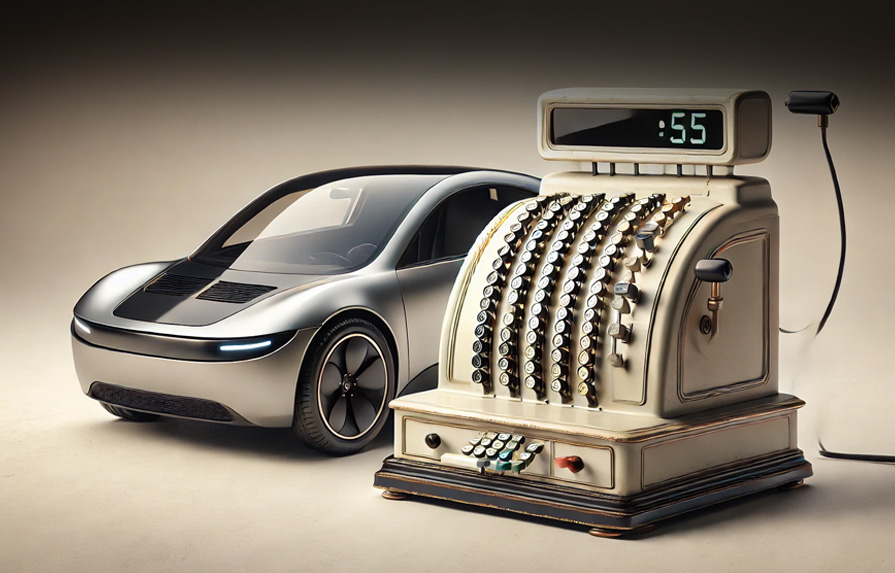
Have You Ever Imagined What The World Would Be Like If, 100 Years Ago, Electric Cars Had Dominated The Auto Market? Well, This Reality Was Very Close To Happening! In The Early 20th Century, Electric Cars Were More Popular Than Gasoline Models.
However, a simple electric motor, like the ones used to open and close drawers in cash registers, was responsible for changing this story forever. But how could such a mundane device have impacted an entire industry? Keep reading to discover how this story unfolded and how it shaped the future of automobiles.
The Rise Of Electric Cars In The Early 20th Century
In the year 1900, electric vehicles represented about 38% of the American Fleet, demonstrating the popularity of these machines that emitted no harmful gases and were easy to handle.
Women, in particular, preferred electric cars, as they did not leave the smell of gasoline embedded in their clothes. Additionally, electric vehicles did not require physical strength to start, unlike gasoline models, which needed a crank to start the engine.
-
OMODA & JAECOO grows in Europe in 2026 with an integrated strategy of sales, innovation, local production, and technological advancement in the United Kingdom, Italy, and Spain.
-
OMODA & JAECOO expands after-sales service in Brazil with competitive maintenance, a 7-year warranty, and high availability of parts for technological SUVs.

-
OMODA & JAECOO appoints Alessandra Souza as executive marketing director in Brazil and accelerates brand expansion with a focus on innovation, networking, and hybrid portfolio.

-
Jaecoo 7 with super hybrid SHS system exceeds 1,200 km of combined range with a 1.5 turbo engine, high-density battery, and intelligent energy management.
At that time, steam and hybrid vehicles also had a share of the market, but most people who opted for gasoline-powered cars did so for a simple reason: it was cheaper.
Although gasoline was more accessible, starting a combustion car before 1912 was no easy task. It required strong arms and, more importantly, technique.
The crank used to start the engine often caused serious and even fatal accidents, as it could spin in the opposite direction with enough force to cause fractures.
The Invention That Changed Everything: The Electric Starter
The beginning of the end for electric cars started with a concern from Henry Leland, founder of Cadillac and Lincoln. Outraged by the accidents caused by the crank, Leland challenged his engineers to create a safer and more efficient method to start combustion cars.
And that’s when a small motor, originally used in cash registers, entered the scene. Charles Kettering, a talented engineer, discovered the potential of the small motor used in NCR (National Cash Register) cash registers.
Kettering, who would later found Delco (Dayton Engineering Laboratories Company), had the idea of adapting this motor to start combustion engines. In 1912, the Cadillac Model 30 was launched with the first electric starter in history, eliminating the need for a crank.
The Decline Of Electric Cars And The Rise Of Internal Combustion
The success of the Cadillac Self Starter was immediate. Sales doubled, and the electric starter quickly became the standard in the automotive industry. In contrast, electric cars, which peaked in 1912 with about 40,000 units, began to lose popularity.
The arrival of the Ford T with an electric starter in 1919 sealed the fate of electric cars. The crankless Model T was sold for less than $300 (about $4,700 today), while electric cars were nearly ten times more expensive.
Another crucial factor in the decline of electrics was the expansion of road infrastructure. As more paved roads connected cities, the gasoline cars’ ability to travel long distances faster and more easily became a significant attraction.
Gasoline was also cheaper and quicker to refuel, compared to the time needed to recharge the heavy lead batteries of electric vehicles.
The Timid Return Of Electrics And The Promising Future
After decades of being forgotten, electric cars began to return timidly in the 1990s, mainly due to strict environmental laws in California. The GM EV1 was one of the first to emerge, but faced difficulties in the market and was taken out of circulation.
Today, with more efficient, lighter batteries and advanced technologies, electric cars are finally finding their place in the global market. The China, in particular, is leading this movement, heavily investing in electric vehicles as part of its environmental and economic strategy.
The legacy of the crank persisted even until 1998, curiously, in the Lada Niva, where a wrench could be used to start the engine in emergencies. However, it seems that electric cars are back to stay, perhaps this time for good. This is because automakers like BYD, Toyota, Volkswagen, and many others see these vehicles as the future of their brands.
Will electric cars finally dominate the market, or will price once again hinder their expansion? Comment below what you think about the future of electric vehicles! Until next time!








Seja o primeiro a reagir!