





 English
  Francês
  Alemão
  Italiano
  Japonês
  Norueguês
  Portuguese
  Spanish
  4 min of reading
  0 comments


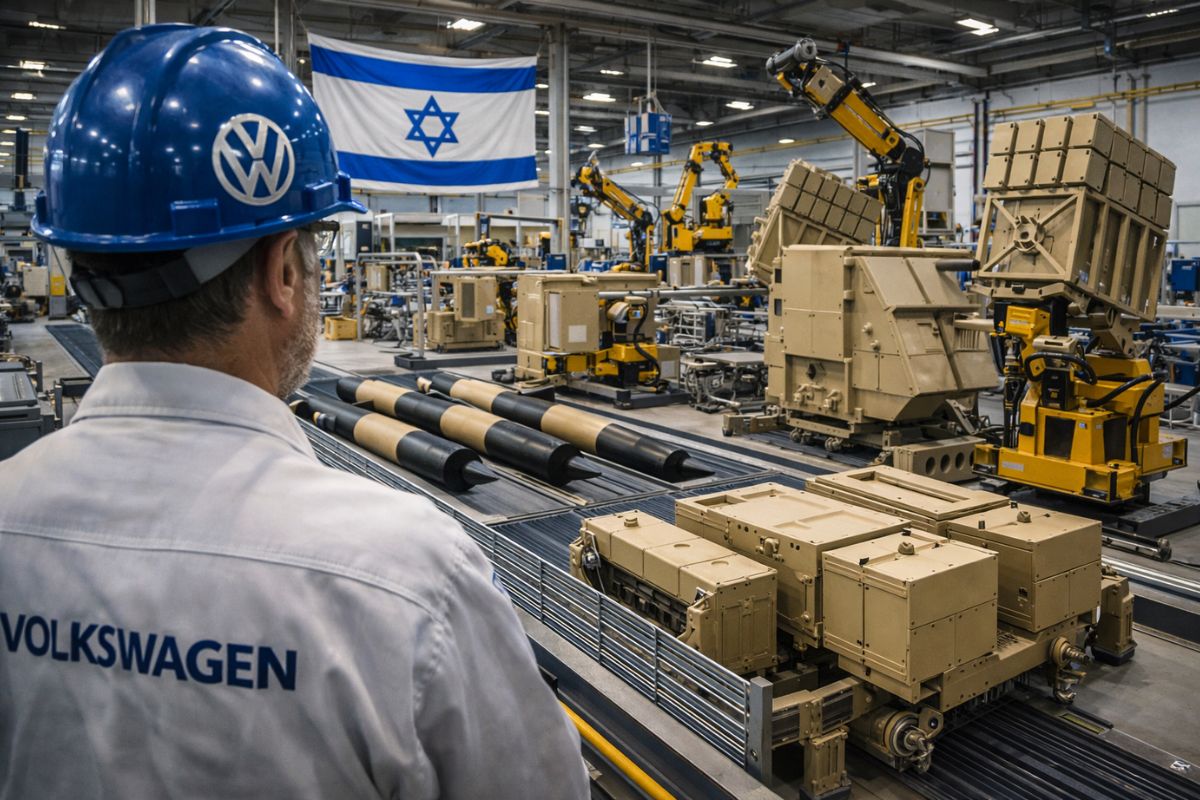
The Volkswagen factory in Osnabrück, Germany, threatened with closure due to the automotive crisis, could be repurposed to produce components for the Israeli Iron Dome missile defense system. The plan aims to save 2,300 jobs and could be operational in 12 to 18 months, according to the Financial Times.
Volkswagen has found an unexpected solution for one of its struggling factories in Germany. The Osnabrück plant, threatened with closure due to the automotive crisis, could be repurposed to produce components and materials for the Iron Dome, the Israeli missile defense system. The news was exclusively reported by the Financial Times and represents a profound shift: Volkswagen would move from assembling civilian vehicles to manufacturing military technology. The goal is to maintain the 2,300 jobs at the factory and leverage an industrial infrastructure that is no longer profitable in the automotive sector.
The measure reflects a broader change in Germany. The automotive sector is struggling with Chinese competition and a slower-than-expected transition to electric vehicles. At the same time, defense spending in Europe is increasing after the war in Ukraine, with Berlin planning to invest more than 500 billion euros in the coming years. In this context, Volkswagen is not alone: factories that once produced cars are now seeking to adapt to the military industry, where demand is stable and growing.
What the Volkswagen factory in Osnabrück will produce for the Iron Dome

According to the Financial Times, the Volkswagen factory would not produce complete missiles, but rather essential components of the Iron Dome system. This includes the trucks that transport the launchers, the launch systems themselves, and the electric generators that power them.
-
Expansion of Federal Institutes: 38 new campuses and R$ 200 million for public education; see the cities included.

-
Lula’s government changes rule in important benefit and thousands of Brazilians will no longer receive it; see what has changed.

-
New Gripen fighter makes Argentines surrender to Brazil, and the heavy reaction exposes envy, frustration, and shock at Brazil’s technological leap.

-
This discovered deposit near the Andes could change the future of Argentina, attract billions, and even shake up the global metals market.


These are fundamental elements for the system’s operation in the field. The plan requires relatively low investment and could be operational in 12 to 18 months.
In addition to production at the Volkswagen factory, Rafael, the Israeli defense company responsible for the Iron Dome, would build another specialized factory in Germany for the production of interceptors. Together, the two facilities would complete the production chain of the system on European soil.
For Volkswagen, the partnership represents a way to maintain industrial activity in Osnabrück without relying on an automotive sector that does not offer short-term prospects for that plant.
How the Iron Dome works and why Europe wants to produce it
The Iron Dome is a missile defense system designed by Israel to intercept short-range rockets before they reach populated areas. The process begins when a radar detects the launch and calculates the projectile’s trajectory.
Next, a control system decides if the rocket poses a real threat. If deemed dangerous, an interceptor missile is launched to destroy it in mid-air, all within seconds. Israel claims to intercept more than 90% of projectiles classified as dangerous.
Europe seeks to strengthen its autonomy in defense matters and reduce dependence on external suppliers. Producing components of the Iron Dome on European soil facilitates the deployment and maintenance of the system.
Some experts question the effectiveness of the Iron Dome against more advanced missiles, as it was designed for short-range threats. Nevertheless, the need to strengthen air defenses drives projects like Volkswagen’s in Osnabrück.
The crisis at Volkswagen and the German automotive sector: why this change is necessary
Volkswagen’s decision to convert a car factory into a military production line is not a whim. It reflects a deep crisis. The German automotive sector faces simultaneous pressure from Chinese competition, which offers cheaper electric vehicles, and an energy transition that is progressing more slowly than planned.
Volkswagen has already announced cuts and restructuring at several plants, and Osnabrück was on the list of factories threatened with closure.
With the planned cessation of current production in Osnabrück, restructuring for the defense sector emerges as one of the few options to maintain 2,300 jobs. Volkswagen has a history of military production: during World War II, the company manufactured military vehicles and even components for V1 rockets.
After decades focused exclusively on the civilian sector, this collaboration with Rafael would represent a partial return to the defense industry, now in a completely different context.
The plan still depends on Volkswagen workers and is not finalized
The plan to convert the Volkswagen factory in Osnabrück for the production of Iron Dome components is not yet finalized. One of the obstacles is the acceptance of the workers themselves, as not all are willing to swap car manufacturing for military equipment production.
The ethical issue of transitioning from a civilian automaker to the arms industry generates internal debate and could affect the timeline.
Still, the alternative is uncertain. Without the reconversion, the Osnabrück factory may simply close its doors, leaving 2,300 people unemployed in a region where the job market is already under pressure.
Volkswagen’s decision reflects a broader change: the European industry is beginning to adapt to a scenario where security is once again a determining factor for the economy. For Volkswagen, the Iron Dome may be less about missiles and more about industrial survival.
What do you think about this decision?








Seja o primeiro a reagir!