





 Portuguese
  English
  Spanish
  4 min of reading
  0 comments


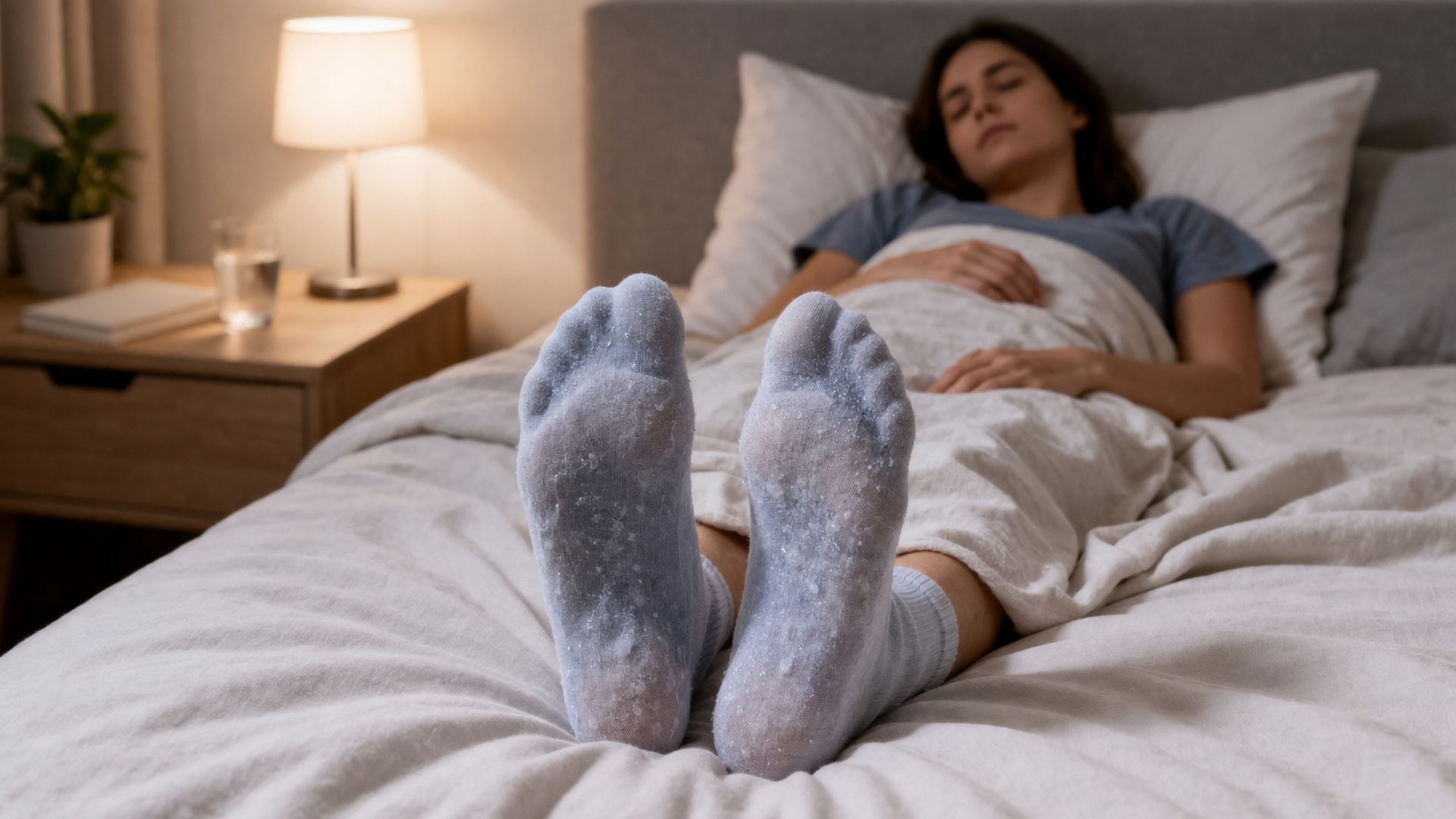
Body thermal regulation gains highlight in sleep debates, while the wet sock technique goes viral without robust scientific backing and raises questions about its real effects on nighttime anxiety and rest quality.
The relationship between body temperature and the onset of sleep has returned to the spotlight in recent weeks, but the available scientific evidence does not reliably confirm that sleeping with wet socks is the shortcut described in viral publications.
What studies show more consistently is something else: the body tends to fall asleep when the core temperature begins to drop, while hands and feet become warmer to facilitate heat loss.
In this process, keeping the room cool, dark, and quiet remains the most solid guidance.
-
Globo presenter lives in an R$ 8 million mansion in the interior of São Paulo, with a private lake, basketball and tennis courts, a “private hotel,” a condominium costing R$ 4,000, and surprising details in the decor.

-
The USA surprises the world with Trump’s new dollar after 165 years, breaking historical tradition.

-
Presenter leaves colossal mansion to live in a sanctuary after selling property for R$ 45 million with 2,600 m², two swimming pools, and a cinema, exchanging luxury for a sustainable 900 m² house with a jabuticaba tree in the living room.

-
A Brazilian thought he was making a good deal but lost R$ 125,000 while trying to buy a Toyota Hilux on Facebook.


What science says about temperature and sleep
Falling asleep depends on a fine adjustment of the organism.
In the hours leading up to rest, internal temperature tends to decrease, while the skin on the extremities warms up.
This mechanism favors heat dissipation and helps the body transition from wakefulness to rest.
Therefore, sleep researchers often treat thermoregulation as an important part of the nighttime routine, but not as an isolated solution for insomnia or anxiety.
At this point, peripheral circulation plays a relevant role.
When the blood vessels in the hands and feet dilate, heat escapes more easily, contributing to the drop in core temperature.
It was this physiological reasoning that led part of the literature to test socks for sleeping and other methods of lightly warming the feet.
In simple terms, the body does not “turn off” because the feet cool down, but because it can efficiently lose heat before sleeping.
The wet sock technique lacks scientific evidence
The main weakness of the so-called “wet sock technique” lies precisely in the lack of direct evidence.
The research found generally evaluates warmed feet, and not the use of cold, wet fabric during the night.
One frequently cited study showed improvement in sleep latency and sleep efficiency with sleeping socks in a cold environment.
However, the observed effect occurred with warming the feet, not cooling.
Even though initial contact with cold water may produce a sense of relief in some people, this does not justify concluding that there will be sustained reduction in heart rate or accelerated release of melatonin.
Melatonin is produced by the brain in response to darkness and the biological clock, not to a specific technique with wet socks.
In practice, this changes the framing of the discussion.
The topic is not exactly a new validated strategy against nighttime anxiety, but a popular adaptation of a real principle of sleep physiology.
More effective habits to improve sleep
If difficulty sleeping arises when the mind remains racing, simple measures tend to have more backing.
Among them are keeping the room dark, quiet, and cool, reducing screen exposure at the end of the night, and maintaining regular bed and wake times.
Methods that comfortably warm the feet also have a more plausible basis than cooling with wet fabric.
Sleeping with clean, dry socks or taking a warm bath can promote heat loss from the body and shorten the time until sleep.
Still, the effect is not universal and does not replace medical evaluation when the complaint is persistent.
There is also an important limit to this type of strategy.
Sleeping better on an isolated night is not the same as treating chronic insomnia or anxiety.
Recurring difficulty falling asleep and daytime fatigue require clinical investigation, as they may involve different factors.
Between viralization and scientific evidence
The popularity of the wet sock technique shows how the search for quick solutions remains strong.
The interest is based on a real biological phenomenon, the role of temperature in preparing the body for sleep.
The problem arises when this mechanism is simplified and turned into an immediate promise.
For those who wish to test nighttime adjustments with less margin for error, the evidence points more towards dry socks, a cool environment, and reduced light before bed.
Improving sleep usually depends more on the combination of a regular routine and an appropriate environment than on an isolated trick.






Seja o primeiro a reagir!