





 Portuguese
  English
  Spanish
  5 min of reading
  0 comments


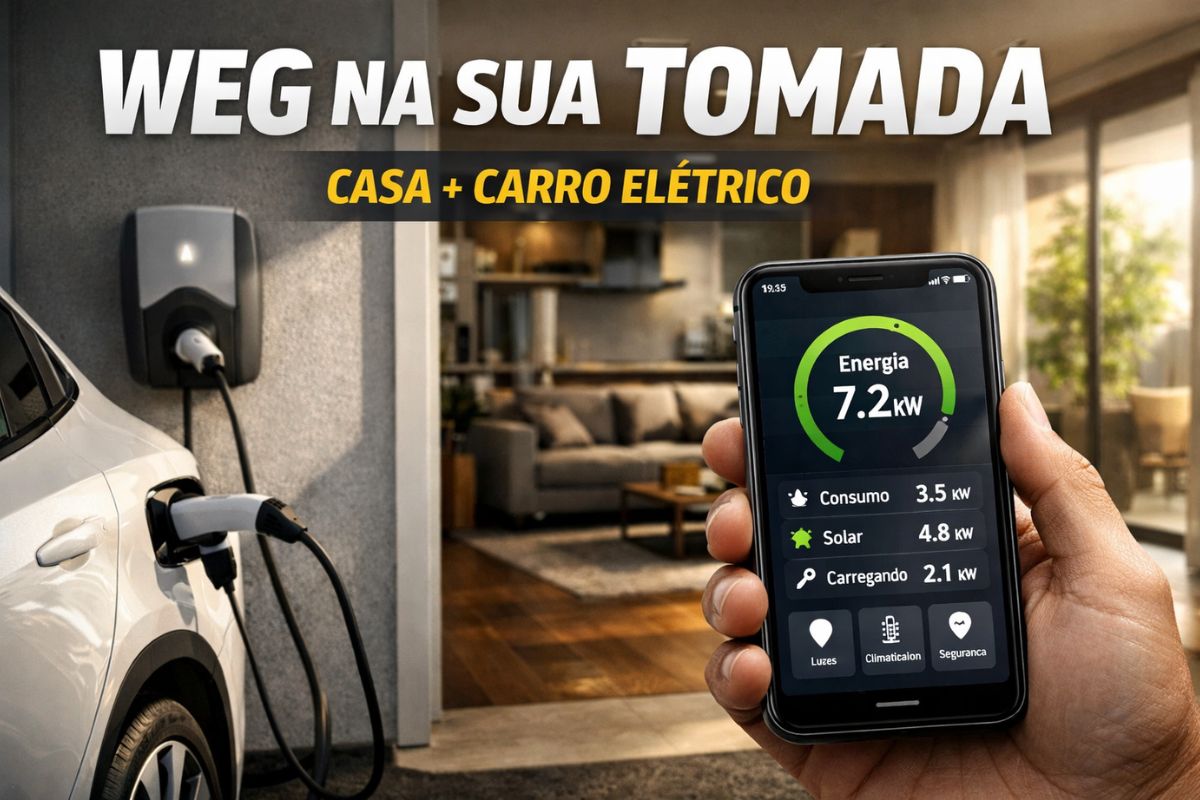
WEG, The Giant from Santa Catarina at B3, Uses Connected Homes, Integrators, and Electric Mobility to Step Out of Industrial Anonymity, Sell Complete Solutions to the End Consumer, Plug Cars into Outlets, Test Technologies with Acquisitions, and Prepare an Energy Ecosystem from the Living Room to the Garage for Brazil’s New Electric Future.
In the last three years, WEG has accelerated a strategic shift: after investing around US$ 500 million in electric motors in 2024 and achieving global leadership in the segment in 2025, the company decided to bring its brand closer to the daily lives of Brazilian families.
Now, WEG is targeting connected homes, electric mobility, and acquisitions focused on the end user, betting on solutions that integrate residences, energy networks, and electric vehicles within a single control ecosystem, from the living room outlet to the garage.
From Industrial Giant to the Spotlight of Brazilian Homes
Among the largest companies listed on B3, with a market value exceeding 200 billion reais, WEG spent decades focused on providing motors, equipment, and systems to other companies.
-
50 viaducts, 4 tunnels, 28 bridges, and 40 kilometers of bike paths: BR-262 in Espírito Santo will receive 8.6 billion reais for the largest engineering project in the state’s history, inspired by the Immigrant Highway in São Paulo.

-
Brazil produces too much clean energy and doesn’t know what to do with it: over 20% of solar and wind capacity was wasted in 2025 while investors flee and 509 renewable generation projects were abandoned in the last year.

-
Piauí will produce a new fuel that replaces diesel without needing to change anything in the truck’s engine and reduces pollutant gas emissions by half: truck drivers from all over the Northeast are already celebrating the news that will arrive later this decade.

-
A new Brazilian shopping center worth R$ 400 million will be built in an area equivalent to more than 4 football fields, featuring 90 stores, 5 cinemas, a supermarket, a college, and parking for 1,700 cars, potentially generating 3,000 jobs.


Its operations were almost entirely B2B, far from retail shelves and the direct recall of the average consumer.
CEO Alberto Kuba explains that WEG has always been in the background, but almost everyone has something made by it at home without knowing.
The shift in focus does not abandon the industrial DNA but rather expands the range of solutions that the company already masters, so the brand becomes recognized within homes as well.
Smart Home Transforms the Residence into a Piece of the Electric System
The turn occurs at a time of growth in the connected home market, where electrical systems, telecommunications, automation, and energy management begin to operate in an integrated manner.
In this smart home model, the residence ceases to be a passive consumer and begins to interact with the electrical grid, apps, and smart devices spread throughout the rooms.
WEG aims to occupy exactly this technological core by offering a portfolio that includes access control systems with facial recognition, monitoring solutions, cameras, smart switches, and other integrated home management devices.
The strategy is to make the consumer see WEG as a complete ecosystem, not just as a manufacturer of motors or electrical panels.
Electric Mobility and Flow Reversal Connects Car, Outlet, and Grid
Besides the internal environment of the house, WEG is advancing in electric mobility with solutions that allow charging electric vehicles from the grid as well as using energy stored in car batteries to power the residence during peak tariff hours or during power outages.
This flow reversal logic is already a reality in countries like China, where connected vehicles help meet the grid demand during peak hours.
For Alberto Kuba, the electric car stops being just transportation and becomes an extension of the domestic and urban energy system, intelligently connecting garage, outlet, and public grid.
Smaller Acquisitions Test Technologies Close to the Consumer
Historically, WEG’s growth was driven by mergers and acquisitions in mature industrial businesses, especially in electric motors.
Only in 2024, the company allocated around US$ 500 million to this segment, consolidating its position as a global leader.
Now, the approach includes assets closer to the end user but with caution.
According to Kuba, WEG does not intend to be aggressive in making big bets at once, but rather make small acquisitions to test technologies and business models, scaling only what works well with the public.
Tupi Mob Gives WEG Direct Access to 400,000 Users
One example of this strategy is the acquisition of control over Tupi Mob, also known as Tupinambá Energia, for 38 million reais.
With this operation, WEG gained direct access to around 400,000 users connected to the charging platform, a user base it had not been directly in contact with until then.
More than just the number of customers, this move provides a field for real-time testing of new charging solutions, tariffs, and integration between electric cars, residences, and the public grid.
Tupi Mob acts as an entry point for WEG to quickly learn from the end user’s behavior and adjust its portfolio.
Integrators Become the Bridge Between WEG and the Homeowner
To support its expansion in the residential market, WEG bases its strategy on integrators, who design and install electrical systems, run wiring, configure connected devices, and, in some cases, manage energy billing.
They serve as the physical link between what the company’s engineering develops and what the homeowner sees working in everyday life.
Instead of interacting individually with millions of consumers, WEG strengthens this network of specialized partners who deliver the complete solution to the customer’s home.
In practice, the integrator becomes the visible face of the project, while WEG consolidates itself as the brain coordinating energy, automation, and connectivity.
Motors Remain Leaders, but Diversification Guides WEG’s Future
Despite the closer relationship with the end consumer, electric motors remain WEG’s main line of business.
The CEO himself acknowledges, however, that this relative share is likely to decrease, precisely because the company reached the top global position in this market in 2025, and the room for growth solely in that area becomes more limited.
Therefore, diversification is treated as a permanent plan.
By combining leadership in motors with smart home solutions, electric mobility, and digital services, WEG seeks to ensure new avenues of growth and daily presence in the life of Brazilians, from the living room outlet to the car charger in the garage.
In your opinion, can WEG step out of the role of invisible giant in the industry to compete with the technology brands that already dominate your home?










-

-

-

5 pessoas reagiram a isso.