





 Portuguese
  English
  Spanish
  5 min of reading
  0 comments



The Chinese destroyer Zunyi, of the Type 055 class, has returned to the focus of naval coverage after appearing in exercises in the South China Sea, a scenario that concentrates maritime disputes, military movements, and increasing attention on anti-submarine capabilities.
The Chinese destroyer Zunyi, of the Type 055 class, was presented by China’s state media as the centerpiece of an anti-submarine warfare exercise conducted in the South China Sea, an area marked by territorial disputes and intense naval activity.
According to the state broadcaster CCTV, the ship was tasked with reconnaissance, early warning, detection, and tracking of a submarine during a training confrontation between surface and submerged units, with real-time data transmission to other units in the task force.
The movement drew attention because the Type 055 had been more associated with air defense and surface combat.
-
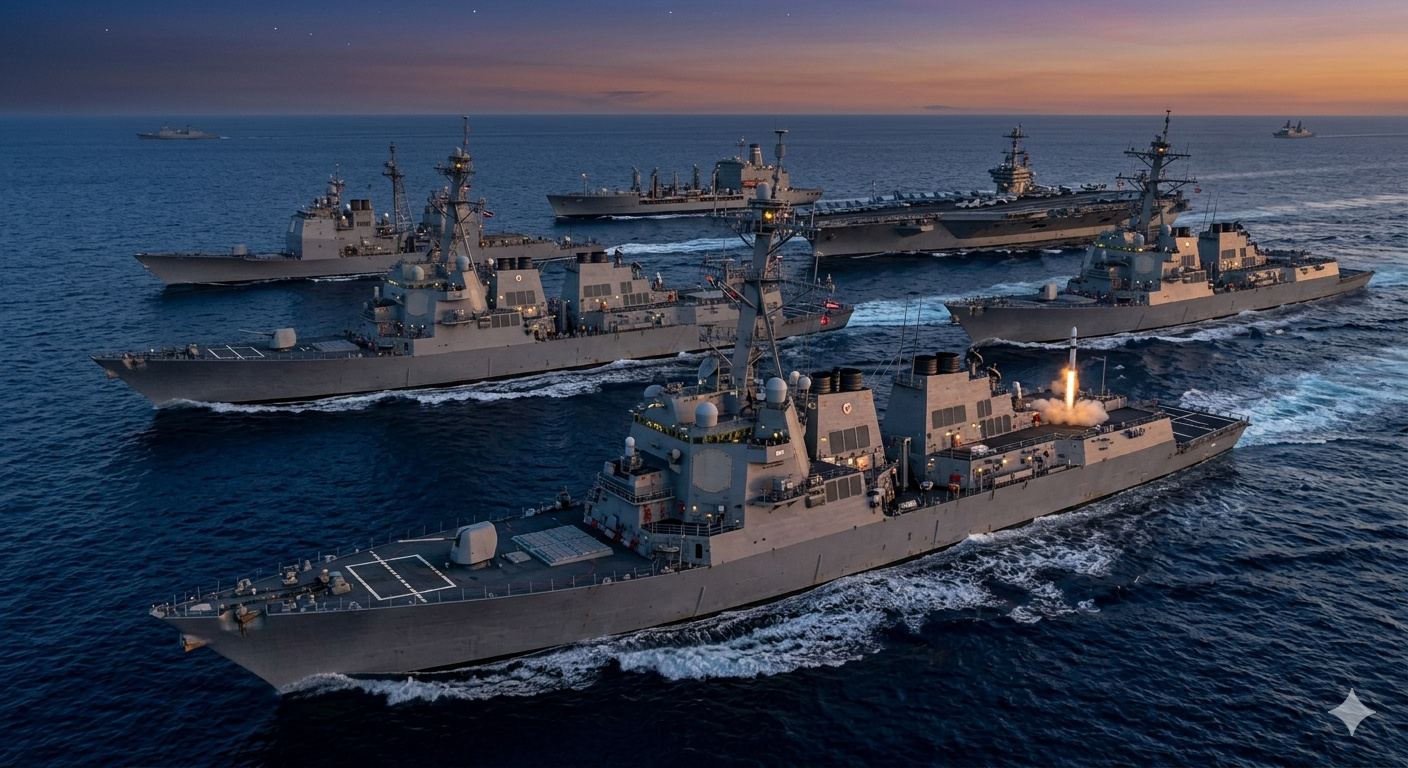
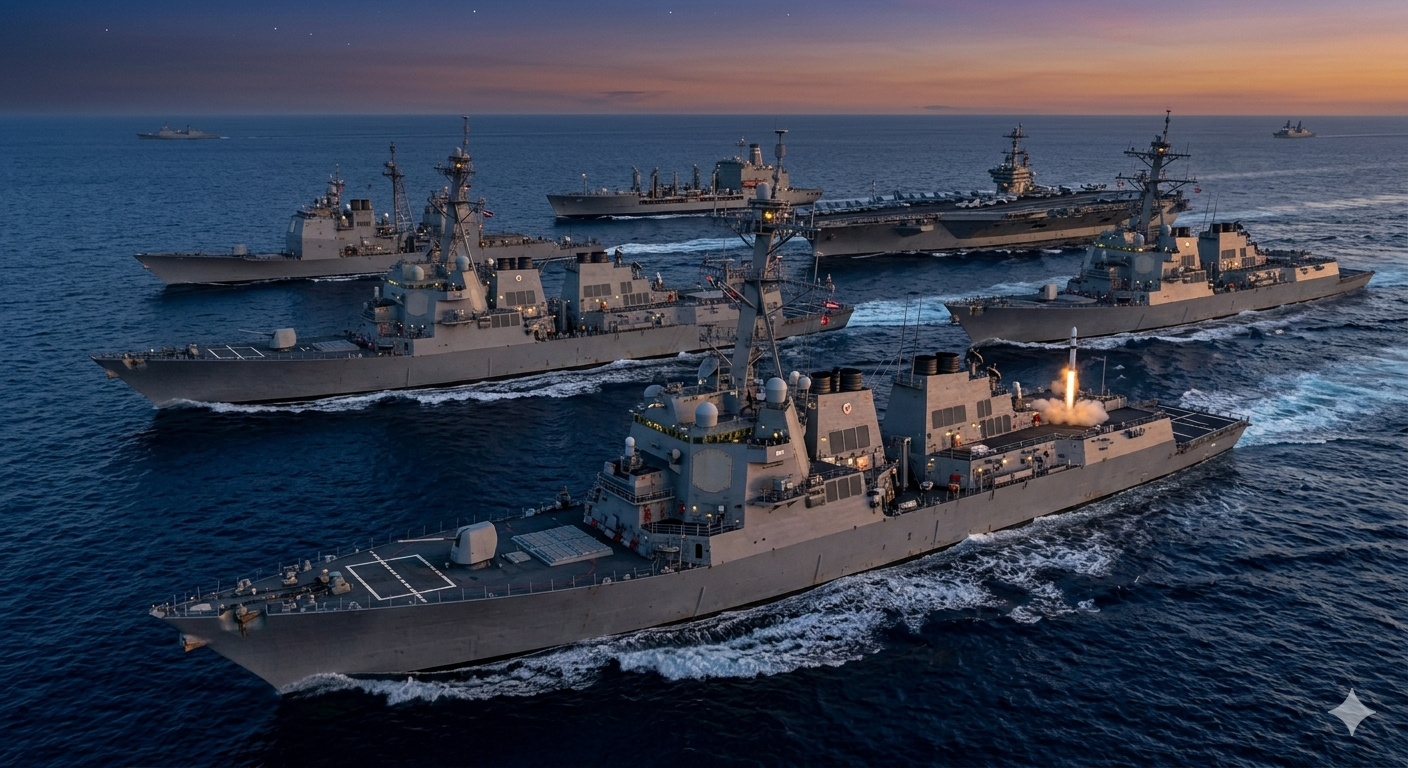
With over 15,000 tons, radars capable of tracking hundreds of targets simultaneously, and more than 120 missiles ready for launch in seconds, modern destroyers cease to be escorts and begin to dominate the naval battlefield.
-
With over 15,000 tons, radars capable of tracking hundreds of targets simultaneously, and more than 120 missiles ready for launch in seconds, modern destroyers cease to be escorts and begin to dominate the naval battlefield.
-
Valued at over $2 billion, the B-2 Spirit bomber requires meticulous inspection, bombs calibrated in a controlled environment, and extreme preparation to disappear from radar and launch attacks with lethal precision.
-
Brazil presents the first national F-39 Gripen fighter and redefines air defense with technological advancement, job creation, and strengthening of the defense industry on the global stage.
Now, according to authorities and analysts interviewed by the Chinese press, the platform is also expanding its role in anti-submarine warfare, one of the most complex fields of naval warfare.
Exercise in the South China Sea and focus on submerged combat
According to CCTV, the training took place in an undisclosed location in the South China Sea and placed the Zunyi in a surveillance and alert role for the naval force.
During the activity, the destroyer reportedly identified submarine targets and transmitted a large volume of information in real-time, helping to form a situational awareness network for the rest of the fleet.
The most relevant aspect of the episode, according to the narrative released by state media, was the type of task assigned to the ship.
Instead of appearing only as an escort focused on air defense or missile launching, the Zunyi was associated with detection and coordination missions against submarines in an area often described by experts as sensitive for this type of operation.

Additionally, the Global Times highlighted that the training took place in a region with considered intense submarine activity and challenging underwater characteristics.
In this context, the choice of the scenario was presented as part of the crew’s preparation in a more complex operational environment.
Type 055 enhances capability with sonar and helicopters
Part of this shift in emphasis, according to experts cited by the Chinese press, is related to the size of the ship.
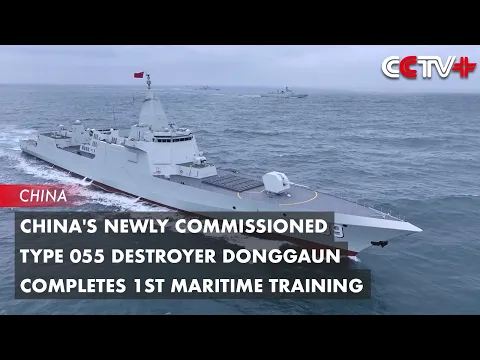
The Type 055 is described by Chinese and foreign outlets as a combatant of more than 10,000 tons, capable of carrying sensors and armaments on a scale superior to that of smaller destroyers in the Chinese navy.
According to military expert Wang Yunfei, interviewed by the Global Times, the larger displacement allows the design to operate more robust bow sonar and towed sonar systems than those used in vessels like the Type 052D and the Type 054A frigate.
The assessment is attributed to an analysis published by the state newspaper.
There is also another operational advantage pointed out in the same coverage.
The ship was built with two hangars for helicopters, while smaller Chinese platforms typically operate only one aircraft, which, according to analysts cited by the official press, expands the surveillance area and accelerates response in submarine search missions.
In practice, the combination of onboard sensors and anti-submarine helicopters is pointed out by experts as a factor that can enhance detection range and tactical employment flexibility.
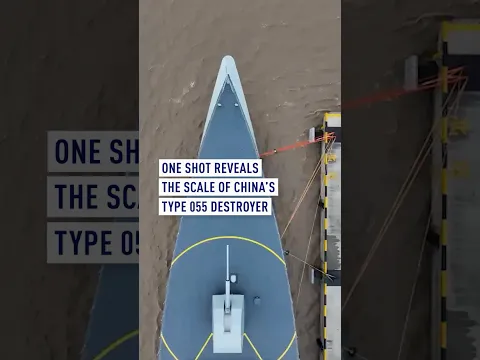

This argument appeared repeatedly in the coverage of the exercise.
According to state media, the Zunyi crew has been honing this capability with prior study of sea conditions and underwater terrain.
Sailor Xu Yi told CCTV that the team analyzed the underwater terrain and marine environment of certain areas before the exercise, taking into account the effects of these variables on acoustic propagation.
According to him, this preparation helps improve efficiency in locating submarines.
The statement was used by the report to illustrate the crew’s adaptation process to more complex maritime scenarios.
Integration of systems and crew training
Another point explored in the material released by China was the technological sophistication of the Type 055.
Yang Minghan, a crew member of the Zunyi, stated that the destroyer brings together new advanced systems, making both operation and the principles of onboard equipment more complex.
In one of the statements reproduced by the Global Times, he summarized the crew’s training logic by saying that, “By mastering every single detail with absolute clarity”, it would be possible to connect these elements into an integrated system and transform them into combat effectiveness.
The formulation was presented by state media as an example that operational gain does not depend only on the platform but also on the crew’s ability to integrate sensors, communications, data analysis, and coordinated response.
In another excerpt reproduced by Newsweek based on CCTV, the state television claims that the Type 055 represents an advance in the design of large Chinese destroyers by combining modern architecture, information systems, and modular construction, as well as high situational awareness.
Zunyi accumulates more than 200 days at sea
The Chinese press also linked the evolution of the Zunyi to the pace of the ship’s deployment.
According to the Global Times and the official military portal Chinamil, the destroyer spent more than 200 days on long-duration voyages within a year and covered over 50,000 nautical miles.
During the same period, according to these publications, the vessel participated in exercises with aircraft carrier groups, readiness patrols in the South China Sea, and realistic combat training in distant seas.
The sequence was presented as part of the ship’s operational maturation process.
Thus, the official coverage treated the anti-submarine exercise not as an isolated episode but as a step in a broader routine of missions.
According to published reports, this set of operations would have served to address challenges of integrated operation and transform new tactics into readiness practices.
At the heart of this movement is the South China Sea itself, where different countries maintain claims over islands, reefs, and maritime areas, while the military presence of regional and extra-regional powers remains high.
In this scenario, the disclosure of the Zunyi’s performance reinforces the message, according to the official Chinese narrative, that the Type 055 has been associated not only with the defense of large naval formations but also with the surveillance of maritime space and the confrontation of threats below the surface.









Seja o primeiro a reagir!