





 English
  Francês
  Alemão
  Italiano
  Japonês
  Norueguês
  Portuguese
  Spanish
  5 min of reading
  0 comments


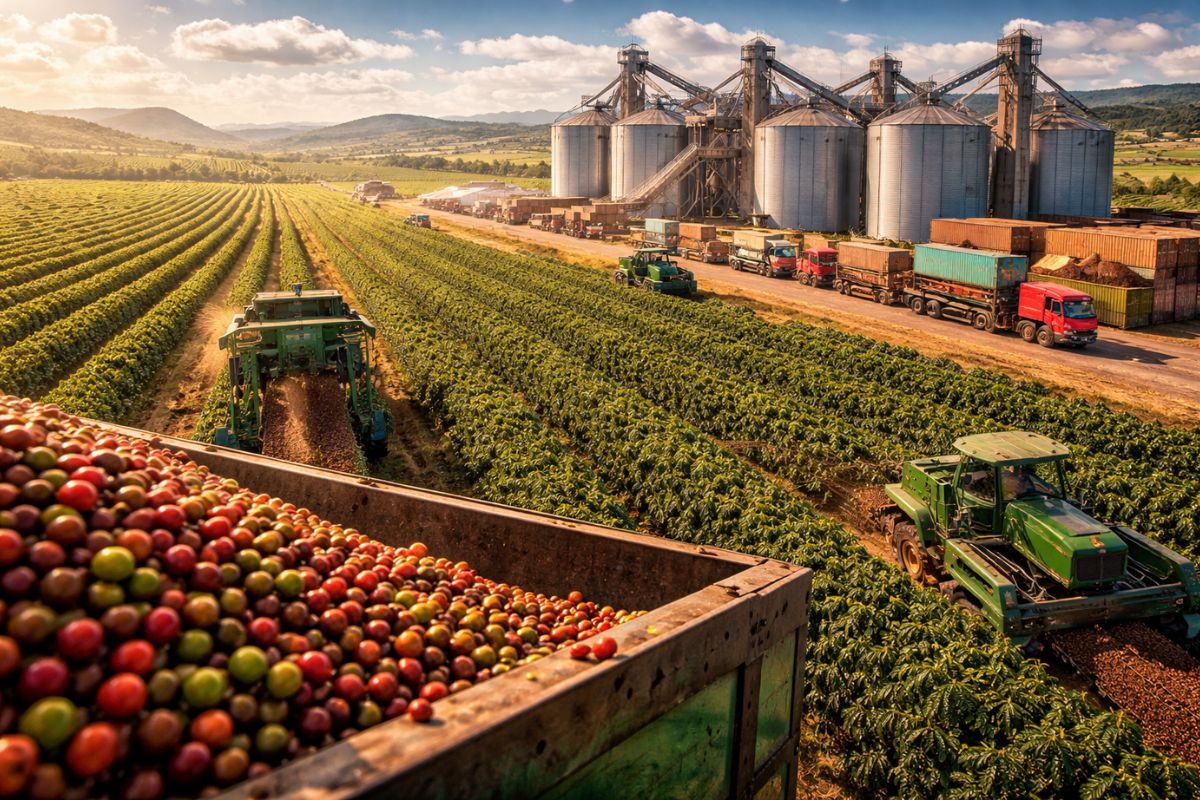
With giant farms, mining group accelerates coffee production with mechanization, drying silos, and industrial structure aimed at the global market
The giant farms of the mining group attract attention even in a country accustomed to large-scale crops. Together, the properties encompass more than 18 million coffee plants and support an operation that moves about 2.2 million sacks per year, between exports and the domestic market.
More than the size of the cultivated areas, what impresses is the way this empire has been structured. Heavy mechanization, drying in silos, industrial processing, and expansion strategy help explain how the group has consolidated itself among the biggest names in Brazilian coffee.
The size of the operation in the field
Brazil already occupies a prominent position in the global coffee market, but within this scenario, some operations manage to stand out.
-
Forgotten region becomes a powerhouse in the heart of Brazil, transforming unproductive lands into fortune and making MATOPIBA the new billion-dollar agricultural empire that almost no one saw being born.
-
With a 775 hp engine, the world’s largest axial combine harvester arrives in Brazil, promising to harvest more in less time with advanced automation and the capacity for platforms up to 61 feet.
-
China and Russia suspend fertilizer exports, prices soar, and Brazil is already at real risk of shortages in the fields.

-
Brazilian soybeans feel little impact from the surge in oil prices, and producers see part of their profits vanish due to higher freight costs, pressured expenses, and uncertainty in sales for the 2025/2026 harvest.
This is where the giant farms of the group come in, placing the company among the largest exporters in the country.
The volume sold annually shows the scale of the business. The group exports about 2 million sacks per year, and when adding the domestic market, it reaches approximately 2.2 million sacks. This level reveals a scale that goes far beyond traditional agricultural production.
Campo Verde concentrates one of the largest coffee structures

Among the group’s properties, Fazenda Campo Verde, in Campo do Meio, Minas Gerais, stands out as one of the most significant examples of this expansion.
The total area of the property is approximately 1,560 hectares, with about 920 hectares dedicated to coffee planting.
On this farm alone, there are more than 3 million coffee plants. The crops are primarily composed of the Mundo Novo and Catuaí varieties, which are well-known in Brazilian coffee cultivation.
The choice of these varieties helps to unite productivity, quality, and adaptation to the climate, reinforcing the role of giant farms in the group’s production strategy.
Heavy mechanization changed the logic of production
The advancement of giant farms did not happen solely through land purchases or increased planted areas. Mechanization played a decisive role in transforming the business. Since its founding in 2004, the group has adopted a highly mechanized production model.
Today, practically all stages utilize modern machines, from soil preparation to harvesting. The change became even more visible after the mechanization of harvesting, which began about 15 years ago.
Before that, the properties employed around 2,000 workers. With the introduction of harvesters, this number dropped to about 380 permanent employees and approximately 300 temporary workers during the harvest season.
The machines began to harvest large areas in less time, reduce costs, and increase operational efficiency, something essential to sustain the production pace of the giant farms.
Drying silos reinforce the post-harvest structure
Another important aspect of the group is in the drying stage. They acquired 11 large drying silos, each with a capacity of approximately 500,000 liters.
These pieces of equipment are essential after harvesting, when the coffee needs to lose moisture to be stored safely.
Without this care, the risk of compromising the quality of the beans increases. Therefore, the drying structure becomes as strategic as the crop itself, especially in operations that handle large volumes. In giant farms, post-harvest needs to match the same level of scale as production in the field.
Industrial structure enhances the strength of the group


The system does not end on the rural properties. The group also maintains a robust industrial structure aimed at processing and storing coffee.
In São João da Boa Vista, in the interior of São Paulo, there is a unit capable of reprocessing about 3,500 sacks per day and storing approximately 130,000 sacks.
In Poços de Caldas, Minas Gerais, the operation is even larger. The unit has the capacity to process about 18,000 sacks per day and store approximately 600,000 sacks.
This level of structure shows that the coffee empire does not rely solely on the crop, but on an integrated chain from the field to the final product preparation.
Technology separates, classifies, and standardizes the beans

Within these units, the reprocessing of coffee takes place, a stage that involves cleaning, classification, and preparation of the beans.
First, the coffee goes through cleaning machines. Then, the beans are separated by screens, density, and electronic selection by color.
These systems automatically identify and remove defective beans. The automated process ensures standardization and quality, something increasingly important in international trade.
When production moves from the giant farms to the industry, it enters a decisive stage to gain value and meet different markets.
Exports take Brazilian coffee to various continents

A large portion of the coffee processed by the group is sent abroad. Among the mentioned destinations are Italy, Germany, Spain, England, Japan, China, the United States, Russia, and countries in the Middle East.
Many buyers are large international roasters that use Brazilian coffee in well-known brands worldwide.
About 90% of the production is destined for commodity coffee, while the remaining 10% corresponds to specialty coffees.
This division shows how the operation works simultaneously with industrial scale and with higher value-added niches.
Expansion came with continuous reinvestment
According to João Faria da Silva, the group’s growth relied on a straightforward strategy: for many years, the money generated by the farms was not withdrawn from the operation but reinvested in purchasing new lands and expanding the crops.
As a result, the group accumulated properties in important regions of Brazilian coffee cultivation, such as Sul de Minas, Cerrado Mineiro, Mogiana Paulista, and Oeste da Bahia.
This movement helped spread the giant farms across areas with different climate, altitude, and soil characteristics, expanding production possibilities.
Certification and scale strengthen the model
In addition to scale, the properties follow certification standards related to sustainability, environmental preservation, input control, and working conditions.
These requirements are increasingly gaining weight in the international market and help sustain the competitiveness of Brazilian coffee.
In this context, the giant farms of the group demonstrate how size, mechanization, storage, processing, and long-term strategy can combine in a single operation.
The result is a production model that transforms extensive crops into a coffee empire with global reach.
Do you believe that the future of coffee in Brazil increasingly involves giant farms and heavy mechanization?









Seja o primeiro a reagir!