





 English
  Francês
  Alemão
  Italiano
  Japonês
  Norueguês
  Portuguese
  Spanish
  5 min of reading
  0 comments



Invisible support vessel sustains long missions, extends the range of Chinese aircraft carriers, and helps explain how Beijing transforms naval presence into operational permanence further from the coast, with logistics capable of keeping task forces in motion.
The expansion of China’s maritime reach relies less on ships that attract the spotlight and more on the means that allow them to operate for long periods.
In this context, the Type 901, a fast support class of the People’s Liberation Army Navy, has become one of the most relevant assets in the Chinese logistics chain.
Official reports from the United States indicate that the fleet operates two Fuyu-class ships, designed to support aircraft carriers and large amphibious ships, while Chinese military records show the Hulunhu in recent replenishment exercises at sea.
-
Archaeologists discover Roman vase buried for over 2,000 years with more than 175 intact gold and silver coins, revealing a desperate strategy to protect wealth during the collapse of the Empire.

-
“Discreet” city in the interior of SP stands out among the smartest in Brazil thanks to a national ranking.

-
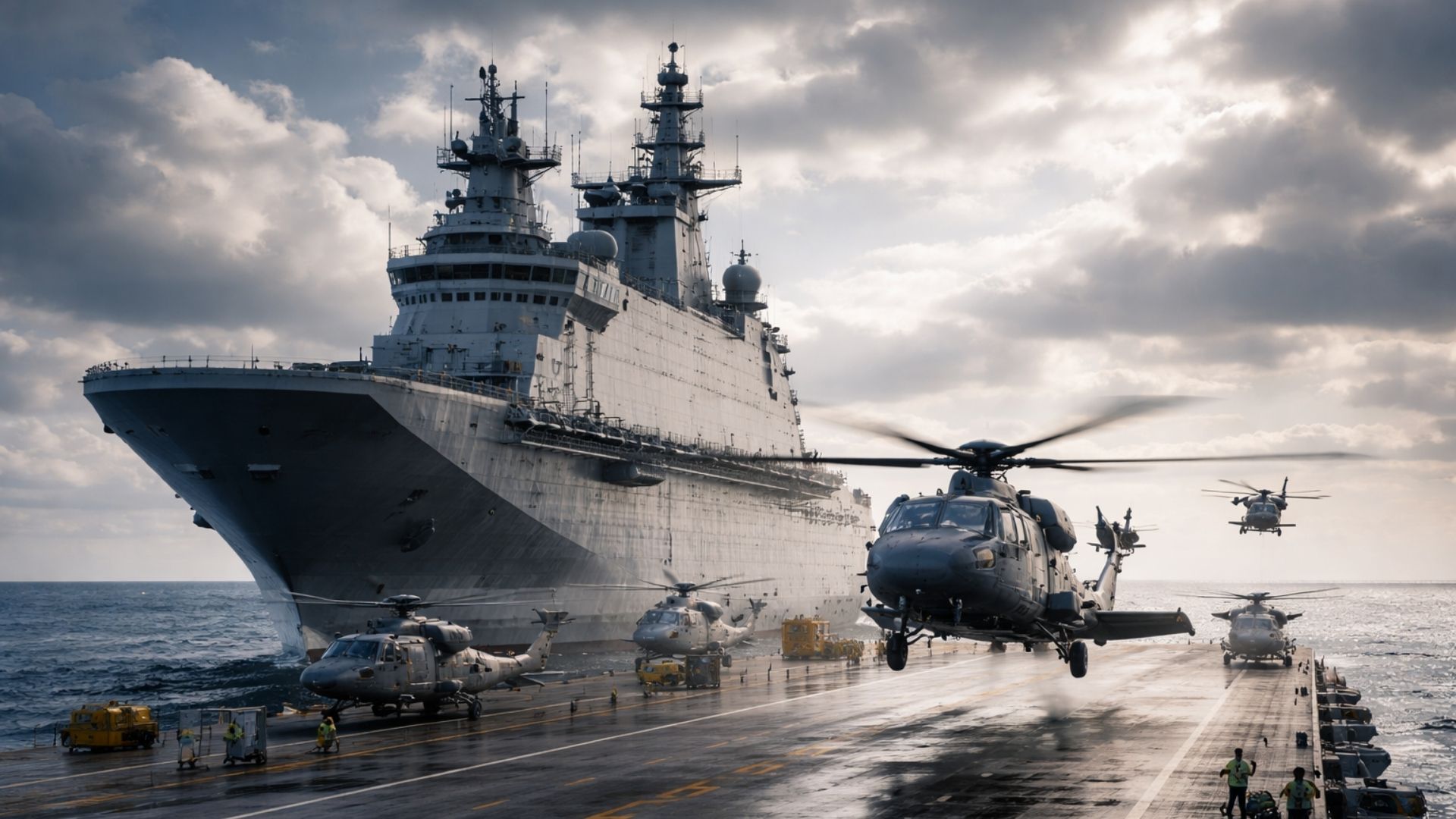
With 27,800 tons, 230.8 meters in length, and space for 18 helicopters, the Canberra class functions as a floating amphibious airbase and gives Australia the capability to operate at sea for more than 45 days.
-
The USA surprises the world by installing 21.9 km of sand fences, planting 195,000 native seedlings, and recreating 1,050 acres of beaches and dunes.


The central point is not in the armament or long-range sensors, but in the role this ship plays within a navy that seeks to sustain presence increasingly distant from the coast.
The aircraft carrier expands air coverage, displays the flag, and projects presence, but depends on a support system capable of delivering fuel, supplies, and cargo without interrupting the movement of the naval group.
It is precisely in this less visible layer that the Type 901 ceases to be a secondary auxiliary and becomes part of the operational core of the force.
Type 901: size and capacity to support aircraft carriers
The numbers help measure this ambition.
A study by the U.S.-China Economic and Security Review Commission, an official body of the U.S. Congress, describes the Type 901 as a platform much larger than the Type 903A, with 241 meters in length and an estimated displacement of 48,000 tons.
The same material informs that the class was specifically designed for replenishing aircraft carrier groups, which distinguishes it from auxiliary ships aimed at more general logistical tasks.
This leap in scale is not only evident in the hull.
In technical testimony presented to the American commission, the Type 901 emerges as a qualitative evolution of the Chinese auxiliary fleet by combining a large cargo volume, speed compatible with more intense formations, and an arrangement suitable for supporting complex task forces.
For a navy that seeks to operate beyond the so-called first island chain, sustaining capacity weighs as much as the number of available combatants.
The design choices reinforce this role.
The commission’s documentation records that the ship employs gas turbines, a solution associated with higher speed, and mentions a configuration of replenishment stations adjusted to the profile of Chinese aircraft carriers.
The same study notes that the class was designed with a special emphasis on fuel and supplies, a predictable requirement to accompany aircraft carriers and their embarked wings during prolonged missions.
Hulunhu in exercises and replenishment at sea
The utility of the Hulunhu has also been described by Chinese state media.
A report from the Global Times, based on images from CCTV, stated that the ship can perform lateral transfers, from the stern, and via air, including simultaneous movement of liquid and solid cargo for more than one ship.
In the same coverage, a crew member stated that the vessel can already replenish the main surface combatants of the fleet in challenging maritime conditions.
In practice, this set reduces the dependence on returning to port and extends the time spent at sea.
Instead of pulling a naval group out of the operational area to replenish fuel, supplies, and inputs, the support ship transfers this logistical burden to the ocean itself.
The result is less visible than the debut of a new missile or the incorporation of a destroyer, but it directly affects the tempo, distance, and duration of missions.
Public records from 2025 show that this function has already become operational routine.
In March, images released by People’s Daily Online, with material from China Military Online, showed the Hulunhu training with the destroyers Anshan, Huainan, and Chengdu during an exercise conducted in early February.
In May, another batch of images displayed the ship in tactical coordination with an embarked helicopter and replenishing from the stern with the destroyer Kaifeng.
Chinese aircraft carriers and the logistics that sustain long missions
The connection between the class and the aircraft carrier groups appears consistently in both Western analyses and Chinese communications.
The annual report from the U.S. Department of Defense states that the Chinese navy possesses a significant force of logistical support ships to sustain long and distant deployments, including two Fuyu specifically built to support operations with aircraft carriers and continuous amphibious ships.
In June 2025, the Xinhua agency reported that the formations of the Liaoning and Shandong aircraft carriers conducted training in the Western Pacific and other waters, focusing on testing protection capabilities in distant seas and joint combat.
Shortly after, at the end of the same month, the agency reported the safe return of both formations after completing combat training in distant waters.
The official Chinese communications about this cycle of exercises reinforced the logistical link of the operation.
The Ministry of Defense of China announced the simultaneous training of the two aircraft carriers in June 2025, while state media showed images of the support ship Chaganhu, also of the Type 901 class, replenishing the Shandong during the activities.
This data helps show that the class is not only associated with isolated demonstrations but is integrated into the operational model of Chinese naval groups.
China’s naval projection depends on logistical support
The strategic importance of this type of vessel grows as China expands the distance and duration of its missions.
The 2024 Pentagon report describes a navy in expansion, with increasing capacity to operate beyond the immediate surroundings of the country and sustain deployments in more distant areas.
In this scenario, the logistical link ceases to be accessory and begins to define the effective range of naval power.
There is, moreover, a contrast that explains why the Type 901 often receives less public attention than it deserves.
Missiles, radars, embarked fighters, and large destroyers translate power more easily into image and political discourse.
On the other hand, the support ship works to ensure that all these means continue to appear in the theater of operations, even when the base on land is far away.
Its relevance, therefore, does not lie in deciding a battle alone, but in allowing the fleet to remain available, supplied, and mobile.
When China seeks to consolidate a blue-water navy, the decisive question is no longer just how many combat ships it can launch to sea.
It becomes equally important how many of these means it can keep operating far from home, for how long, and with what regularity.
In this calculation, the Hulunhu and its sister ship fulfill a silent but central role: transforming occasional presence into operational permanence.





Seja o primeiro a reagir!