





 English
  Francês
  Alemão
  Italiano
  Japonês
  Norueguês
  Portuguese
  Spanish
  5 min of reading
  0 comments


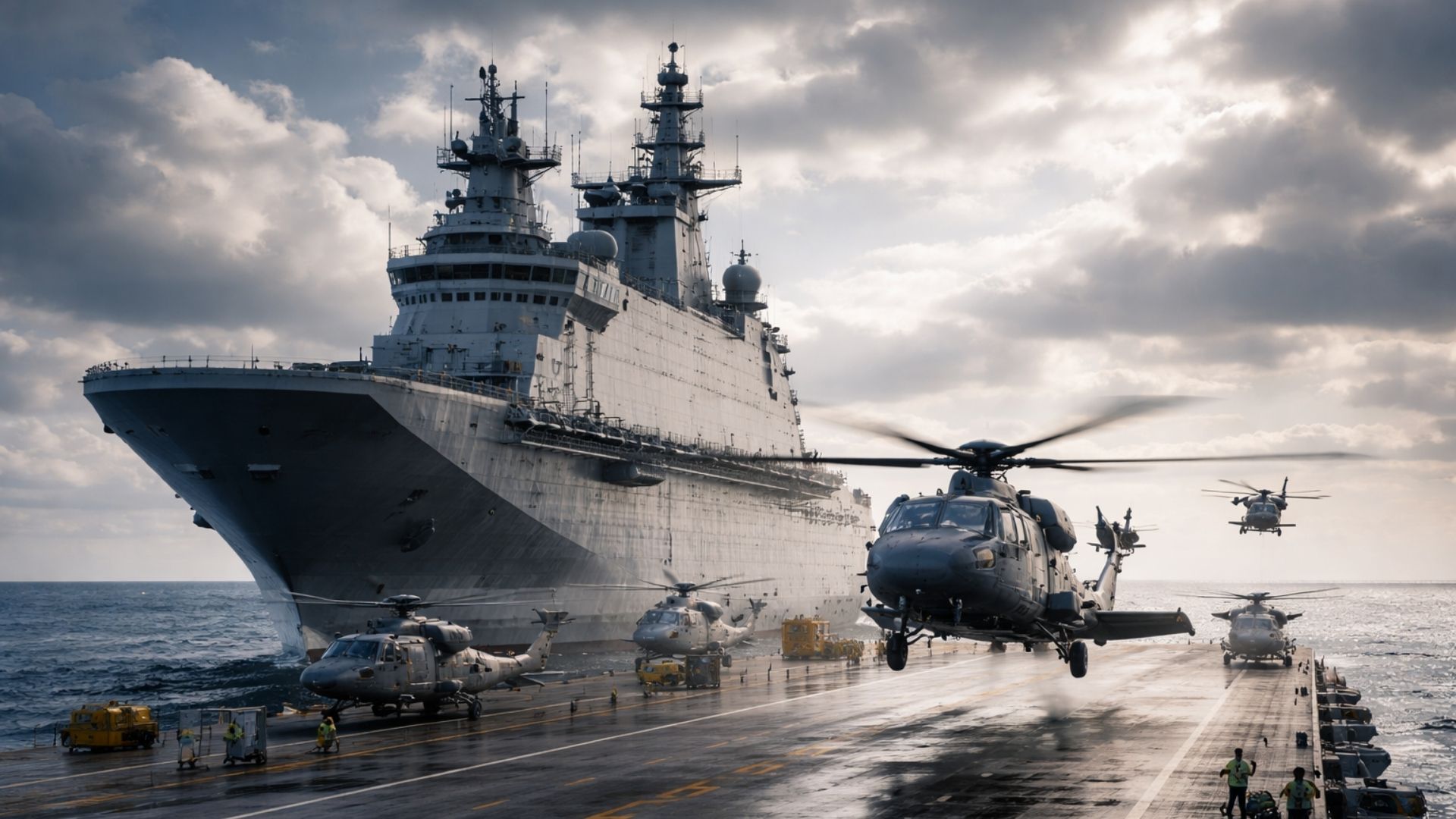
Canberra-class ships combine military projection, logistical support, hospital structure, and aerial operations on the same platform, expanding Australia’s capacity to operate in the Indo-Pacific with prolonged autonomy, rapid response to crises, and strategic presence in coastal and insular areas.
The incorporation of the Canberra class has redefined Australia’s ability to project force and provide logistical support in coastal regions by bringing together in a single platform aerial, maritime, and hospital resources capable of operating for extended periods without relying on land infrastructure.
Official data from the Royal Australian Navy indicates that the HMAS Canberra, the first ship of the class, displaces 27,800 tons and is 230.8 meters long, with the capacity to embark up to 1,046 military personnel, transport 110 vehicles, and accommodate up to 12 Abrams tanks, in addition to operating multiple aircraft simultaneously.
Although often compared to helicopter carriers, the ships are classified by the Australian Navy itself as Landing Helicopter Docks, a category that combines a flight deck for aerial operations with a floodable well designed for launching landing craft.
-
Archaeologists discover Roman vase buried for over 2,000 years with more than 175 intact gold and silver coins, revealing a desperate strategy to protect wealth during the collapse of the Empire.

-
With 241 meters, 48 thousand tons, and a structure designed to accompany aircraft carriers at sea, the Chinese ship that refuels fleets in motion was born to push Beijing away from the coast and has become the hidden gear of its naval projection.
-
“Discreet” city in the interior of SP stands out among the smartest in Brazil thanks to a national ranking.

-
The USA surprises the world by installing 21.9 km of sand fences, planting 195,000 native seedlings, and recreating 1,050 acres of beaches and dunes.


This design allows the vessel to operate multifunctionally, serving simultaneously as a airbase, logistics center, command platform, and amphibious projection means, connecting the maritime environment directly to the coast through different operational vectors.
Canberra class design and strategic reach
The origin of the design dates back to the Spanish model Buque de Proyección Estratégica, developed by Navantia, which served as the basis for the construction of the largest ships ever incorporated by the Royal Australian Navy, according to records from the Sea Power Centre.
Official information indicates that the operational range reaches about 9,250 nautical miles at economical speed, while the autonomy exceeds 45 days, allowing the vessel to remain in prolonged operation in areas far from Australian territory.
This factor significantly expands the country’s operational radius in the Indo-Pacific, a region marked by great distances, chains of islands, and logistical challenges that require platforms with high sea sustainment capacity.
Flight deck and capacity for 18 helicopters
The flight deck is one of the central elements of the Canberra class, measuring approximately 202.3 meters long and 32 meters wide, totaling an area of about 4,750 square meters dedicated to aerial operations.
The Royal Australian Navy reports that the space accommodates six simultaneous points for medium helicopters on the port side, in addition to two elevators that connect the deck to the hangar, allowing continuous flow of aircraft between operational areas.
Inside the ship, the hangar occupies approximately 990 square meters, while areas designated for light vehicles can be adapted to increase aerial capacity, enabling the transport of up to 18 helicopters depending on the mission configuration.
This flexibility allows for quick adjustments to the ship’s profile between military, logistical, or humanitarian operations, according to the operational needs established by naval command.
Amphibious operations and disembarkation from sea to coast
Another relevant differentiator is the ability to conduct amphibious operations quickly and in volume, integrating aerial and maritime means to transport troops, vehicles, and supplies directly from the sea to the coast.
Each unit can operate up to four LCM-1E type landing craft, enabling the simultaneous movement of military forces and heavy equipment, including armored vehicles and essential logistical supplies for land operations.
The Sea Power Centre highlights that the design was conceived for operation in complex coastal environments, where limited or non-existent ports require ships capable of operating with relatively shallow drafts and great access versatility.
The hull structure and the monohull steel design contribute to this capability, allowing maneuvers in shallower coastal areas and expanding employment options in insular regions of the Indo-Pacific.
Floating hospital and disaster response
In addition to its military function, the Canberra class is considered a strategic asset in humanitarian aid missions and disaster response due to its onboard medical infrastructure and capacity to transport large volumes of supplies.
The Australian Navy reports that the ships are equipped with two operating rooms, an intensive care unit with eight beds, and complete facilities for radiology, pathology, pharmacy, and dental care, configuring a floating hospital.
This set allows for operations in humanitarian crisis scenarios, providing medical care, logistical support, and transportation of specialized teams to areas affected by natural disasters or regional emergencies.
HMAS Canberra in Operation Tonga Assist
The practical use of these capabilities was evidenced during Operation Tonga Assist, conducted after the underwater volcanic eruption and tsunami that hit Tonga, according to information from the Department of Defence of Australia.
On that occasion, the HMAS Canberra transported over 417 tons of supplies, including food, recovery equipment, vaccines, and medical teams, in addition to supporting the movement of people between islands and reconnaissance of affected areas.
The operation demonstrated the ship’s capacity to act as a large-scale logistics and humanitarian center, integrating transportation, medical care, and coordination of efforts in a single naval vector.
Role of the Canberra class in Australian naval strategy
The importance of the Canberra class is also reflected in military exercises and Australia’s operational doctrine, which uses these ships to train the projection of power from sea to land in complex scenarios.
In activities reported by the Department of Defence, forces composed of soldiers, sailors, and aviators conduct combined operations involving disembarkation by vessels, aerial insertions, and integrated logistical coordination.
Reports from the Australian National Audit Office indicate that the ships HMAS Canberra and HMAS Adelaide, incorporated in 2014 and 2015, respectively, are considered central assets of the country’s amphibious capability, with an expected operational life until the mid-2050s.
These vessels concentrate functions ranging from amphibious warfare to humanitarian assistance, consolidating a model of multifunctional ship adapted to Australia’s strategic demands in its regional environment.






Seja o primeiro a reagir!