





 Portuguese
  English
  Spanish
  6 min of reading
  0 comments


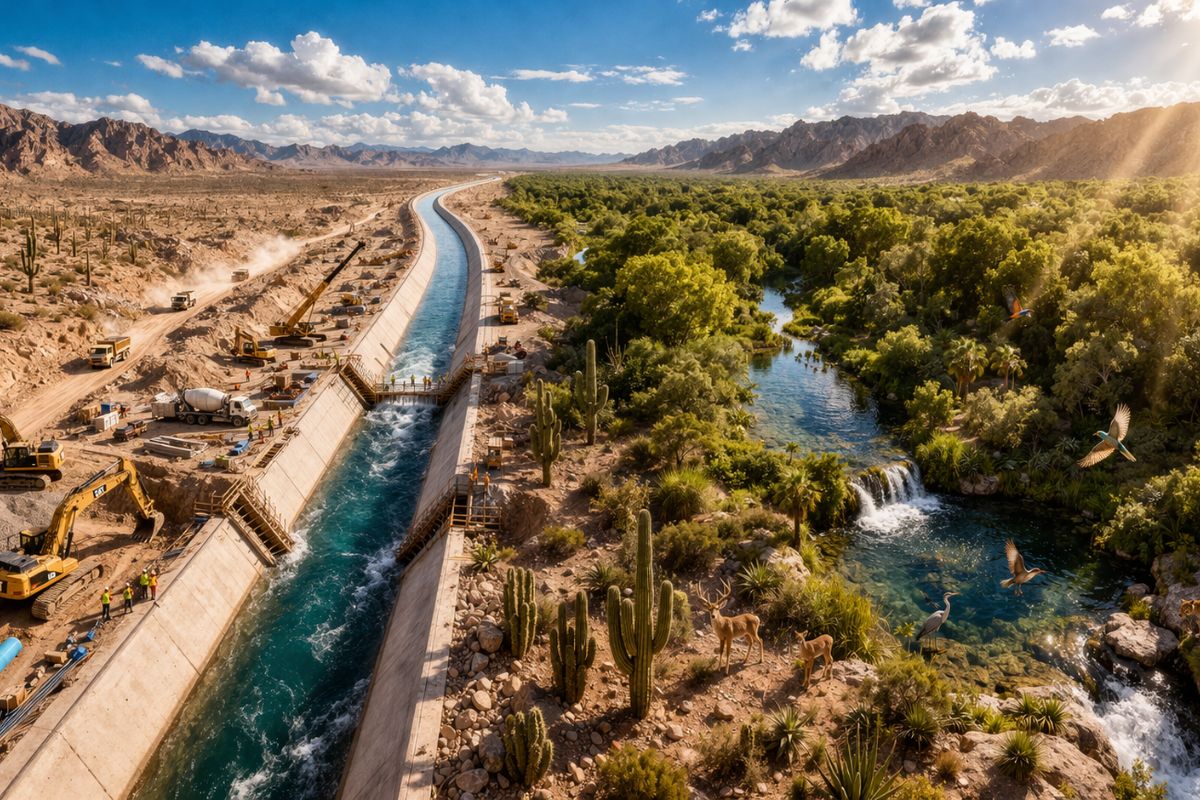
Water guides the Mega Sual in the Chihuahua desert, where water capture advances with the work and supports the plan to create a forest in the desert.
The proposal is not just to dig ditches in the land. The project aims to change how water moves, infiltrates, and remains in the soil, creating conditions to support trees, grasses, and a more resilient vegetation cover in a region marked by drought.
The idea is to use the property’s topography to capture, direct, and infiltrate water into the soil, expanding the drainage area from 5 to 11 acres. In practice, this transforms the landscape into a structure designed to hold a scarce resource and distribute this moisture over time.
The Mega Sual advances through the desert on an unusual scale
The Mega Sual already reaches 1,200 feet in length and crosses a wide part of the property. When presenting the current stage of the work, the project leader emphasizes that the 95% does not mean completion, but rather the extent of the effort required to build something of this magnitude in such a harsh environment.
-
New CCR concrete paving technology promises roads up to 3x more durable, less maintenance, and cost reduction in Brazil.

-
Made from recycled plastic, plastic wood is gaining space in the construction industry because it does not rot, resists moisture, and reduces maintenance costs over the years.

-
Florianópolis will receive a million-dollar BRT that will begin construction in 2026 with nearly 400 million in funding from the federal government and the Inter-American Development Bank, and the map already shows the routes for the exclusive bus corridors.

-
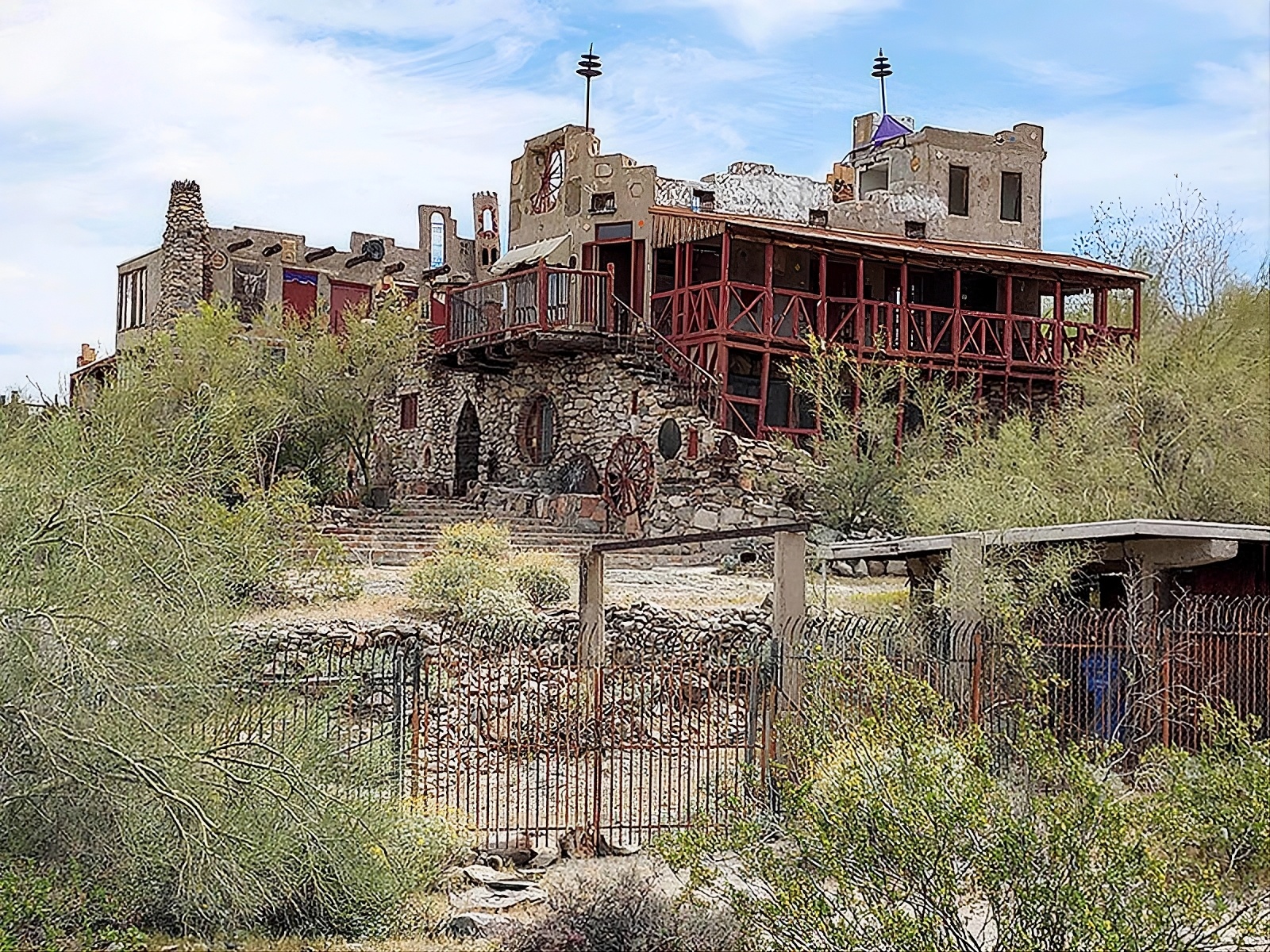
Without a blueprint, without an engineer, and using scrap from the dump, a father spends 15 years building an 18-room castle for his daughter, featuring tram tracks, 13 fireplaces, and over 700 m², which may now be demolished.
The visit to the site also serves to show how the system was designed. The ditches were marked to receive the flow coming from the top of the hill and direct the water in a zigzag pattern, favoring infiltration into the soil. The logic is simple in theory, but enormous in execution.
When the set is ready, the combined sections should reach almost a mile. This helps explain why the project attracts attention even from those observing from the road.
How the water capture is expected to double on the property
One of the most important points of the work is the expansion of the capture area. The plan is to increase from 5 to 11 acres, which completely changes the volume of water available within the property.
According to the presented calculation, this could increase the annual capture from 500,000 gallons to over 1 million. This is not just about storing water, but about preventing it from being lost to another watershed.
The strategy is to take advantage of the natural shape of the terrain. Instead of letting the runoff escape, the project creates infiltration ditches that divert and distribute this flow to a safe point, where the water can be absorbed with less risk of erosion.
Engineering and logistics become a constant challenge
The work requires continuous adjustments. In several sections, the problem is not just digging, but controlling the speed of the water and preventing it from destroying what has already been done.
Therefore, some areas need to be elevated, reinforced with large stones, and prepared to function as spillways.
The plan includes clearing paths with the tractor, transporting stones with a trailer, and setting up dissipation fields to slow down the force of the runoff. Without this care, the water that should regenerate the soil could simply erode everything.
The scale of the project also pressures logistics. There are stones too heavy for the tractor’s capacity, sections that need to be widened, and critical points where multiple runoffs converge. This forces the work to combine earthmoving, terrain reading, and practical adaptation.
The design of the land was conceived to infiltrate water and protect trees
The shape of the Mega Sual is not random. In one of the final sections, the structure is described as a design that goes down and then up, precisely to allow planting in more favorable positions.
The concern is to prevent desert trees from having their crowns and roots in waterlogged soil. The water needs to remain available, but without turning the ditch into a point of permanent saturation.
Alongside these areas, the proposal includes planting grasses capable of generating biomass, keeping the soil covered, and resisting drought.
Among them are the giant sacaton and the alkaline sacaton, chosen to compose the vegetation cover and keep the space functional even for the passage of machinery.
Moist soil after months without rain reinforces the project’s potential
One of the most relevant signs appeared in the soil. Even without significant rain for about three months, there was still moist soil in parts of the system.
This was interpreted as proof that the sual can already retain water and store moisture for a longer time.
This point is crucial because the real reservoir is not just on the surface. The water stored in the soil is what can sustain trees and grasses when the rain disappears.
According to the report, half a million gallons of water were stored throughout the year. This reserve should allow the establishment of more productive species, including trees that would normally require heavy irrigation to grow in that environment.
The ultimate goal is to create a forest in the desert
The project does not hide its ambition. The stated goal is to build a forest in the desert using the landscape to aid in the retention of water.
To achieve this, the plan includes drought-adapted trees, such as palo verde and mesquite, as well as other species that can benefit from the accumulated moisture.
The logic is that by increasing the water availability in the soil, the location will no longer depend on irrigation spread throughout the area. Instead of throwing water everywhere, the system tries to make the land itself work as a reservoir.
This is the point that transforms the work into something greater than an engineering intervention. The Mega Sual begins to function as regeneration infrastructure, connecting topography, infiltration, vegetation cover, and long-term planning.
The final 5% still require machinery, maintenance, and precision
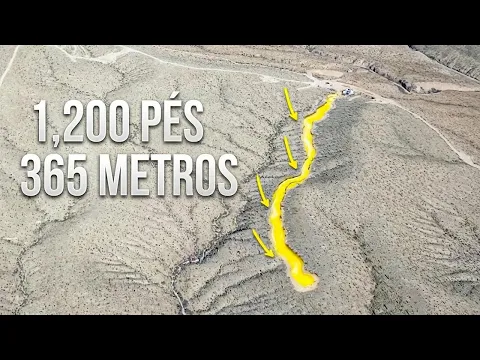

Even with 95% completed, the final section shows why the work cannot yet be considered finished.
The tractor, an essential piece for construction, has entered a phase of heavy maintenance, with replacement of chassis parts, chain, gears, and other components.
The expectation is to put the machine back into operation to finalize the last adjustments, install the track pads, and complete what is left on the land.
In a project of this scale, finishing is not just about digging the last part, but ensuring that everything continues to function.
Therefore, the 95% holds real weight. They show that the Mega Sual is already practically formed, but still depends on structural finishing, fine corrections, and operational capacity to enter its full phase.
What this work already proves in the Chihuahua desert
The Mega Sual has not yet reached 100%, but it already demonstrates a concrete change in the relationship between terrain, drainage, and retention of water in the Chihuahua desert.
The expansion of capture, the presence of moist soil months after the rain, and the planting planning indicate that the project has already moved beyond the realm of ideas.
More than a giant ditch, the structure has become the foundation of a real attempt to build a forest in the desert. And this explains why the work attracts so much attention even before it is officially completed.
Do you believe that projects like this can really transform dry areas by making better use of the water from the land itself?








Seja o primeiro a reagir!