





 Portuguese
  English
  Spanish
  6 min of reading
  1 comment


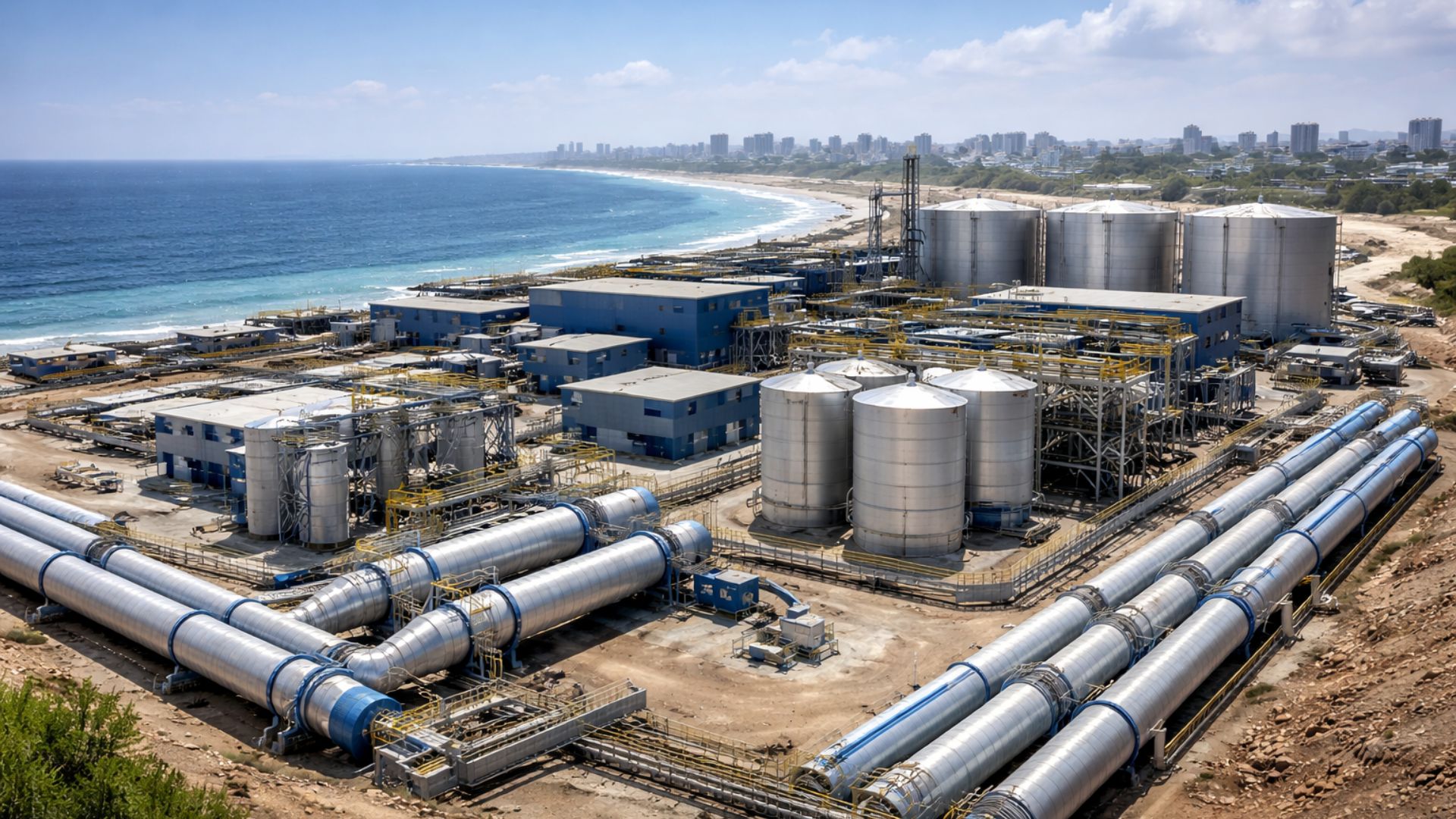


Installed on the Coast of Tamil Nadu, New Desalination Plant Integrates Chennai’s Strategy to Expand Supply Sources, Reduce Dependence on Reservoirs, and Face Climate Variations in One of India’s Largest Metropolises.
The Indian city of Chennai, the capital of Tamil Nadu, is installing a new reverse osmosis desalination plant with a capacity to produce 400 million liters of potable water per day from the sea.
This initiative is part of a set of measures adopted to increase water supply in a context of population growth, climate variation, and pressure on reservoirs and aquifers.
Perur 400 MLD Project and Strategic Location
The project is officially identified as the Perur 400 MLD SWRO Desalination Plant and is being installed in the Perur area, along the East Coast Road, in a coastal area south of the city.
-
Motorola launched the Signature with a gold seal from DxOMark, tying with the iPhone 17 Pro in camera performance, Snapdragon 8 Gen 5 that surpassed 3 million in benchmarks, and a zoom that impresses even at night.

-
Satellites reveal beneath the Sahara a giant river buried for thousands of kilometers: study shows that the largest hot desert on the planet was once traversed by a river system comparable to the largest on Earth.

-
Scientists have captured something never seen in space: newly born stars are creating gigantic rings of light a thousand times larger than the distance between the Earth and the Sun, and this changes everything we knew about stellar birth.

-
Geologists find traces of a continent that disappeared 155 million years ago after separating from Australia and reveal that it did not sink, but broke into fragments scattered across Southeast Asia.

The project includes, in addition to the desalination unit, pumping systems, reservoirs, and pipelines, responsible for integrating the new source into the urban supply network.
Water Management and the Role of Metrowater

The execution is in charge of the Chennai Metropolitan Water Supply and Sewerage Board, the agency responsible for water and sewage services in the metropolitan area.
The initiative is part of the local strategy of diversifying supply sources, in a scenario marked by a strong dependence on the monsoon regime and significant fluctuations in the volume of water available throughout the year.
International Financing and Japanese Cooperation
According to information released by the Japan International Cooperation Agency, the project is financed through a structured loan for official development assistance.
The agreement includes not only the construction of the plant but also the expansion of transmission infrastructure and technical support actions related to system management.
In public material accompanying the financing, the Japanese agency states that the daily water demand in Chennai exceeds 1.4 billion liters, while the effectively supplied volume shows variations that result in deficits, especially during drought periods.
According to the document, this imbalance affects both domestic supply and economic activities in the region.
Associated Infrastructure and Project Scope
The financed project includes the implementation of the desalination plant with a capacity of 400 million liters per day, as well as the construction of pumping stations, reservoirs, and transmission networks.
Technical consulting services are also planned to monitor the works, support initial operations, and implement institutional actions focused on water resource management.

Limitations of Traditional Water Sources
The choice of desalination is related to the geographical location of the city, facing the Bay of Bengal, and the structural limitations of traditional water sources.
Local supply has historically depended on surface reservoirs, extractions from distant basins, and groundwater extraction, all subject to seasonal variations and operational restrictions.
History of Desalination in Chennai
The new Perur plant adds to other desalination units already existing in Chennai that have been operating for over a decade.
Even with these installations, the city continues to face challenges in the regular supply of water, which keeps the use of water trucks and emergency solutions in parts of the metropolitan area.
Reports from the Indian press noted that the Minjur plant, with a capacity of 100 million liters per day, remained out of operation for prolonged periods due to contractual and maintenance issues.
Meanwhile, the Nemmeli plant, with an estimated capacity of 150 million liters daily, has shown limitations in evenly serving rapidly expanding urban areas, such as the Old Mahabalipuram Road corridor.
Structural Reinforcement of Urban Supply
In this context, the Perur unit was designed as a structural reinforcement of the system, aiming to significantly increase the supply of desalinated water and reduce pressure on other sources.
The institutional expectation is that the produced volume will help to meet supply for neighborhoods in the southern part of the city and newly incorporated administrative regions into urban growth.
Progress of the Works and Timeline

Updates reported throughout 2025 by local outlets indicated significant progress in the civil and marine works of the project.
The same publications suggest that the delivery timeline is associated with completion targets between 2026 and 2027, depending on the stage of each component of the infrastructure.
The estimated total cost is billion rupees, with participation from external financing.
Reverse Osmosis Technology
In the technical design, the plant adopts the seawater reverse osmosis process, technology widely used in large desalination plants.
The system transforms saltwater into potable water by applying high pressure on semi-permeable membranes, capable of retaining dissolved salts and other impurities.
Marine Intake and Pre-treatment
The operation begins with marine intake, carried out through large-diameter pipes that channel seawater to the industrial area.
Then, the liquid undergoes pre-treatment stages aimed at removing sediments, organic matter, and particles that could compromise the performance of the membranes.
Production of Potable Water and Brine
After this stage, high-power pumps increase the water pressure and direct it to the reverse osmosis modules.
At this stage, separation occurs between the permeate, which corresponds to desalinated water, and the saline concentrate, known as brine.
The produced water then undergoes physical-chemical adjustments, mineral conditioning, and disinfection, before being directed to reservoirs and integrated into the urban distribution network.
As part of the process, the generated brine is returned to the sea through discharge structures designed to meet environmental parameters established by the competent authorities.
Marine Works and Piping

A recent announcement from a company involved in the execution of the works reported the completion of relevant stages of the marine structures, including the installation of intake and discharge pipelines.
According to the announcement, two intake lines and one discharge line were installed, each approximately 2,500 millimeters in diameter, as well as an intake section extending over a kilometer.
Distribution and Operational Bottlenecks
In addition to the industrial unit, the project includes the construction of a transmission network responsible for transporting the produced water to the consumption centers.
This system involves pumping stations, intermediate reservoirs, and long stretches of pipelines, essential components to ensure the desalinated volume effectively reaches the served neighborhoods.
Local authorities and institutional documents indicate that the expansion of desalination aims to reduce the vulnerability of supply during periods of low reservoir recharge and intensive aquifer exploitation.
The strategy also aims to create a source less dependent on climatic variability, given that the raw material for the process is the ocean.
Operational and Maintenance Challenges
Despite the expansion of installed capacity, previous experiences in Chennai indicate that the availability of desalinated water does not eliminate challenges related to distribution, maintenance, and continuous operation of the units.
Issues such as operation contracts, membrane replacement, and stable power supply remain determining factors for the system’s operation.
Desalination as Permanent Infrastructure
By incorporating a plant with 400 million liters per day as a permanent part of urban infrastructure, Chennai formalizes desalination as a structural element of its supply model.
In a metropolis where demand is constantly growing and traditional sources present limitations, the expansion of this type of solution becomes central in water planning.
Facing a scenario where the city simultaneously invests in the expansion of desalination and confronts historical challenges of distribution and system maintenance, what kind of measure is likely to have the greatest impact on the daily supply to the population: constructing new megastructures or modernizing and efficiently managing existing networks?







Sempre falei isso,se a tendência do mar é encher e a água potável acabar porque não usar está água pra consumo e manter o nível do mar ,já que as geleiras todos os dias estão caindo com riscos de cidades até desaparecerem.