





 Portuguese
  English
  Spanish
  3 min of reading
  0 comments


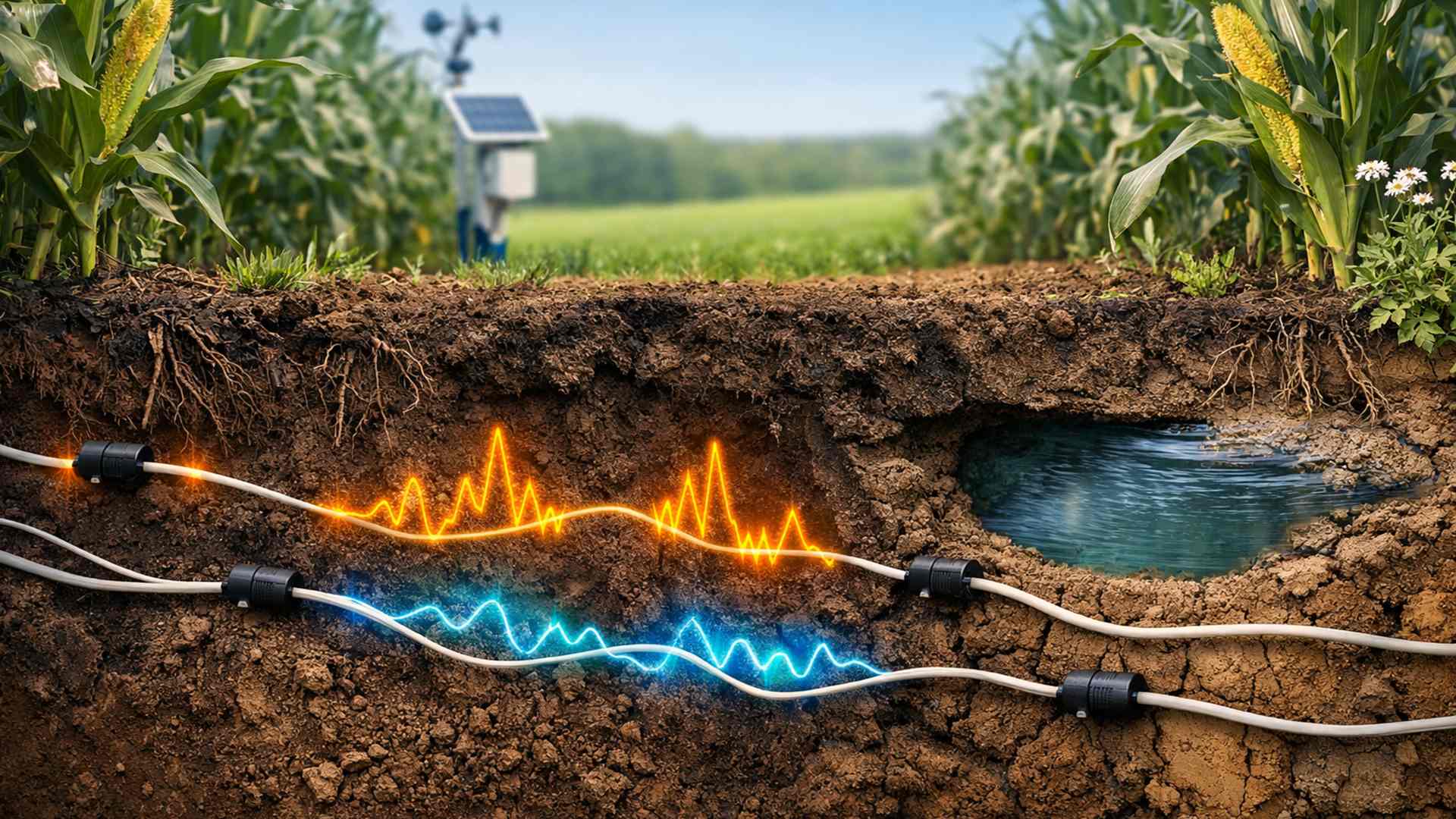
Study conducted on an experimental farm in the United Kingdom used optical fiber sensors to monitor the movement of water in the subsoil and concluded that intensive agricultural practices can reduce deep infiltration, increase surface evaporation, and compromise crop resistance to extreme weather events
An innovative research led by Dr. Shi Qibin from the Institute of Geology and Geophysics of the Chinese Academy of Sciences revealed how conventional agricultural practices compromise the natural structure of the soil. The international study used fiber sensors to monitor the movement of water in the subsoil and identify the damage caused by the use of heavy machinery and the deep plowing process.
The results indicate that these activities disrupt essential systems of pores and microscopic channels that function as the “internal plumbing” of the land.
Fiber sensor monitoring in agriculture
The team of researchers implemented an advanced technological technique to observe subsoil processes without the need for physical excavations.
-
They said no to 26 million dollars and would do it all over again: mother and daughter from Kentucky reject a million-dollar offer from a mysterious company that wants to build the largest data center in the state on more than 2,000 acres of rural land.

-
While corn requires rain and is expensive, sorghum produces almost the same volume per hectare at a cost up to 80% lower and uses less water, and it is revolutionizing dairy farming in the Triângulo Mineiro, where producers save hundreds of reais per hectare.
-
A rural producer from Urubici cries as he shows 50 tons of plums thrown on the ground because no one wanted to buy them, and in desperation, he records a video asking anyone to come to the property to pick the fruits before they rot.
-
Unable to pass through Hormuz, Brazil activated a plan B that uses Turkey as a gateway to the Middle East: the route through Gibraltar and the Mediterranean is longer and more expensive but ensures that chicken, beef, and corn continue to reach Arab markets.


By converting standard optical fiber cables into a large-scale sensor matrix, installed on an experimental farm at Harper Adams University in the United Kingdom, it was possible to capture accurate data about the underground environment. This system allowed for the detection of tiny vibrations generated by water flow in real-time.
The use of fiber sensors enabled minute-by-minute tracking of water movement through soil layers. This approach gave rise to the field of agrosismology, which assesses the health of water systems without disturbing the integrity of the land.
The technology demonstrated that healthy soils act as natural sponges, while areas subjected to intense mechanical interventions lose this capacity for absorption and storage.
Impacts of mechanization on water infiltration
The high-resolution data obtained from the study showed that rainwater tends to accumulate near the surface in soils undergoing intensive cultivation.
Due to this superficial location, the liquid evaporates quickly under sunlight, leaving the deeper layers of soil dry and inaccessible for crops.
In contrast, undisturbed lands function as efficient filters that transport moisture to deep zones, where roots can utilize it during dry periods.
Frequent plowing and heavy tractor traffic reorganize soil particles and break the mechanical bonds that allow respiration and water circulation. According to Dr. Shi Qibin, soil should be understood as a porous medium that operates with capillaries within the water cycle, and not just as a collection of particles.
The disruption of this system drastically reduces the resilience of crops in both flooding and severe drought scenarios.
Capillary modeling and ecological resilience
To support the observations, scientists developed a dynamic model of capillary tension based on the so-called “ink bottle effect.”
This concept explains that water enters soil pores easily but finds greater difficulty in exiting, depending on the capillary forces at play. The model reveals that soil resistance varies as it dries or moistens, presenting a complexity superior to traditional soil mechanics.
The preservation of natural soil structures is pointed out by researchers as a determining factor for adapting agriculture to extreme climatic conditions.
The diagnosis of agricultural conditions in real-time allows farmers to develop more sustainable strategies for food production. Maintaining ecological stability depends on interrupting the cycle of excessive compaction and tillage that compromises the vital functioning of the terrestrial ecosystem.
This article was based on a study from the Institute of Geology and Geophysics of the Chinese Academy of Sciences.










Seja o primeiro a reagir!