





 Portuguese
  English
  Spanish
  6 min of reading
  0 comments


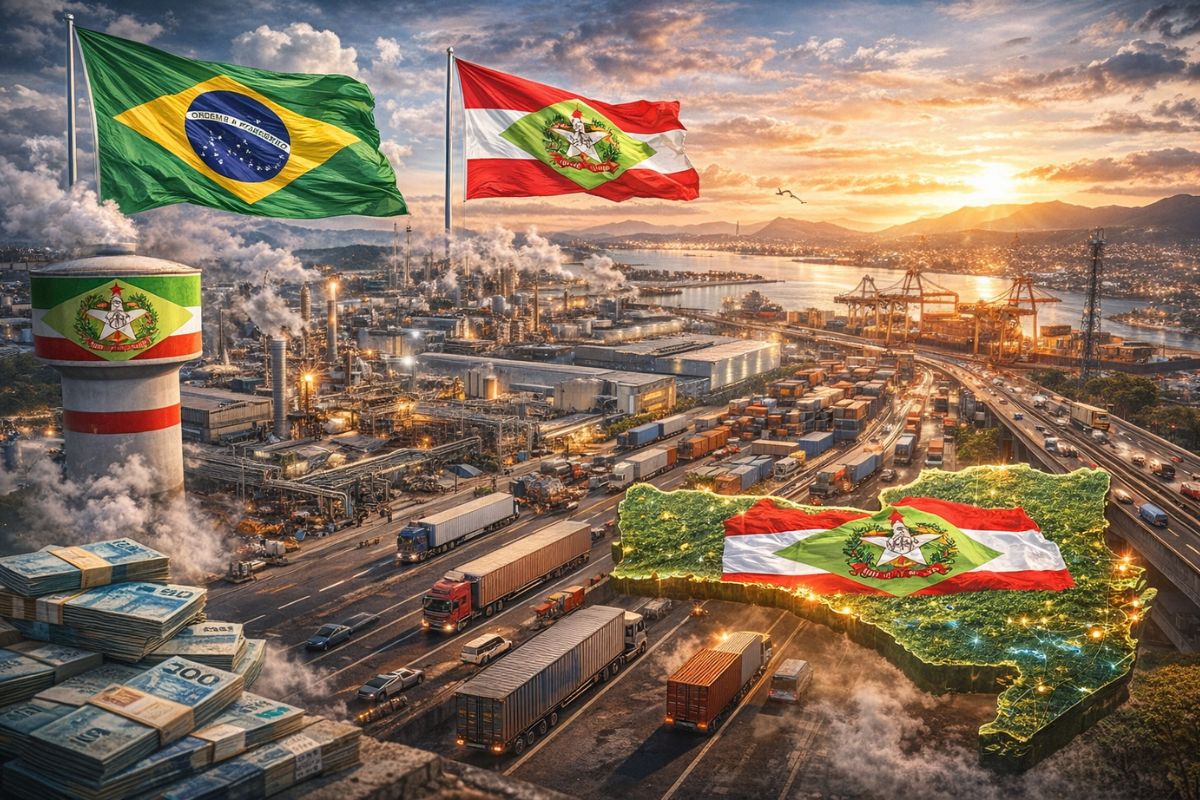
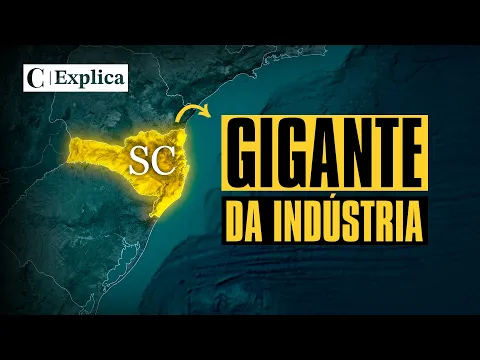
Santa Catarina occupies just over 1% of the national territory, but its industrialization generated 64 thousand companies and nearly 937 thousand jobs in the sector. The industry in Santa Catarina grew by 5.3% in 12 months, well above the national average, and accounts for about 4.7% of all Brazilian manufactured exports.
Santa Catarina built, over more than a century, one of the most diversified and competitive industrial parks in Brazil, and it did so by following a completely different path from the national model. While Brazilian industrialization historically concentrated on the Rio-São Paulo axis, with large state projects and strong dependence on public and foreign capital, the state of Santa Catarina built its productive base from small family workshops, European immigration, and decentralized technical expertise.
The most recent numbers confirm the result of this trajectory. Santa Catarina’s industrial production grew by 5.3% in 12 months, at a time when much of the national industry is practically stagnant. The state is home to more than 64 thousand industrial companies, generates nearly 937 thousand jobs in the sector, and exported about 6.6 billion dollars in industrialized products in 2025. More than half of everything that Santa Catarina exports is already industrialized products, not raw materials.
The legacy of immigrants that planted the industrial seed

image: Marcelo Martins
The history of the industry in Santa Catarina begins between 1860 and 1880, with the arrival of large contingents of German, Italian, and Austrian immigrants, mainly in the Itajaí Valley and in the northern part of the state.
-
Brazil has just secured a secret route through Turkey to save agribusiness exports that were threatened by the closure of the Strait of Hormuz amid violent clashes in the Middle East.
-
JBS, founded by the Batista brothers, continues to conquer the world: the entrepreneurs built a ‘factory in the desert’ with 3,000 jobs.
-
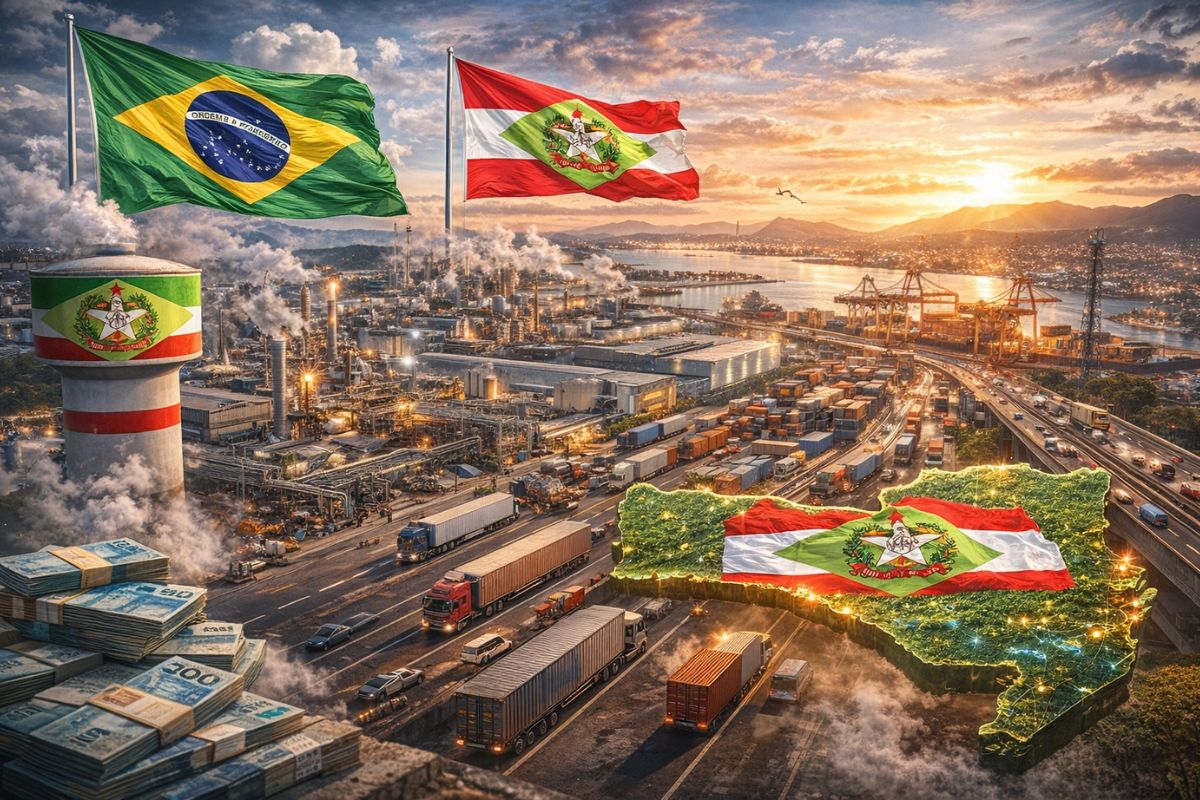
With only 1% of Brazilian territory, Santa Catarina has built one of the most competitive industrial parks in the country with 64,000 companies, nearly 1 million jobs, and a growth of 5.3% while the national industry is practically stagnant.
-
China banned the export of 22 tons of meat from Argentina.

These immigrants received small properties and brought with them technical skills related to weaving, carpentry, metallurgy, and basic mechanics, creating early on a productive structure that did not depend on large capital or the central government.
This technical legacy generated an organic and decentralized model of industrialization, based on family workshops, artisanal production, and continuous reinvestment.
Unlike what happened in the rest of the country, Santa Catarina did not wait for a state plan to industrialize the industry was born from the ground up, driven by communities that knew how to make things and needed to produce to survive.
The textile industry of the Itajaí Valley that became a national reference

The first industrial sector to structure itself consistently in Santa Catarina was the textile sector, starting in the 1880s. Companies like Hering, Karsten, and Döhler emerged during this period in cities like Blumenau and Brusque, initially producing basic fabrics and household items for the regional market.
Throughout the first decades of the 20th century, these companies began to invest in spinning, weaving, and integrated finishing, reducing dependence on external suppliers and gaining scale.
Between the 1930s and 1950s, the Itajaí Valley was already the main textile hub in southern Brazil. Thousands of small garment factories orbited around the large textile mills, forming a complete chain with suppliers of machinery, maintenance, and specialized labor.
This productive ecosystem is one of the reasons why Santa Catarina maintains relevance in the sector to this day, even in the face of Asian competition that has disrupted textile hubs in other regions of the country.
Joinville and Jaraguá do Sul: the cradle of Santa Catarina’s metalworking
While the Itajaí Valley consolidated itself in textiles, the northern part of Santa Catarina began to develop an industrial profile focused on metallurgy and mechanics starting in the 1940s and 1950s.
WEG, founded in 1961 in Jaraguá do Sul as a manufacturer of low-power electric motors, is now one of the largest electrical equipment companies in the world and a symbol of the potential of the Santa Catarina industry.
Tupy, in Joinville, consolidated itself during the same period as a major iron foundry for auto parts and industrial components. Schulz, founded in 1963, grew in the production of air compressors.
The differential of this region was the specialization in technical engineering products, with a high degree of standardization and quality requirements, which facilitated the entry of these companies into global supply chains decades later. Joinville, with its hundreds of industries, is now the largest industrial park in Santa Catarina.
Agroindustry in the west and ceramics in the south complete the mosaic

In western Santa Catarina, industrialization followed a different logic. The base is agricultural, with small properties and family production that integrated into cooperatives and slaughterhouses starting in the 1950s.
Sadia expanded its operations in the region significantly in the 1950s and 1960s, Perdigão grew as a major meat processor, and Aurora brought together several regional cooperatives starting in 1969. This model of integration between industry and rural producers allowed for economies of scale, sanitary standardization, and export capacity, transforming the region into one of the main hubs of animal protein in the country.
In southern Santa Catarina, especially in the Criciúma region, the ceramic industry was born from the coal base and the availability of clay. Companies like Eliane and Portobello grew by investing in automation, design, and production technology.
In the 1990s and 2000s, the ceramic hub of southern Santa Catarina was already exporting to dozens of countries, competing directly with Italian and Spanish producers, a remarkable achievement for an industry that was born in a coal mining region.
The model that explains the industrial resilience of Santa Catarina
A common point among the different industrial hubs of the state is the model of organic and family growth, with low levels of indebtedness and continuous reinvestment in productive capacity. Most of the large companies in Santa Catarina did not grow through acquisitions financed by state incentives, but through plant expansions, portfolio increases, and constant improvements in internal processes.
This model results in companies that are more resilient to crises, with strong technical expertise and less dependence on credit cycles.
Santa Catarina built, without a large centralized plan, what experts like Michael Porter describe as productive clusters regions where different sectors share suppliers, skilled labor, and technical knowledge, forming more competitive and less vulnerable ecosystems to specific shocks.
When one sector slows down, another sustains part of the economy, and that is why the state maintains nearly 23% of formal jobs in industry, compared to about 13% at the national average.
Technology and logistics enhance competitive advantages
In recent decades, Santa Catarina has also developed a relevant technological industry hub, especially in the Florianópolis region, generating thousands of new qualified jobs.
The state hosts one of the largest startup ecosystems in the country outside the Rio-São Paulo axis, with companies in software, automation, hardware, and digital services directly connected to the existing production chains in manufacturing, logistics, energy, and construction.
Logistics is another asset. The port of Itajaí, which consolidated itself as a container port starting in the 1970s and 1980s, is close to the main industrial hubs of the state.
This proximity between factories and the port reduces costs and facilitates the export of industrialized products, something uncommon in the Brazilian standard, which has historically been more focused on commodities.
The state road network connects the production hubs directly to the coast, reinforcing the logistical competitiveness that helps explain why Santa Catarina exported 6.6 billion dollars in manufactured goods in a single year.

With information from the channel Curioso Mercado.
And you, did you know that Santa Catarina had such a diversified industry? Which industrial hub in the state caught your attention the most? Leave your opinion in the comments.








Seja o primeiro a reagir!