





 English
  Francês
  Alemão
  Italiano
  Japonês
  Norueguês
  Portuguese
  Spanish
  5 min of reading
  0 comments


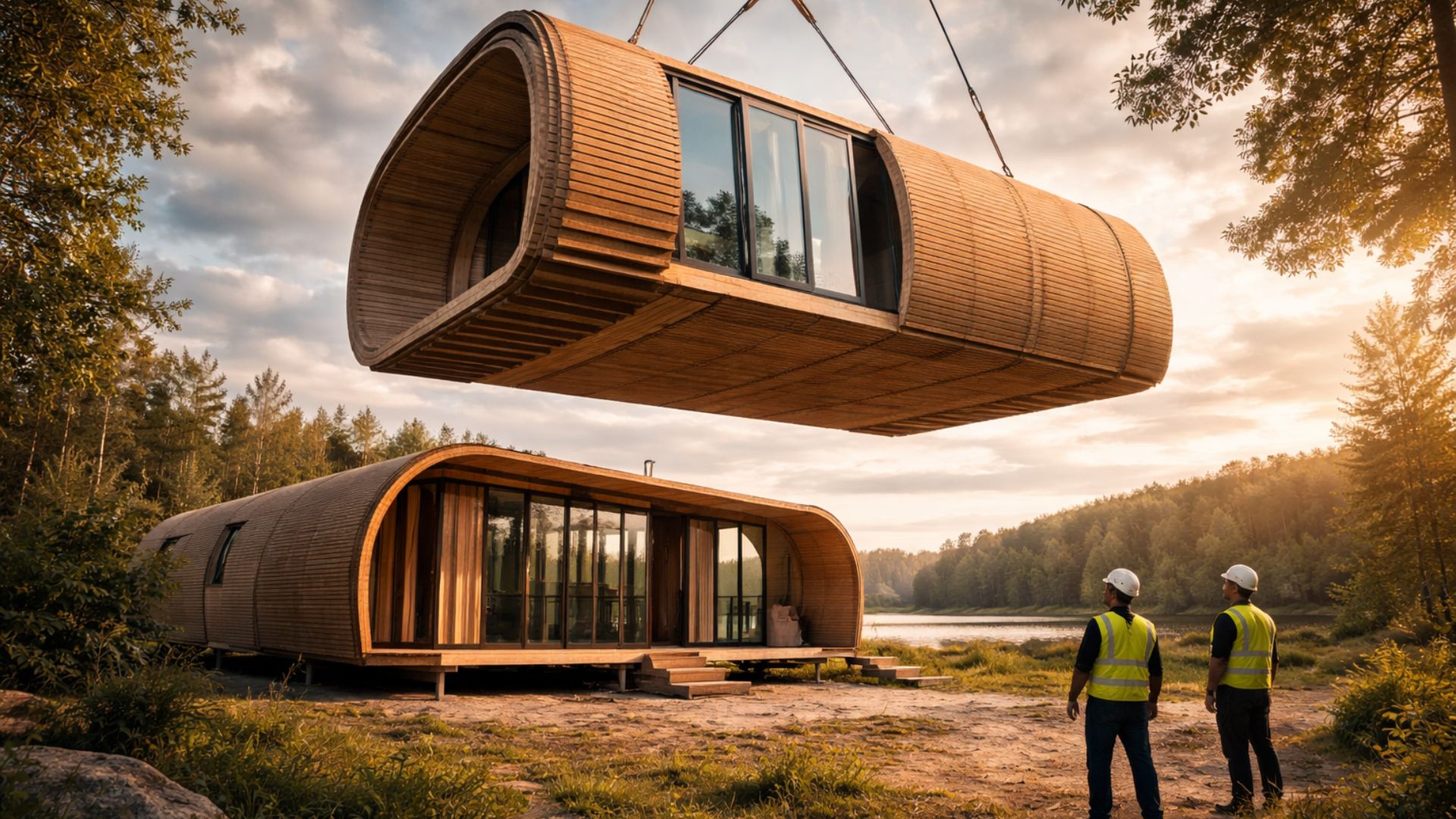
Modular construction with structural cardboard challenges traditional architecture standards by combining quick assembly, easy transport, and a sustainable proposal in a housing model that has already sparked international interest and expands the debate on new materials and construction methods.
A house made from structural cardboard, assembled in modules and installed outside the conventional construction logic, has transformed the Wikkelhouse into one of the most well-known projects in European modular architecture.
Developed by the Dutch company Fiction Factory, the proposal combines industrial manufacturing, quick assembly, and the possibility of reconfiguration, with intended uses for compact housing, offices, studios, and accommodation.
How modular construction works outside the site
The project draws attention because it replaces part of the materials most associated with traditional construction with a pre-fabricated system that concentrates production in a controlled environment.
-
Government unlocks R$ 554 million for a highway that has been requested for decades and accelerates the duplication of BR.
-
Billions of barrels on the equatorial margin could lead Amapá to double its oil production in Brazil — the state aims to enter the route of companies in the Campos Basin, attract investments, and boost jobs and businesses in the oil and gas sector.
-
Without bricks, without cement, and without endless construction: the cardboard house that is assembled in modules and can be moved.
-
Billions of barrels on the equatorial margin could lead Amapá to double its oil production in Brazil — the state wants to enter the route of companies in the Campos Basin, attract investments, and boost jobs and businesses in the oil and gas sector.

Instead of raising walls on-site with masonry, the company manufactures segments ready for transport and connection at the installation site, reducing the direct interference of the construction and shortening the final assembly stage.
At the center of this proposal is the material that provokes the most strangeness at first glance.
According to Fiction Factory and specialized publications, each module of the Wikkelhouse is formed by 24 layers of cardboard rolled around a mold with a predefined shape, bonded with sustainable profile glue to create a rigid piece, with strength and insulation.
Structural cardboard and weather protection

After this stage, the core receives external weather protection and a wooden finish, which completely alters the final appearance of the set.
In practice, the house does not exhibit an improvised look nor does it suggest a fragile temporary shelter, despite cardboard remaining a central element of the structure.
The solution seeks precisely to distance this immediate association between cardboard and precariousness.
Modularity allows expansion and adaptation
Modularity is another decisive point in understanding the international interest surrounding the project.
Each segment is about 1.2 meters deep and can be connected to other modules in sequence, allowing for the creation of larger or smaller units depending on the intended use.
Thus, the house stops being thought of as a fixed volume and starts functioning as an expandable set of pieces.
In specialized coverage, these modules are also described as approximately 4.6 meters long, 3.5 meters high, and weighing around 500 kilograms per unit.
This scale allows for the organization of effective environments, with the possibility of integrating a living room, bedroom, kitchen, bathroom, or balcony from the combination of pieces with different functions.
Practical uses go beyond traditional housing
Fiction Factory presents the Wikkelhouse as a solution for real uses, not as a conceptual design exercise.
On the official website, the company mentions applications such as holiday home, guest house, and office, while architecture reports indicate that the model has also been observed as an option for residential annexes and small hospitality operations.
This industrialized logic helps explain why the house has gained traction in discussions about new construction models.

When most of the process happens in the factory, cutting, preparation, finishing, and fittings no longer depend entirely on the conditions of the land.
This makes installation more predictable and, in suitable situations, it can be completed in one day after preparing the area that will receive the modules.
Sustainability and renewable materials gain importance
Speed, however, is not the only argument used to support the proposal.
The environmental discourse appears consistently in the presentation of the Wikkelhouse, which highlights the use of materials such as cardboard, wood, and other components of renewable origin.
On the official website, the company states that the project is built exclusively with sustainable materials and is on its way to becoming a 100% biodegradable house.
This positioning connects to a broader scenario, where modular constructions and systems with lower environmental impact have begun to gain visibility in different markets.
Still, the case of the Wikkelhouse stands out because it transforms a material not commonly associated with permanent housing into a relevant part of the structure, without sacrificing refined finishing and commercial appeal.
Transport and reinstallation expand usage possibilities
Another aspect that expanded the project’s reach was the possibility of transport and reinstallation.
Since the modules are manufactured separately and connected later, the unit can be disassembled and taken to another address, as long as the technical configuration and conditions of the new location allow for this operation.
This trait brings the house closer to a more flexible model, aimed at needs that may change over time.
Not by chance, the company claims to have already installed Wikkelhouses in gardens, rooftops, and even over water.

This variety of deployment helps explain the project’s circulation in publications about design, innovation, and alternative housing, in addition to reinforcing the idea that the product can occupy spaces where conventional construction would require a different scale of intervention.
Internal design reinforces functional housing proposal
The internal design also weighs in on this reception.
The promotional images and reports about the project show interiors with wooden finishes, large glazed surfaces, and compact carpentry solutions, in an aesthetic that resembles more of a high-standard tiny house than the precarious image that the word cardboard usually suggests.
This contrast has become a central part of the product’s identity.
Durability depends on maintenance and proper use
Durability is one of the most sensitive points when the subject reaches the public.
In international coverage, the Wikkelhouse is described as a structure designed to last for decades, as long as it is used within the intended conditions and maintained in accordance with the system.
Resistance, in this case, does not depend solely on the cardboard itself, but on the set formed by glued layers, external protection, and final finishing.
There is also an important symbolic component in the way the house was named.
The name Wikkelhouse derives from “wikkelen,” a Dutch verb related to the idea of rolling or wrapping, directly referencing the process that shapes the modules.
This choice summarizes the logic of the product and transforms the very construction method into a brand, instead of hiding the unusual origin of the material.
More than a visual curiosity, the project has come to represent a concrete change in the way compact housing and housing manufacturing are thought about.
By shifting a decisive part of construction to an industrial process, the Wikkelhouse reinforces a trend where predictability, transport, customization, and reduced dependence on the site gain weight in the sector.
In this context, cardboard ceases to be just packaging and enters the debate on how architecture can test unlikely materials without abandoning real use, comfort, and finishing.







Seja o primeiro a reagir!