





 Português
  Inglês
  Espanhol
  4 min de leitura
  1 comentário


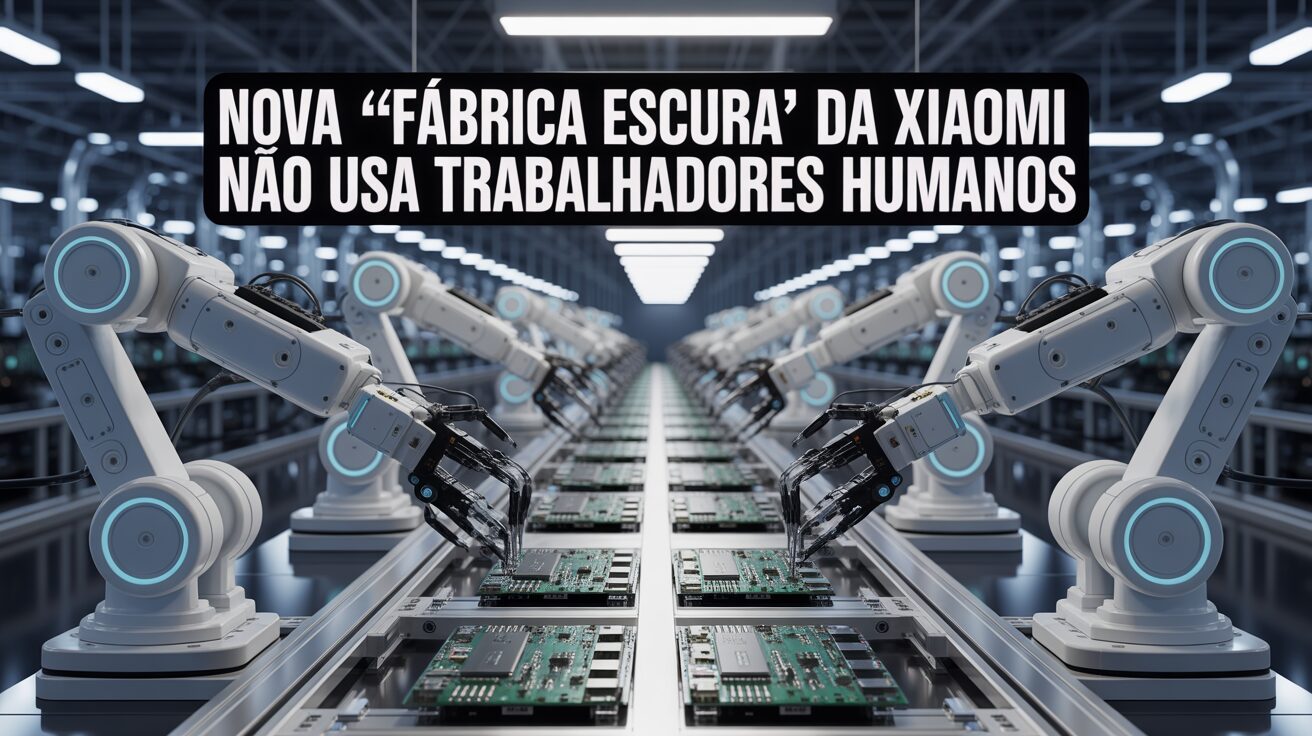


Totally Automated, Xiaomi’s New Factory Operates in the Dark, Without Human Presence, Using Only Robots and Artificial Intelligence to Keep Production Active 24 Hours a Day.
At the forefront of industrial innovation, Xiaomi recently unveiled, in China, a facility that is redefining the standards of modern manufacturing: a factory without workers, also known as a “dark factory.” The name is not merely symbolic. The plant, located in the Changping district, literally operates in the dark, as no activity requires lighting – all processes are conducted by robots.
With continuous operation, 24 hours a day, seven days a week, the unit represents a new milestone in global industrial automation, completely eliminating human presence on the factory floor. With this, Xiaomi combines artificial intelligence, big data, and cutting-edge robotics to control, adjust, and optimize every stage of production in real time.
Robots Replace Humans in All Processes
From the receipt of raw materials to the final assembly of electronics, Xiaomi’s workerless factory carries out the entire production process autonomously. There are no breaks for lunch, nor shift changes. The robots operate with constant precision, reducing errors and increasing output.
-
Found in one of the most radioactive places on Earth, this Chernobyl fungus may be doing something with radiation that no one has been able to explain to this day.

-
A bright yellow mushroom imported from Asia escaped from a cultivation farm in the United States in 2010 and is now aggressively spreading across 25 states, destroying entire communities of native fungi in American forests.

-
Buried under China, a colossal machine weighing 20,000 tons began operating as the largest neutrino detector on the planet and, in just 59 days, surpassed results that science took half a century to achieve.

-
Iran enters the center of a climate alert after the war emitted 5.6 million tons of CO2 in two weeks, surpassing the annual pollution of entire countries.


The facility spans 81,000 square meters and required an investment of 2.4 billion yuan (approximately US$ 330 million). The production capacity is 10 million devices per year, including the foldable smartphones MIX Fold 4 and MIX Flip, which are expected to lead the company’s portfolio in the coming years.
In addition to total automation, the dark factory features an intelligent dust removal system, even eliminating the need for cleaning services. Quality control algorithms identify potential faults before they even occur, automatically adjusting production.
China Leads the Advance of Smart Factories
With over six million factories in operation, China is recognized as the largest industrial center in the world. However, Xiaomi’s new facility highlights a quiet transformation: the rise of so-called dark factories, which not only automate processes but completely eliminate human presence from the factory environment.
The adoption of workerless factories reflects a global movement towards digitization and intensive use of artificial intelligence in industry. In China, this model also responds to challenges such as rising labor costs, pressure for efficiency, and the demand for large-scale production with a lower margin of error.
Job Disruption Worries Experts
The rapid spread of the dark factory model raises alarms about the impacts on employment. According to the Future of Jobs report from the World Economic Forum, about 23% of jobs are expected to undergo significant changes in the next five years due to automation and artificial intelligence.
The same report indicates that 83 million jobs are expected to be eliminated, while 69 million will be created, with an emphasis on roles directed towards management and optimization of technologies. Still, 44% of the skills currently required are expected to become obsolete, necessitating large-scale reskilling.
Experts warn that the replacement of human roles by machines will not be balanced, at least in the short term. Xiaomi’s workerless factory, for example, operates with few support technicians and software development teams, while manual operational activities have been completely eliminated.
UN Calls for Global Governance for Artificial Intelligence
The advancement of artificial intelligence in sectors such as manufacturing has led the UN to issue a warning. In a recent report, experts designated by Secretary-General António Guterres stated that the world faces a “governance deficit” regarding AI. According to the document, the absence of global regulations could create unpredictable risks to security, human rights, and economic stability.
Comparisons with the nuclear arms race of the 1940s have been made by researchers such as Max Tegmark and Geoffrey Hinton, who left positions in major tech companies to warn about the dangers of uncontrolled AI development. Hinton, considered one of the “fathers of artificial intelligence,” argues that once an AI passes the Turing test (i.e., is indistinguishable from a human), control over it may be lost.
Technology with Responsibility
Despite the concerns, there is consensus among experts that industrial automation, as exemplified by Xiaomi’s dark factory, brings concrete gains in efficiency, sustainability, and cost reduction. The question becomes how to balance innovation with social impact.
As China rapidly advances with the workerless factory model, other countries watch closely the practical and ethical effects of replacing human labor with robots. The expectation is that the future of industry will depend not only on technology but also on the ability of governments and companies to adapt to this new production paradigm.
Source: News.com.au







Aunque es un reto resulta triste e interesante para las civilizaciones.