





 Portuguese
  English
  Spanish
  4 min of reading
  2 comments


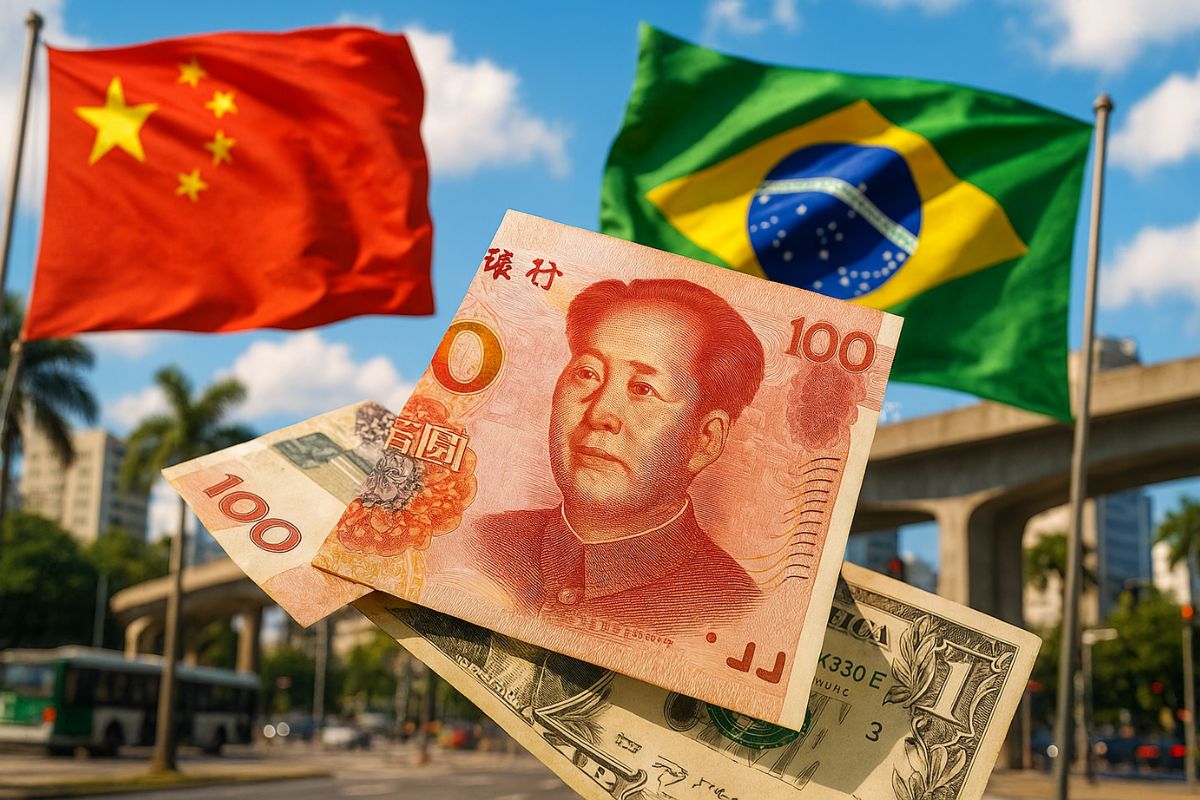


With Transactions in Local Currency, Clearing in the Country, and Joining CIPS, the Yuan Gains Ground in Brazil, Advances in Reserves, and Already Represents a Relevant Part of Bilateral Trade Without “Replacng” the Dollar All at Once.
The Yuan Gains Ground in Brazil as Brazil and China have begun to conduct direct transactions in local currencies, reducing exchange costs and increasing export competitiveness. According to the portal straitstimes, since 2023, the bilateral agreement allows for business to be conducted in renminbi and real without dollar intermediation, in a bid for diversification and efficiency.
The effects are already visible: the use of the yuan has increased in Brazilian reserves and, by 2025, it reached about 40% of the operations in bilateral trade, a movement that strengthens the relationship with the country’s main trading partner. Still, experts argue that this transition is gradual and does not eliminate the dollar’s relevance in international exchanges in the short term.
The Agreement in Practice: What Changes in Companies’ Routine
In practice, the operational design has been enabled by concrete measures. China has authorized the ICBC to act as the clearing bank for the yuan in Brazil, facilitating direct payments between reais and renminbi.
-
Brazilian city gains industrial hub for 85 companies that is equivalent to 55 football fields.

-
Peugeot and Citroën factory in Argentina cuts production by half and opens a layoff program for more than 2,000 employees after Brazil drastically reduced purchases of Argentine vehicles.

-
A Brazilian city gains a factory worth R$ 300 million with the capacity to process 200 thousand tons of wheat per year, a mill of 660 tons/day, silos for 42 thousand tons, and an industrial area of 276 thousand m².

-
Havan will leave the shopping mall in Blumenau to inaugurate something that the chain has never done before: a megastore in half-timbered style in the Historic Center of the city, which is expected to be completed in May and change the landscape of local retail.


At the same time, Brazilian institutions like BOCOM BBM have joined the CIPS (Cross-Border Interbank Payment System), an alternative to SWIFT, streamlining settlements and reducing friction.
This arrangement shortens the currency chain (avoiding double conversions), reduces spreads, and provides predictability of timelines.
For shipments of commodities and manufactured goods, the simplification eliminates cash friction, improves margins, and in some cases helps to negotiate prices with more commercial aggressiveness.
Reserves, Trade, and the Measured Advance of the Yuan
In addition to trade flows, the Yuan gains ground in Brazil in its own international reserves, where it has already surpassed the euro and has taken second place.
The signal is strategic: in addition to diversification, it indicates operational confidence in the renminbi payment ecosystem.
In trade, the curve is upward. In 2025, about 40% of the transactions between Brazil and China began to use local currencies, marking a significant leap compared to previous years.
Meanwhile, bilateral exchange reached US$ 157 billion in 2024, a level that enhances the relevance of mechanisms that reduce costs and time in settlements.
Who Benefits from the Change and Why
Exporters of commodities and sectors with standardized contracts reap immediate gains from reduced currency costs and greater predictability.
SMEs are also starting to benefit from simpler conditions to transact in yuan, something that was previously restricted to large players with sophisticated financial structures.
For the local financial system, the partial migration creates opportunity: banks and fintechs begin to offer hedge solutions, currency accounts, and payments aimed at renminbi.
The more companies internalize the flow in yuan, the greater the liquidity and efficiency of the entire mechanism.
Risks and Limits: The Dollar Doesn’t Fade Away Overnight
Despite the progress, there are clear limits. The dollar remains dominant in trade and global financing; de-dollarization is gradual and sector-specific.
Additionally, the yuan operates under capital controls, which requires risk governance and hedging tools adapted to the Chinese regime.
Another sensitive point is the geopolitical exposure: deepening financial ties with China could increase dependencies and require a nuanced understanding of the international scenario.
For Brazil, the pragmatic gain (reducing costs and diversifying) must come with caution, transparency, and good currency management.
Payment Infrastructure: CIPS, Clearing, and Swap
The backbone of the advance lies in the infrastructure. The CIPS expands the reach of renminbi payments with more direct settlement, while the local clearing of ICBC provides operational support to companies.
Additionally, monetary cooperation includes a swap agreement between the central banks, opening a liquidity line and providing security to the market in times of stress.
This tripod CIPS + clearing + swap supports the thesis that the Yuan gains ground in Brazil due to operational capacity, not just narrative. Without a track, the train doesn’t run: here, the track has been extended.
Financial Multipolarity: Trend, Not Rupture
What we observe is a growing multipolarity, where local currencies like the yuan gain ground in niches where there is commercial scale and infrastructure.
It’s not a rupture, it’s a rearrangement: the dollar remains central, while renminbi and other currencies take slices in specific transactions, reducing costs and risks for those trading with China.
For Brazil, the strategy diversifies funding and increases degrees of freedom in foreign trade. Balance is the keyword: leveraging efficiency without losing risk management and without concentrating dependencies.
In balance, the movement in which the Yuan gains ground in Brazil is already palpable: more use in reserves, installed clearing, CIPS in operation, and growing participation in trade with China.
It is a pragmatic step towards lower costs and more predictable timelines without declaring the end of the dollar.
And you, do you think that increasing the use of the yuan in transactions with China is a competitive advantage for Brazilian companies? Which sectors should adhere first commodities, manufacturing, retail? And what is an acceptable level of currency risk in this diversification? Share your thoughts in the comments we want to hear from those who operate in the day-to-day of foreign trade.







Eu queria ser um mosquitinho e olhar para cara de tristeza dos Bolsonaristas 😆😆😆
Você já é um mosquitinho, kkk, quero ver a sua alegria daqui 10 anos, kkkk