





 Portuguese
  English
  Spanish
  5 min of reading
  0 comments


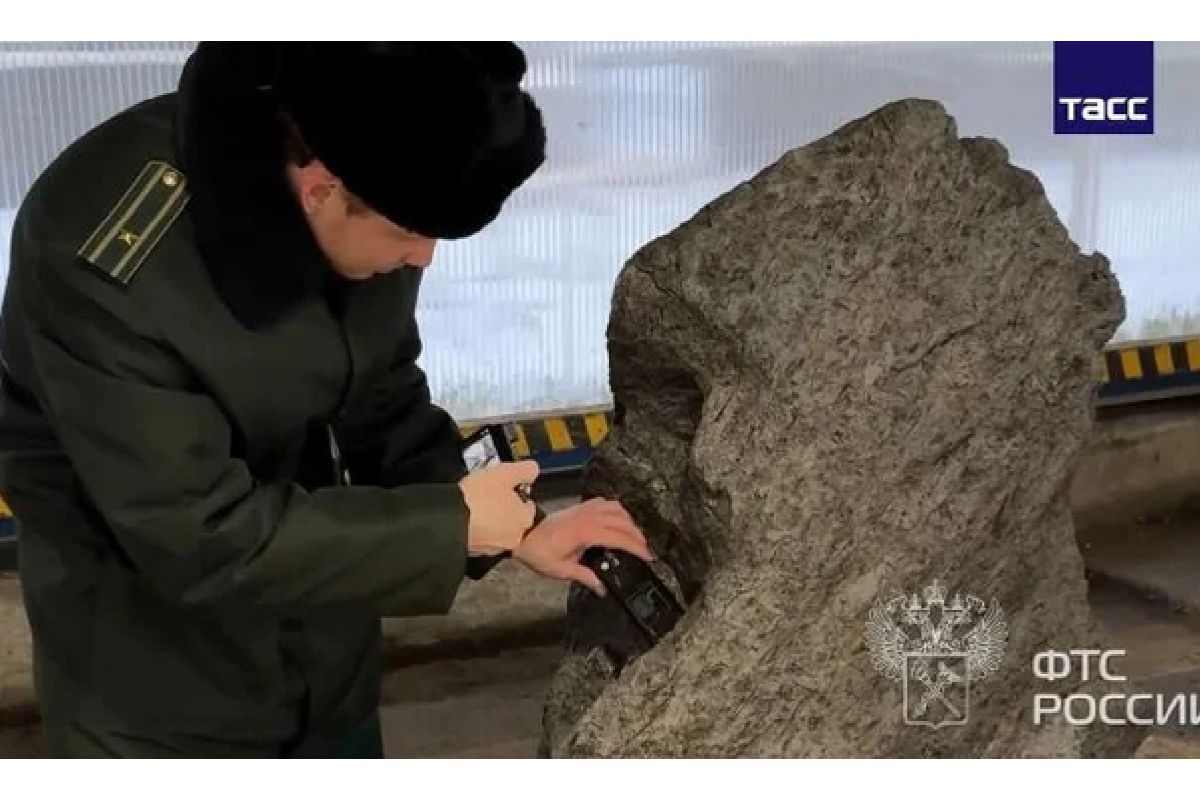
Fragment Of The Aletai Meteorite, Classified As A Siderite Rich In Rare Metals, Has Been Declared A Landscape Sculpture, Valued At R$ 24 Million And Could Become An Emblematic Case Of Smuggling Scientific Heritage
What seemed to be just another routine inspection of a container at the port of St. Petersburg ended in a major discovery. Russian agents found a metallic block weighing 2.8 tons described in the paperwork as a “decorative garden sculpture.” After a more detailed analysis, they discovered that the supposed ornament was, in fact, a fragment of the Aletai meteorite, one of the rarest and most valuable iron meteorites ever cataloged, estimated to be 4.5 billion years old, nearly the same age as the Solar System.
The operation prevented the Aletai meteorite from leaving Russia for the United Kingdom discreetly, as if it were just an ornamental item. Instead, the cargo became the centerpiece of a criminal case for smuggling goods of strategic importance and cultural heritage, with a potential sentence of up to three years in prison for those involved. Suddenly, a “garden ornament” turned into a symbol of the clash between private commerce and the protection of scientific treasures.
How The Aletai Meteorite Was Discovered In The Middle Of A Common Container
To understand the case, we must go back to the end of January 2026, at the port of St. Petersburg. During scanning and cargo checking, customs authorities identified a container destined for the United Kingdom containing an object described as a “landscape sculpture.”
-
Friends have been building a small “town” for 30 years to grow old together, with compact houses, a common area, nature surrounding it, and a collective life project designed for friendship, coexistence, and simplicity.

-
This small town in Germany created its own currency 24 years ago, today it circulates millions per year, is accepted in over 300 stores, and the German government allowed all of this to happen under one condition.

-
Curitiba is shrinking and is expected to lose 97,000 residents by 2050, while inland cities in Paraná such as Sarandi, Araucária, and Toledo are experiencing accelerated growth that is changing the entire state’s map.

-
Tourists were poisoned on Everest in a million-dollar fraud scheme involving helicopters that diverted over $19 million and shocked international authorities.


So far, nothing extraordinary. The problem began when the declared weight and density of the item caught the agents’ attention.
Upon opening the package, the team found a huge metallic rock with an irregular surface and a grayish color.
The forensic analysis concluded that it was not an artistic piece but a fragment of the Aletai meteorite, classified as a siderite, a type of meteorite composed mainly of iron and nickel.
In other words, instead of decorative art, Russian customs were confronted with a celestial body of high scientific relevance.
A Garden Ornament Worth Millions In The Form Of The Aletai Meteorite
From the moment of identification, the value of the cargo changed significantly. Estimates cited by Russian authorities indicate that the fragment of the Aletai meteorite could be valued at around 3.6 million euros, equivalent to over R$ 24 million.
This high price is directly linked to the rarity and importance of the meteorite for scientific research.
Videos released by the Russian press show agents forcibly opening the transport box to reveal the massive metallic block. Every inch of that fragment of the Aletai meteorite condenses billions of years of cosmic history, something far beyond purely decorative value.
With the seizure, the Federal Customs Service of Russia opened a case for smuggling goods of strategic importance or cultural heritage, making it clear that the attempt to disguise the shipment would not be treated as a simple classification error.
From Outer Space To International Smuggling: What Is The Aletai Meteorite
The Aletai meteorite is not just any meteorite. Discovered in 1898 in Xinjiang Uyghur, near the Altai Mountains in northern China, it was named after the region where it was found.
There is no record of the exact moment of its fall, leading researchers to believe that the impact occurred in prehistoric times.
According to studies cited by Russian authorities, the Aletai meteorite is about 4.5 billion years old, nearly the same age as the Solar System.
The hypothesis is that it is a fragment of the core of a protoplanet or a large asteroid that disintegrated during the formation phase of the planets.
Scientifically, the Aletai meteorite serves as a physical archive of the early Solar System, preserving information that no longer exists anywhere else.
Why The Aletai Meteorite Is So Valuable For Science And The Market
In addition to its extreme age, the Aletai meteorite stands out for its chemical composition. It has a high concentration of rare metals, such as gold and iridium, elements considered fundamental for studies on the origin of the Earth, celestial bodies, and the processes that formed rocky planets.
This type of material is highly sought after by private collectors and the rare item market, which helps explain the attempt to ship it disguised as an ornament.
At the same time, scientists strongly criticize the private commercialization of large fragments of the Aletai meteorite, as this removes valuable samples from the reach of academic research, making detailed and continuous analysis difficult.
Each piece that disappears into private collections represents one less opportunity to advance our understanding of cosmic history.
The Path Of The Aletai Meteorite To Russian Customs
Russian authorities claim that the fragment of the Aletai meteorite had previously been imported to Russia from a member country of the Commonwealth of Independent States (CIS), a bloc that includes former Soviet republics.
From there, the cargo would head to the United Kingdom, likely towards a private buyer.
Despite the interception, neither the name of the supposed buyer nor the identity of the person who attempted to export the Aletai meteorite have been disclosed so far.
The lack of transparency fuels speculation about the kind of network involved in such operations, which combine space geology, high market value, and gaps in international oversight.
Aletai Meteorite As A Symbol Of The Dispute Between Science And Commerce
Ultimately, this episode places the Aletai meteorite at the center of a dilemma that goes beyond the Russia–United Kingdom border.
On one side, there is the scientific interest in preserving and studying these rare fragments as much as possible, which hold clues about the formation of the Solar System.
On the other, there is the high-end luxury and collecting market, willing to pay millions for a piece of extraterrestrial metal for private display.
The interception in St. Petersburg highlights this dispute. When a fragment of the Aletai meteorite is treated as a mere garden ornament, what is at stake is not just a fiscal crime, but the potential loss of global scientific heritage.
The way authorities handle the case may serve as a reference for future attempts to smuggle rare geological material.
In light of all this, if you had the chance to decide the fate of this fragment of the Aletai meteorite, would you leave it on display in a public museum, under scientific custody, or do you think it is acceptable for it to become a private piece in a luxury collection?
With information from Xataka.









Seja o primeiro a reagir!