





 English
  Francês
  Alemão
  Italiano
  Japonês
  Norueguês
  Portuguese
  Spanish
 4 min of reading
  14 comments


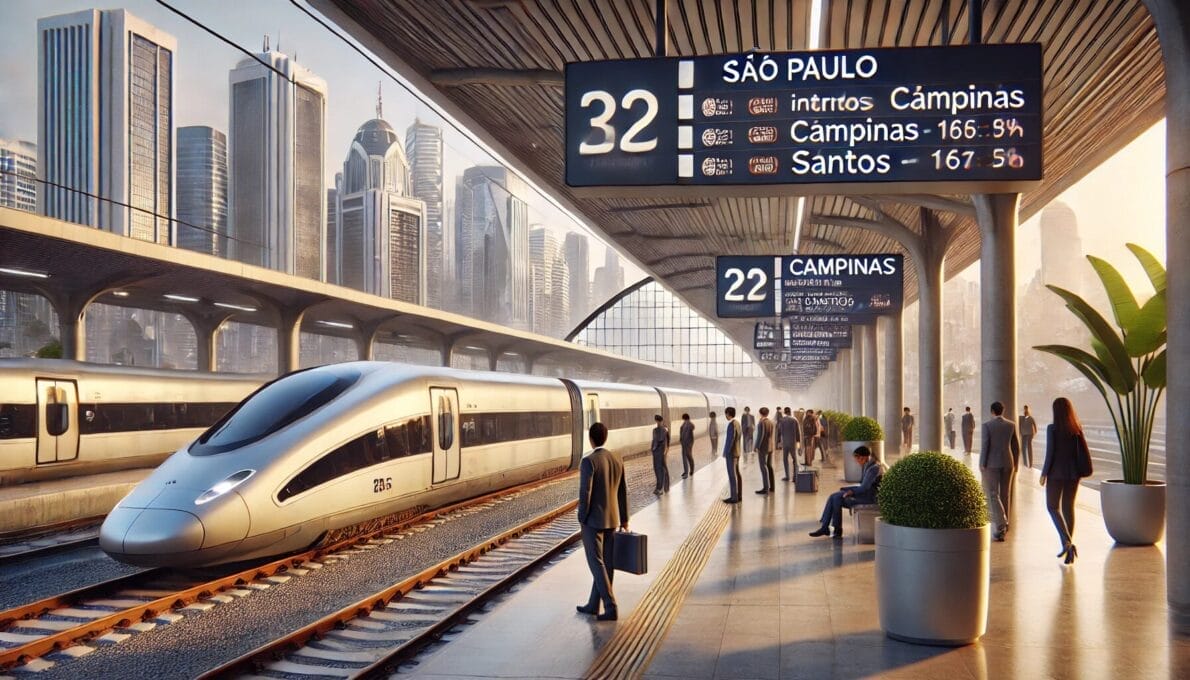

With the Intercity Train, the government of São Paulo plans to improve mobility between the capital and the interior of the state, including routes to Campinas, Sorocaba, and Santos.
Imagine saving hours of travel and still having a new way of transportation connecting São Paulo to the interior of the state.
This is the goal of the Intercity Train (TIC), an ambitious project announced by the government of São Paulo that promises to transform the state’s railway infrastructure.
More than just shortening distances, the project aims to boost economic development and create jobs in various cities.
-
Unemployment rises again to 5.8% at the beginning of 2026, raising alarms about the end of temporary positions and its impact on the Brazilian job market.

-
Document organization can cut invisible costs in small businesses, a simple step that prevents waste, rework, and losses in daily operations.

-
Chinese giant worth nearly R$ 4 billion that manufactures cables for electric cars, solar energy, and robotics wants to open a factory in SC.
-
Many employers do not know, but the law guarantees domestic workers a 25% increase in salary during trips, 50% for overtime, 20% for night shifts, and 17 additional benefits that can lead to labor lawsuits if not paid.


Expansion of the Intercity Train: Beyond Campinas, New Routes on the Horizon
The TIC already has an initial planned line that will connect São Paulo to Campinas, but the project goes beyond.
According to Governor Tarcísio de Freitas, there are plans to extend the line to cities like Americana, Limeira, and Ribeirão Preto, enabling greater mobility for those traveling between the capital and the interior.
In an interview with the newspaper “O Liberal,” Tarcísio revealed that routes to Sorocaba are also being studied.
And Bauru, in addition to a strategic link to the Baixada Santista, facilitating access to Santos.
Deadlines and Implementation Stages
The first phase, connecting São Paulo to Campinas, is expected to begin operations in 2031.
The intermetropolitan train service, which will include stops in Jundiaí, Valinhos, Louveira, and Vinhedo, is expected to start in 2029, offering a practical option for those living in these cities and working in the capital.
For the São Paulo-Sorocaba segment, the auction is set to take place in 2025, with the contract signing anticipated for 2026.
With this new line, the journey between the two cities will take approximately one hour, reducing the current time of up to 130 minutes by road.
It is estimated that the São Paulo-Sorocaba TIC will serve a demand of 50,000 passengers per day.
Connections with São José dos Campos and Santos Are Also in the Plans
In addition to Campinas and Sorocaba, the TIC envisions new routes to other regions.
According to the Department of Partnerships and Investments, one of the priority connections will be between São Paulo and São José dos Campos.
Known as the TIC East Axis, this segment will take about 75 minutes to traverse the four municipalities along the route, serving an estimated population of 2.7 million people.
The investment for this route is estimated at R$ 10 billion.
Another important axis is the TIC South Axis, which will connect the capital to the Baixada Santista.
This segment should be between 80 and 130 kilometers, offering a journey of approximately 90 minutes and directly benefiting 1.8 million people.
In addition to improving mobility, the TIC South Axis also promises to alleviate traffic on the Anchieta-Imigrantes highway system.
Jobs and Economic Benefits for the Population
One of the major attractions of the TIC is its potential for job creation.
Just the TIC South Axis, between São Paulo and Santos, is expected to create about 13,000 jobs, in addition to stimulating the regional economy with the construction of new stations and railway infrastructure.
With an estimated investment of R$ 10 billion for the entire expansion, the project is expected to drive the development of urban and peripheral areas, opening doors for businesses and facilitating the movement of workers between metropolitan regions and cities in the interior.
Next Steps and Challenges for the Intercity Train
While the São Paulo-Campinas and São Paulo-Sorocaba segments already have established deadlines, the connections with São José dos Campos and Santos still depend on feasibility studies and private partnerships.
So far, there is no forecast for an auction or the start of works for the East and South axes, according to the Department of Partnerships and Investments.
The expectations surrounding the Intercity Train are high, but technical and financial challenges still need to be overcome for the project to come to fruition.
With an ambitious plan and various cities benefiting, the TIC has the potential to revolutionize transportation in São Paulo.
Do you believe the Intercity Train will be the solution to improve mobility between the capital and the interior? Share your opinion!







No Brasil com essa ineficiencia, burocarcia e o principal a corrupção, os projetos são tem 20 anos de atraso quando não é suspenso, se fosse no Japão em seis meses estaria todas as ferrovias prontas no dia exato. Pais do atraso e retrocesso é o Brasil, vive no passado e lá não sai nunca.
É urgente que se agilize a implantação das ferrovias, que nunca deveriam ter desaparecido. O trânsito das rodovias anda saturado pelo volume de automóveis e transporte de carga, além de estar super arriscado devido a condições das próprias estradas e da direção perigosa. O trem será o salvador da pátria!!!!
Transporte sobre trilhos faz parte de toda a Europa , Estados Unidos , China , Japão, Rússia, etc….só aqui que resolvemos andar na contra mão da mobilidade e hoje estamos 50 anos atrás dos outros nesse quesito, enquanto em 10 anos a China fez 27mil km de ferrovias nos aqui sucateados 8mil km de trilhos .