






 Portuguese
  Spanish


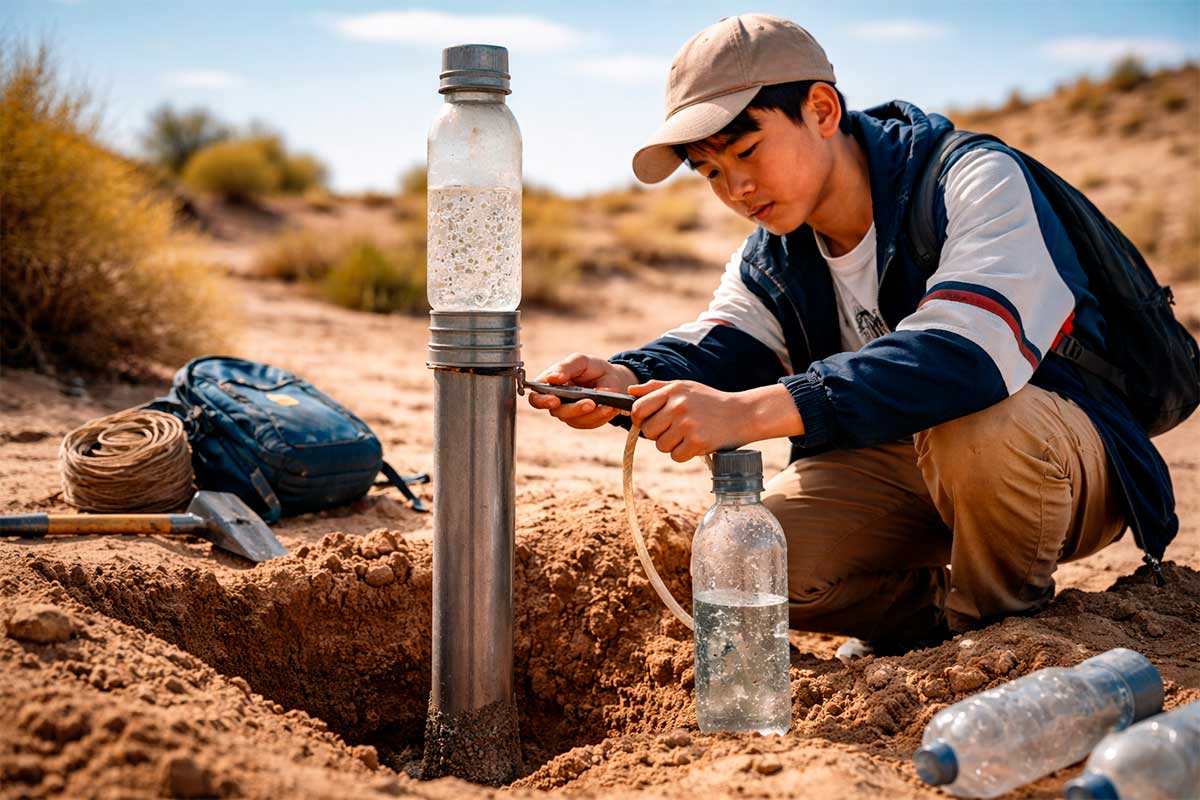


Invention developed in Chifeng transforms condensation into passive irrigation and emerges as a promising reinforcement in the fight against desertification. The project gained international prominence after earning Jia Mingxuan a gold medal at one of the world’s major invention fairs.
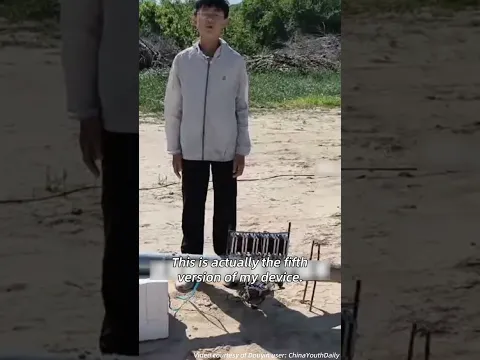
The advance of desertification and the difficulty of keeping seedlings alive in the early stages of planting continue to be one of the biggest bottlenecks in reforestation in dry areas. It was in this scenario that the 14-year-old Chinese student Jia Mingxuan caught attention by creating a device capable of capturing moisture from the air and delivering it directly to the roots of trees, without relying on electricity, pumps, or connections to external water sources.
The solution was born in Chifeng, Inner Mongolia, an area within the large ecological belt of northern China. In November 2025, the project won gold at the 77th edition of iENA, an international fair held in Nuremberg, Germany, which put the teenager on the radar of researchers and environmental restoration programs.
The principle of the system is simple but ingenious. Steel tubes buried in the ground, combined with repurposed parts and passive ventilation at the top, take advantage of the temperature difference between the surface and the underground layer to condense the vapor present in the air, forming small droplets that move to the root zone.
-
Free Internet Begins Testing in São Paulo Metro Stations, Network-Wide Rollout Expected by 2026

-
Man Transforms Desert Ranch into Forest by Harvesting Rainwater, Captures 15,000 Gallons in One Downpour, Builds 100 Dams with 6 Volunteers

-
16 kWh Solar Battery Powers Entire Home Off-Grid, Lasts Over 22 Years with 8,000 Cycles, Delivers 10,000 Watts for Appliances
-
Drones Can Now Detect Underwater Mines Hidden by Sand and Algae Using Aerial Images, Special Light, and AI




The interest surrounding the invention is growing because it emerges within the context of the Great Green Wall of China, also known as the Three-North Shelterbelt Forest Program, a megaproject initiated in 1978 to contain the advance of arid areas in 13 provinces and expected to continue until 2050.
How the observation of condensation indoors became a solution for newly planted trees

The idea did not originate in a laboratory. In March 2025, during a school activity that asked students to create invention proposals, Jia recalled a simple domestic scene, the formation of droplets on a cold surface in the kitchen, and wondered if the same physical principle could help seedlings in drought-stricken areas.
From there, he began to design a device that directs air into the structure and promotes condensation formation underground. The result is localized, slow, and continuous irrigation, aimed not at large volumes of water, but at the most delicate moment in the plant’s life, when the seedling is still trying to establish itself in the ground.
The development of the prototype also required an uncommon persistence for his age. Living in a boarding school, Jia had to travel about 30 kilometers to test the equipment, retrieve the buried structure, measure the accumulated moisture, and return to his school routine, sometimes leaving early in the morning to keep track of the results.
Why Chifeng became a real field to test solutions against desertification
The Aohan Banner region in Chifeng helps explain why an invention like this gained so much weight. Official reports indicate that in the 1960s, the area was much more arid, with annual rainfall around 380 millimeters and sand covering more than three-quarters of the land in some places.

The situation improved after decades of planting and ecological management. Today, the local forest cover exceeds 40%, but stability is still sensitive, as dry and windy areas continue to impose high mortality rates on newly planted seedlings, precisely the phase when manual irrigation becomes more expensive, slow, and difficult to maintain.
What the invention solves in reforestation and why it can go beyond the Chinese case
In practice, Jia’s device addresses a crucial point in forest restoration. Technical literature on microirrigation for arid zones shows that the early stages of planting concentrate a large part of the risk of failure, and that localized systems, with low water doses and high efficiency, can reduce losses precisely in sandy soils, windy areas, and difficult-to-access locations.

This type of approach is also valued because it does not attempt to replicate traditional agricultural irrigation. In reforestation, the most important thing is often to ensure the establishment of the seedling, with minimal water consumption, low maintenance, robustness, and simple operation, attributes that fit well within the logic of the prototype created in Chifeng.
Therefore, the invention draws attention not only for the symbolic factor of having emerged from a teenager but also for bringing together characteristics that are often lacking in remote areas. It uses accessible materials, does not require an electrical grid, and serves as a complement to other tools already used in local reforestation, including precision planting methods adopted in Aohan in recent years.
At the same time, the project should not be treated as a magic solution. Recent studies on China’s large afforestation programs show that combating desertification requires continuous planning, correct species selection, water management, and assessment of the resilience of planted forests, especially in regions with severe climates.
International recognition amplifies the weight of a simple idea made with common materials
The award received by Jia in Nuremberg expanded the reach of the story because iENA is among the most well-known international fairs in the invention sector. The 2025 edition brought together more than 540 inventions and exhibitors from various countries, which gives greater dimension to the achievement of a student who arrived at the event with a handmade prototype aimed at a concrete environmental problem.
After the award, Jia began collaborating with a research team in Shanghai to improve the design of the device. This move suggests that the idea has moved from the phase of school curiosity to a stage closer to technical validation, focusing on transforming the prototype into a practical tool for reforestation.
External interest also makes sense because semi-arid regions in different parts of the world face the same difficult equation: little water, high irrigation costs, and high mortality rates in the first months of planting. Passive and localized technologies, such as those reviewed by researchers in the field, gain traction precisely because they offer low water consumption and direct application to the root, reinforcing the potential for adapting such solutions to other dry scenarios.
The story of Jia Mingxuan also touches on a point that may divide opinions. A simple and inexpensive idea may save more seedlings than grand campaigns based solely on the quantity of planting. Do you think the future of reforestation lies more in accessible technology like this or in large infrastructure projects? Leave your opinion in the comments.







Nonsense ai slop image at top of article.