





 Portuguese
  English
  Spanish
  10 min of reading
  3 comments


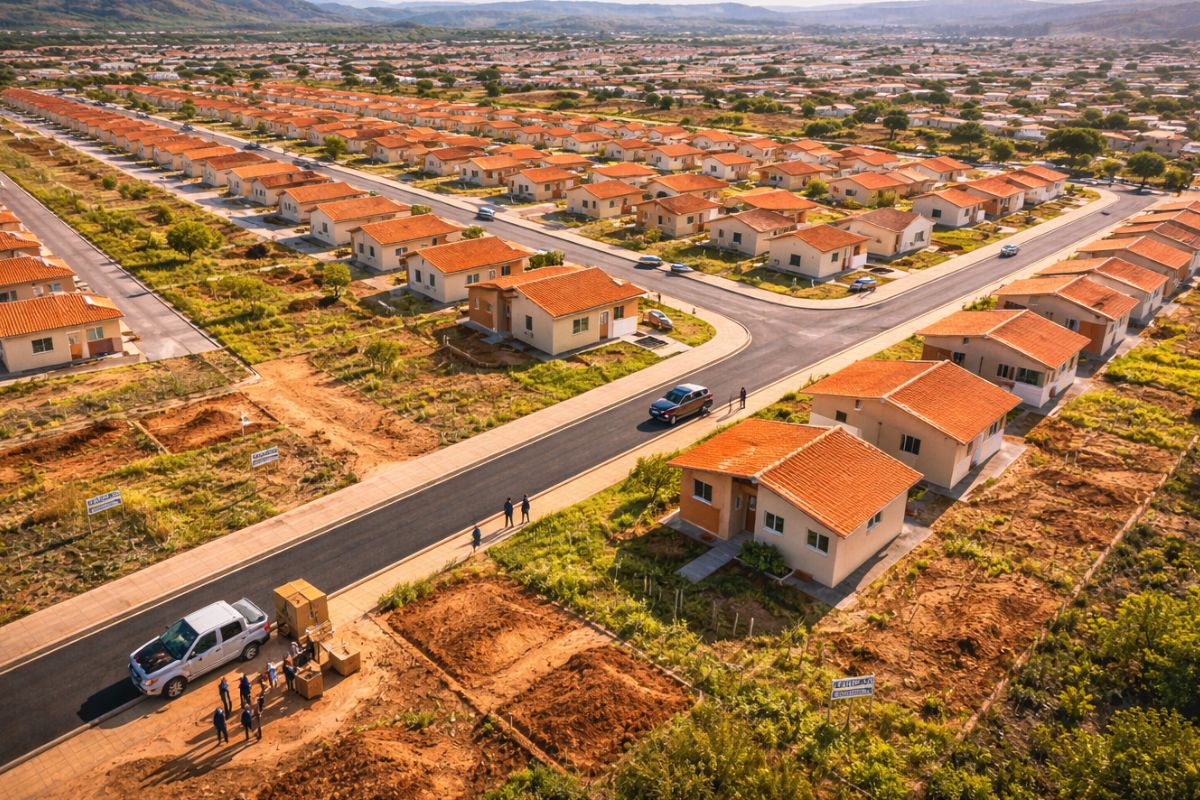


List Shows Brazilian Cities with Basic Infrastructure, Land Starting at R$ 40 Thousand and Simple Houses Ranging from R$ 50 Thousand to R$ 150 Thousand, Where It Is Still Possible to Own a House Without 30-Year Financing.
Instead of competing for a 30 m² studio for R$ 3,000 in São Paulo or Rio, many people are looking at other Brazilian cities that the traditional market ignores. These are municipalities with stores, schools, internet, hospitals, and 300 m² lots costing the price of a used car, where the dream of home ownership is becoming feasible again.
While the capitals “kill” the dream of owning a home with unaffordable financing, these 10 cities offer another route: geographic arbitrage, low cost of living, and the real chance to trade eternal rent for a paid-off property. Below, you can see the context of this turnaround and what each place truly has to offer.
What’s Behind These Cheap Brazilian Cities

Before the list, it’s important to understand the backdrop. Brazil is vast and deeply unequal. Income, formal jobs, and high-value services are concentrated in a few metropolitan areas, while the countryside has plenty of space, land, and cheap housing.
-
The government requests the Federal Revenue Service for a new system to automate the income tax declaration, reducing errors, time, and bureaucracy for millions of Brazilians.

-
Pix in installments, international Pix, and contactless payment without internet: the Central Bank revealed the new features coming to the tool that is already used by almost every adult in Brazil.

-
Mercado Livre has just started selling medications with delivery in up to three hours to your door, and this move could completely change the way Brazilians buy medicines on a daily basis.

-
In Dubai, rising tensions from the war in the Middle East are causing super-rich individuals to leave the Gulf and direct their fortunes to a new financial refuge in Asia.


This creates a simple effect: the closer to the metropolis, the more expensive the square meter; the farther away, the cheaper. However, cheap does not mean abandoned. In many cases, these are Brazilian cities with adequate infrastructure, active commerce, and internet, but without the “toll” of a famous zip code.
For those who work remotely, are retired, or can relocate for local jobs, this difference in cost of living becomes an opportunity for wealth: selling a property or leaving an expensive rent in the capital to buy a house outright in the countryside, often having money left over to invest.
10. Juatuba, Minas Gerais: Affordable Satellite of Greater BH
About 50 kilometers from Belo Horizonte, Juatuba has just under 30,000 inhabitants and urban lots around R$ 40 thousand for approximately 300 m² in popular neighborhoods.
It is the type of city that exposes the schizophrenia of the Brazilian real estate market: while a 50 m² apartment in BH exceeds R$ 500 thousand, here you can buy land for the price of a used car.
Simple 2-bedroom houses typically range from R$ 100 thousand to R$ 150 thousand, in neighborhoods such as Samambaia and Cidade Satélite. The city is strategically located along a route connecting Betim, Igarapé, and Mateus Leme, home to major industries in the region like the Fiat/Stellantis complex, which drives demand for housing.
The infrastructure is not luxurious but functional: paved streets, electricity, water, local commerce, and inter-municipal transport taking workers to Betim and BH daily.
The sensitive side is the documentation: some cheap lots still come without full infrastructure, which means you’ll spend extra on sewage and paving, as well as commute time for those depending on jobs in the capital.
For those who work remotely or are already employed in Betim, Juatuba functions as the “glitch in the Matrix” of the real estate market: instead of paying R$ 1,500 in rent per month in BH, you turn that same money into owning land in the medium term.
9. Itapuí, São Paulo: Forgotten Interior with Balanced Budget
In the Bauru region, with just over 13,000 inhabitants, Itapuí is one of those Brazilian cities that the rest of the state forgot exists. And that’s precisely what drives prices down: simple single-story houses ranging from R$ 100 thousand to R$ 120 thousand and urban lots of 250 m² for about R$ 60 thousand to R$ 80 thousand.
The economy revolves around agriculture and local trade. It is not an industrial hub, has no shopping malls, or vibrant nightlife.
But it has public schools, a health clinic, pharmacy, market, and bakery, with infrastructure that works because it’s not saturated. The atmosphere is genuinely interior: church on Sundays, conversations in the square, barbecues on weekends.
For those in São Paulo paying R$ 3,000 in rent for a cramped studio, working remotely and living in Itapuí becomes a stark math equation: buy a house for R$ 100 thousand, lower living costs, and gain space, silence, and mental wellbeing. It’s the conscious trade-off of “hustle” for financial health.
8. Espírito Santo do Turvo, São Paulo: Real Backyard for the Price of a Parking Spot
With about 4,000 inhabitants, Espírito Santo do Turvo is tiny but offers something rare: large lots, ranging from 500 to 600 m², for around R$ 100 thousand to R$ 120 thousand. It’s land where you can fit a house, a real backyard, a garden, trees, and even chickens if you want.
The structure is minimal but functional: municipal school, health clinic with specific service days, pharmacy, small market, bakery, butcher, church, and central square. It’s the basics for those seeking simplicity. Public transport is almost non-existent, so you need a car to get to larger cities.
The financial aspect is where the town shines: very low property tax, cheap utility bills, and local food prices much lower than in capitals. For retirees and remote workers, it’s almost a “financial hack.” A single minimum wage that barely covers rent in São Paulo can buy a house outright here and even leave some extra cash for the month.
7. Guaratinguetá, São Paulo: Low Cost of Living in a Well-Structured Medium City
Guaratinguetá, in the Paraíba Valley, already plays in another division. With around 120,000 inhabitants, it’s a fully-fledged medium city, with industry, commerce, universities, hospitals, and above-average quality of life, yet still has a significantly lower cost of living than São Paulo.
In more peripheral neighborhoods, lots range from R$ 80 thousand to R$ 150 thousand, and ready houses range from R$ 150 thousand to R$ 250 thousand, prices that today, in many neighborhoods of the capital, wouldn’t even buy a small apartment.
Rent, food, and transportation cost a fraction of what is paid in São Paulo, which makes salaries “stretch” in a way that residents of São Paulo are almost unfamiliar with.
For those selling property in regions like Guarulhos or the periphery of São Paulo, using that money to buy a larger house in Guaratinguetá and still having capital left over is pure geographic arbitrage.
The city offers jobs in industry and services, has cinemas, restaurants, gyms, good schools, and pleasant weather. However, the window of opportunity is not eternal: the more people discover it, the more prices tend to rise.
6. Teixeira de Freitas, Bahia: Regional Hub on the Rise in Southern Bahia
With about 160,000 inhabitants, Teixeira de Freitas is the main municipality in a region that is accelerating growth in southern Bahia. Lots in more distant neighborhoods are priced between R$ 60 thousand and R$ 80 thousand, and houses range from R$ 120 thousand to R$ 200 thousand, prices that are still much lower than in Salvador.
The city has strong commerce, expanding services, well-rated public education, and urban infrastructure developing, with paved streets, improving sanitation, fiber optics coming in, hospitals, and clinics. Everything indicates a city on the rise.
For those able to arrive now, buying land or a house in Teixeira de Freitas is betting on future appreciation, as southern Bahia has been receiving tourism, investments, and new businesses. The challenge remains the same: lower salaries compared to the Southeast and a job market concentrated in commerce and services.
However, for those working remotely or having their own income, the cost of living vs. quality of life equation is very advantageous.
5. Imperatriz, Maranhão: Houses for R$ 50 Thousand and Land for the Price of a Smartphone
With approximately 260,000 inhabitants, Imperatriz is the second-largest city in Maranhão and one of the most aggressive examples on this list of Brazilian cities where you can still purchase a house almost for the price of an economical car. In peripheral neighborhoods, there are reports of simple houses priced between R$ 40 thousand and R$ 60 thousand, and lots for R$ 10 thousand to R$ 15 thousand.
The economy is driven by energy, logistics, and commerce. Basic infrastructure works, with hospitals, schools, universities, active commerce, and a real estate market beginning to heat up with new neighborhoods and developments.
It’s not paradise: the heat is intense, 40 degrees are not uncommon, and there are neighborhoods with precarious infrastructure and rising crime.
But from a financial standpoint, anyone with R$ 50 thousand saved can literally buy a house outright instead of entering a 30-year financing plan.
For small investors, there is also a strategy of buying two or three cheap houses to rent, creating passive income with a total investment that would not buy a single property in capitals.
4. Alfenas, Minas Gerais: University City with Affordable Properties
Alfenas, in southern Minas, has around 80,000 inhabitants and a characteristic that influences the real estate market: it’s a university town, with a federal campus that brings thousands of students every year. This creates a constant demand for rental properties and opens up opportunities for small investors.
Lots in neighborhoods close to the center range from R$ 60 thousand to R$ 80 thousand, and simple houses range from R$ 100 thousand to R$ 180 thousand.
There are reports of apartments bought for around R$ 130 thousand and rented for about R$ 1,000 per month, generating an annual return greater than traditional fixed income.
The quality of life is a strong point: mild climate, organized city, hospitals, varied commerce, lively bars and restaurants driven by the university life, reasonable security, and a tranquil interior culture.
Prices have been rising with the city’s “discovery,” but there are still opportunities for those who want to combine low living costs, good infrastructure, and income potential from student rentals.
3. Mossoró, Rio Grande do Norte: Affordable Medium City with Complete Infrastructure
With around 300,000 inhabitants, Mossoró is the second-largest city in Rio Grande do Norte and frequently appears in surveys of Brazilian cities with the lowest cost of living. In more distant neighborhoods, you can find houses priced from R$ 80 thousand to R$ 100 thousand and lots from R$ 40 thousand to R$ 50 thousand.
The economy relies on oil, salt, commerce, and services. There are shopping malls, cinemas, fast food chains, dealerships, large supermarkets, popular fairs, public and private universities, and a regional hospital, meaning it’s a real city, not a village. Food and services usually cost much less than in capitals like Natal or Fortaleza.
The climate presents challenges: semi-arid, hot, and dry, with little rain and lots of sun. For those who tolerate heat, the math works particularly well for retirees and remote workers: sell an expensive property in a coastal capital, buy a larger home in Mossoró, and still have money left to invest while drastically reducing monthly living costs.
2. Barra Velha, Santa Catarina: Coast with Home Ownership Without Being a Millionaire
On the northern coast of Santa Catarina, with about 30,000 inhabitants, Barra Velha breaks the rule in Brazil: it’s a beach town where it’s still possible to buy land and houses at prices well below other tourist areas in Santa Catarina.
Lots frequently appear between R$ 100 thousand and R$ 150 thousand and houses between R$ 150 thousand and R$ 250 thousand, which, for southern coast standards, is practically a “bargain.”
The city has light sand beaches, clean water, structured commerce, schools, markets, pharmacies, a hospital, and a strong local culture, with traditional festivals and seafood-based cuisine.
In addition to living well, there’s an investment logic: seasonal rentals in summer help pay the property tax and maintenance for the entire year, and the strategic location, about 130 km from larger industrial centers, allows many people to live in Barra Velha and work in another city. For those who work remotely, it’s the chance to enjoy a beach routine without paying millions for Florianópolis or Balneário Camboriú.
1. Ji-Paraná, Rondônia: Economic Frontier with Land for R$ 30 Thousand
Closing the list, Ji-Paraná, in Rondônia, with around 130,000 inhabitants, represents the Brazil that is still being built, where the square meter remains cheap. In distant neighborhoods, lots for R$ 30 thousand to R$ 40 thousand and simple houses priced between R$ 70 thousand and R$ 90 thousand are still a reality.
The city has structured commerce, hospitals, banks, a federal university, a small shopping center, cinemas, restaurants, national supermarket chains, and local fairs with regional products at producer prices.
The economy revolves around agriculture and commerce, with a strategic location on BR-364 linking Rondônia to Acre and Mato Grosso.
The cost of living is one of the major attractions: a family can live comfortably on about R$ 3,000, something impossible in large capitals.
The Amazonian climate, hot and humid, requires air conditioning and increases the electricity bill, but even so, the total monthly expenses are often significantly lower than in the South and Southeast.
For small business owners, service providers, and mobile workers, Ji-Paraná serves as a “reset” for financial life: a paid-off house, less competition, reduced operating costs, and the chance to venture without having to compete with large chains on every corner.
Is It Worth Leaving the Capital for These Brazilian Cities?


In the end, the common denominator for these 10 Brazilian cities is simple: they won’t make you rich overnight, but they can give back something that the big capitals have long taken from the middle class: home ownership, free time, and a balanced budget at the end of the month.
It’s a clear trade-off: status and conveniences of the metropolis for real assets, lower financial stress, and a different type of quality of life, with more space, silence, and a low cost of living. It’s not for everyone, but it’s the strategy for those who realize that the game in the capitals is broken.
And for you, trapped in expensive rent in the capital: which of these Brazilian cities would make the most sense to restart your life and finally get out of rent, if you could move today?








EU SOU DE GUADATINGUETÁ AQUI NAO EXJSTE TERRENO DE 40 MIL E MUITO MENOS CASA DE 70 MIL !!!!!
Residencial Acqua, localizado as margens do Lago do Rio Paraná, município de Anarilândia, Mato Grosso do Sul, um verdadeiro PARAISO, para se viver, co. Terrenos e casas com preços acessíveis e muito baixo. Lietralmente UM PEDACINHO DO CÉU ESTÁ ALI.
Moro aqui em Juatuba MG,na cidade satélite e gostaria muito que o site informasse quais são os lotes de 300 M² que custam R$40,000,00,desde que não sejam pirambeiras ,quero comprar todos esses lotes.
Não falem sobre o que não sabem.
Tolices ditas na internet prejudicam a liberdade de expressão!