





 Portuguese
  English
  Spanish
  5 min of reading
  0 comments


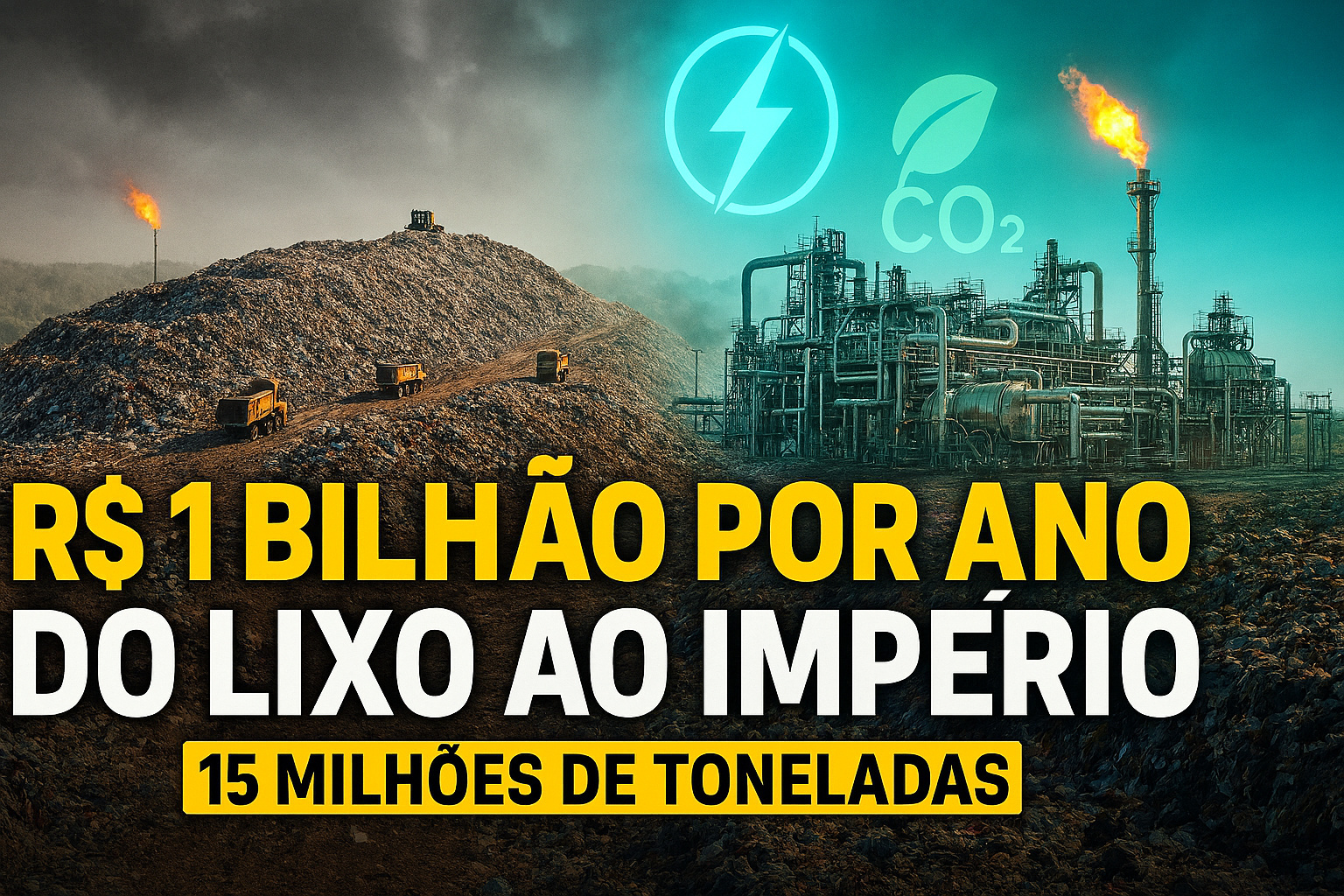
Orizon Transforms More Than 14 Million Tons of Waste Per Year Into Energy, Biogas and Carbon Credits, and Builds Billion-Dollar Empire in Brazil.
Waste has always been treated as a problem in Brazil. For decades, millions of tons of waste were discarded in open dump sites, contaminating rivers, soil, and groundwater. Even after the creation of the National Solid Waste Policy, over 3,000 dump sites still remain active in the country, according to public sector data. For municipal governments, this represents a permanent environmental and financial challenge. For most people, it’s just an unavoidable nuisance.
But for Orizon Waste Valorization, a Brazilian company listed on the B3, this scenario has turned into an opportunity for industrial scale. What was once seen as an environmental liability became a structured business model, generating biogas, electricity, biomethane, fertilizers, and carbon credits. Today, the company manages over 10 million tons of waste per year and operates 18 eco-parks distributed across 12 Brazilian states.
The story begins in 2013, when two experienced entrepreneurs decided to invest in the sector that few wanted to touch: waste.
-
Friends have been building a small “town” for 30 years to grow old together, with compact houses, a common area, nature surrounding it, and a collective life project designed for friendship, coexistence, and simplicity.

-
This small town in Germany created its own currency 24 years ago, today it circulates millions per year, is accepted in over 300 stores, and the German government allowed all of this to happen under one condition.

-
Curitiba is shrinking and is expected to lose 97,000 residents by 2050, while inland cities in Paraná such as Sarandi, Araucária, and Toledo are experiencing accelerated growth that is changing the entire state’s map.

-
Tourists were poisoned on Everest in a million-dollar fraud scheme involving helicopters that diverted over $19 million and shocked international authorities.


From Bankrupt Company to Strategic Waste Platform
The origin of Orizon lies in the acquisition of the former Rastec, a waste sector company that had accumulated approximately R$ 700 million in debt. The company had grown through acquisitions between 2007 and 2009 but lost operational efficiency and entered into financial crisis.

What seemed like a problematic asset hid a strategic element: licensed sanitary landfills. A landfill is not just simple land. It occupies areas that can reach 2 or 3 million square meters, requires years of environmental licensing, and can have a lifespan of 20 to 30 years. Those who control landfills control the final disposal of urban waste from large regions.
The new controllers decided to completely restructure the company. They sold non-strategic areas, renegotiated debts, reduced costs, and concentrated investments in what they called waste valorization eco-parks.
The former Rastec was reorganized and began operating as Orizon.
How an Eco-Park Works
An eco-park is not just a landfill. It is an integrated environmental industrial complex. Different processes happen in a coordinated manner within the same space.
First, the received waste goes through mechanized sorting. Recyclable materials are separated and sold as industrial input. What cannot be recycled goes to the landfill, where organic decomposition generates biogas.
This biogas is captured by drainage systems and sent to processing units. Part of it is used for electricity generation. Another part can be purified and turned into biomethane, a renewable fuel that can replace fossil natural gas.
The leachate, a liquid resulting from the decomposition of waste, is also treated and can generate reuse water for industrial applications.
Additionally, the company produces fuel derived from waste and sells carbon credits, as capturing and controlled burning of methane reduces greenhouse gas emissions.
What was once buried now generates multiple revenue streams.
Business Model: Recurring Revenue and Multiple Profit Lines
The Orizon model is supported by three main pillars.
The first is the disposal fee. Municipalities and companies pay to have their waste received at the eco-parks. This payment generates predictable and recurring revenue.
The second is the monetization of by-products. The sale of recyclables, electricity, biogas, and biomethane creates new layers of revenue.
The third is the sale of carbon credits, linked to emission reduction through methane capture.
This combination transforms a basic collection and disposal service into an industrial operation with multiple financial flows.
Growth, IPO, and Billion-Dollar Numbers
In 2021, Orizon conducted a public initial offering on the B3. The IPO raised approximately R$ 554 million and valued the company at around R$ 1.6 billion.
Since then, growth has accelerated. The company now operates 18 eco-parks and serves directly or indirectly about 40 million Brazilians.
The market value reached approximately R$ 6.5 billion. By 2024, revenue surpassed R$ 1 billion, and adjusted net profit reached R$ 184 million, according to market data released.
These figures do not represent national waste production, but rather the volume managed by the company. Brazil generates more than 80 million tons of urban solid waste per year. Orizon manages a portion of this total but with strong industrial monetization capacity.
Entry Barriers and Competitive Advantage
The waste sector has high natural barriers. Complex environmental licensing, the need for capital-intensive investment, and long implementation timelines make it difficult for new competitors to enter.
Additionally, well-located landfills operate as regional monopolies. Municipalities need to dispose of waste daily, and alternatives are limited.
By transforming landfills into eco-parks, Orizon increased the profitability of an asset that was previously seen only as basic infrastructure.
Waste as a Long-Term Strategic Asset
Waste is a perennial business. It does not depend on traditional economic cycles. During both growth and recession periods, waste continues to be generated daily.
The difference lies in how it is treated. Burying waste represents a cost. Valuing waste represents industrial opportunity.
The trajectory of Orizon shows how a sector considered backward in Brazil was, according to executives in the market itself, about 30 years behind European waste valuation models.
By importing technology and adapting it to the national context, the company created a platform that combines sanitation, renewable energy, and circular economy.
The Structural Challenge of Brazil
Despite the growth in waste valorization, Brazil still faces enormous structural challenges. Thousands of dump sites remain active. The full implementation of the National Solid Waste Policy still encounters financial and technical barriers in various municipalities.
In this context, companies capable of structuring large-scale industrial models tend to gain strategic relevance.
Orizon has not solved the waste problem in the country. But it has demonstrated that waste can shift from being merely an environmental liability to becoming an economic asset.
The Logic Behind the Empire
The decision to invest in waste was seen as audacious. Purchasing a heavily indebted company for nearly R$ 700 million seemed like excessive risk.
But the logic was clear: those who control landfills control a constant flow of raw material. And if this raw material can be transformed into energy, fuel, and environmental credits, the model ceases to be merely sanitation and becomes a base industry.
While part of the country still buries wealth underground, Orizon has built a system capable of extracting value from what was once ignored.
The main lesson is not just in the billions in transactions. It lies in the change of mindset. Waste is not merely disposal. It is underutilized resource.
And in a country that still struggles to eliminate dump sites, those who understand this logic can transform a structural problem into a long-term business.










-

-

-

4 pessoas reagiram a isso.