





 Portuguese
  English
  Spanish
  6 min of reading
  0 comments


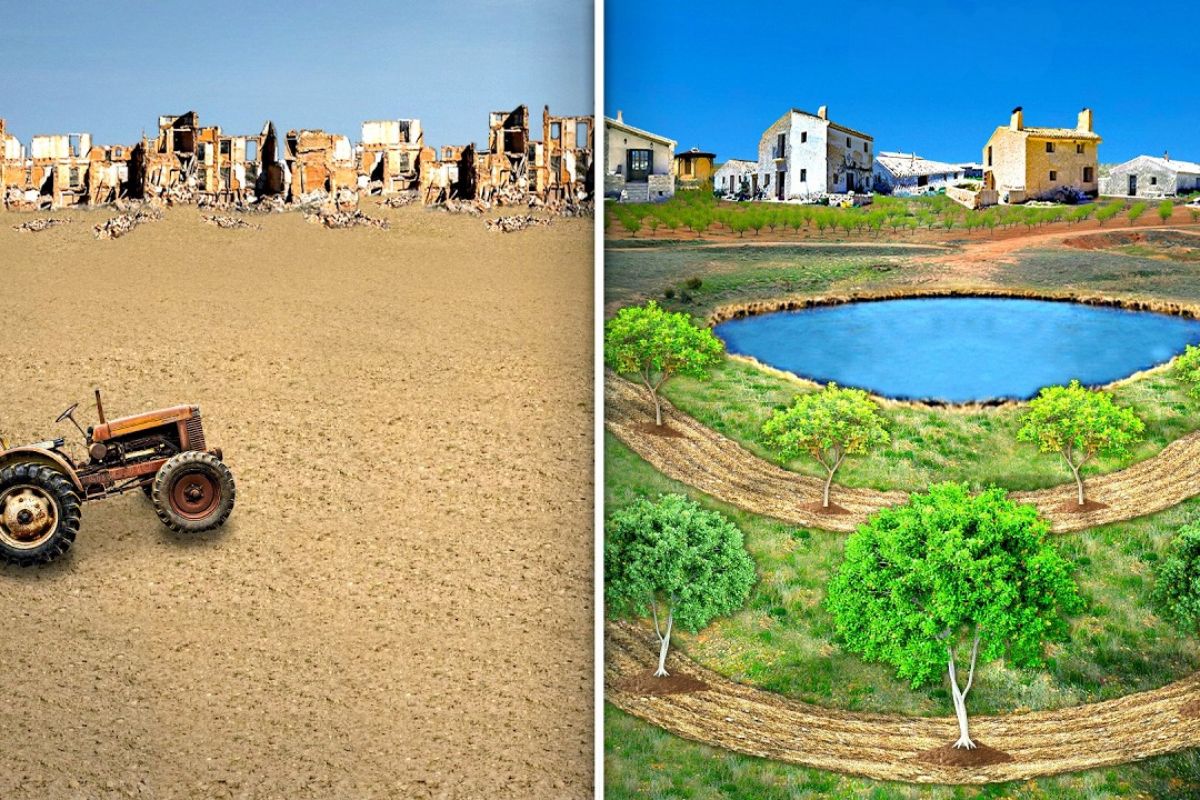
In La Junquera, Arid Plateau of Southern Spain, Old Houses Have Come Back to Shelter People and a Pioneering Restoration Camp Began Training Volunteers. Agroforestry, Ditches, Lagoons, and Keyline Reorganize Water and Soil to Combat Erosion, Rural Abandonment, and Regional Economic Loss with Applied Science and Local Water Capture
La Junquera entered the global conversation on regeneration when it decided to confront an old problem in southern Spain without shortcuts: depopulated territory, scarce water, declining biodiversity, and exhausted soils from decades of management that only extracted. What seemed like an isolated farm began operating as a practical restoration field, with people from around the world working and learning in the same place.
The case draws attention because it does not emerge from a grand plan, but from repeated ecological infrastructure, measured and adjusted methodically. Instead of promising miracles, La Junquera attempts to demonstrate, in practice, that the landscape can once again retain water, sustain vegetation cover, and create a minimum base for the local economy to function.
Why a Village Disappears from the Map and Why It Matters

The expression “abandoned territories” appears as a direct diagnosis: young people leave rural areas, migrate to cities or other countries, and the landscape is reduced to mechanized farms where the owner appears sporadically.
-
Motorola launched the Signature with a gold seal from DxOMark, tying with the iPhone 17 Pro in camera performance, Snapdragon 8 Gen 5 that surpassed 3 million in benchmarks, and a zoom that impresses even at night.

-
Satellites reveal beneath the Sahara a giant river buried for thousands of kilometers: study shows that the largest hot desert on the planet was once traversed by a river system comparable to the largest on Earth.

-
Scientists have captured something never seen in space: newly born stars are creating gigantic rings of light a thousand times larger than the distance between the Earth and the Sun, and this changes everything we knew about stellar birth.

-
Geologists find traces of a continent that disappeared 155 million years ago after separating from Australia and reveal that it did not sink, but broke into fragments scattered across Southeast Asia.

The result is not only social. When life disappears from the territory, management tends to simplify everything, and the soil becomes a fragile support for a single logic of production.
In the southern Spain described here, simplification materializes in extensive grids of almond and olive monoculture, with little consideration for the terrain and natural flow of water.
The reported consequence is a degraded system, with a decline in organic matter, increased erosion, and loss of biodiversity, in a context where water scarcity and climate instability worsen margins for error.
What La Junquera Changed First: Home, People, and Operational Base

The reconstruction begins with the basics and the symbolic: old houses come back to exist as places of work and permanence, not as ruins.
The physical restoration of the village creates the conditions for a continuous effort because an ecological project without constant human presence tends to become delayed maintenance, and delayed maintenance leads to silent collapse.
The organizational shift appears with Camp Altiplano, described as the first Ecosystem Restoration Camp in the world, that transforms the restoration routine into a system of learning and labor.
The narrative includes the presence of the movement’s founder, John D. Liu, and the passage of thousands of people over seven years, reinforcing that La Junquera has become a magnet for international volunteerism guided by practice.
Water as Survival Engineering: Lagoons, Ditches, and Microecosystems
The restoration in La Junquera is described as water management applied to the terrain. Lagoons are dug in strategic positions, at the bottom of valleys, to receive water from intense rain events that converge into the basin.
Meanwhile, contour ditches function as trenches to reduce erosion, hold water, and induce changes in vegetation along the moisture gradient.
The technical logic is clear: create a structure for water to remain on the land long enough for roots, oxygen, and microbiology to start operating again.
The change in vegetation cover is not treated as aesthetic, but as a sign of microecosystems emerging in an arid, windy, and cold climate, where regeneration is slow and depends on repetition.
Soil as Active: Decompaction, Compost, and Seed Mix

In the described experimental field of five hectares, the starting point was decompaction, without tilling the soil as a plow would do.
The use of a deep ripper is presented as a technique to create paths for infiltration and rooting, reducing the physical blockage that transforms rain into runoff and runoff into soil loss.
Then comes the fertility-building package: applying compost to increase organic matter, change texture, and accelerate biological activity, along with a mix of 30 different seeds for cover.
The intention is to stabilize the surface, diversify roots, shade, and create biological resilience where there was previously only exposure.
Agroforestry Instead of Grids: Productivity with Layers and Less Risk
The strategy does not abandon the region’s dominant crop, almonds, but attempts to redesign the system around it.
Instead of pure monoculture, layers of rosemary, lavender, and thyme are introduced in alternation, creating diversity and allowing space for mechanization without destroying the aromatic component. This addresses a central economic point: maintaining productive viability without reverting to a pattern that degrades.
The discourse of risk appears without romanticization: monoculture is vulnerability to fluctuations in climate, pests, diseases, and market.
Biodiversity is treated as systemic insurance, not as a detail. The direct comparison with industrial orchards in the background reinforces the contrast between a model that accelerates erosion and another that attempts to redistribute water and build fertility.
Keyline and Scale: From the 5-Hectare Experiment to a 1,100-Hectare Farm
The Keyline is presented as a water management and agriculture system that uses natural contours to redistribute moisture from where it concentrates to areas where it lacks.
In practice, this means drawing lines and interventions to guide water through the land, reducing erosive concentration and increasing useful infiltration.
The scale issue arises when the project itself describes the experimental field as part of a larger farm, 1,100 hectares, and raises the challenge of translating learnings from the camp to more conventional areas, with conventional machinery and more pragmatic choices.
The idea is not to copy everything, but to incorporate strips of vegetation and cover that improve soil health and reduce erosion while maintaining harvests.
Alvalal and the Regional Effect: When Technique Becomes Network
The expansion is not restricted to the property. The narrative connects the camp to a territorial articulation called Alvalal Association, which works to restore the territory and carries the discussion to almond orchards outside of La Junquera, including in areas at the foot of the Sierra Nevada.
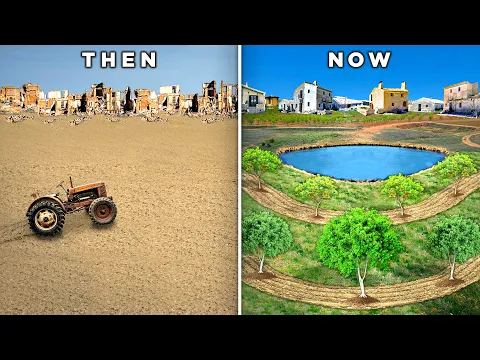
The strongest visual marker is simple: where once desert soil predominated under orchards, green cover emerges.
This section reinforces a point of credibility: the field contrast is what convinces, because it shows that management can reduce plowing, sustain organic matter, and maintain biodiversity even in a context of scarce water.
The existence of over 80 ecosystem restoration communities worldwide, inspired by this vision, appears as a sign of the social method’s replication, not as automatic proof of ecological success.
La Junquera serves as proof of concept for an uncomfortable idea: restoration is not just planting trees; it is reorganizing water, soil, work, and human permanence in the territory.
The case gains strength precisely by combining simple water engineering, soil management oriented by cover, and a social arrangement that sustains continuous operation, with volunteerism and practical learning.
To Truly Engage: If You Had to Choose One Point to Start Something Similar, Water, Soil, or Community, what Would Be the First Viable Step in Your Reality and Why? And Where Do You Think Projects Like La Junquera Most Fail in Practice: Lack of People, Lack of Method, or Lack of Economic Scale?








-

-

-

5 pessoas reagiram a isso.