





 Portuguese
  English
  Spanish
  9 min of reading
  0 comments


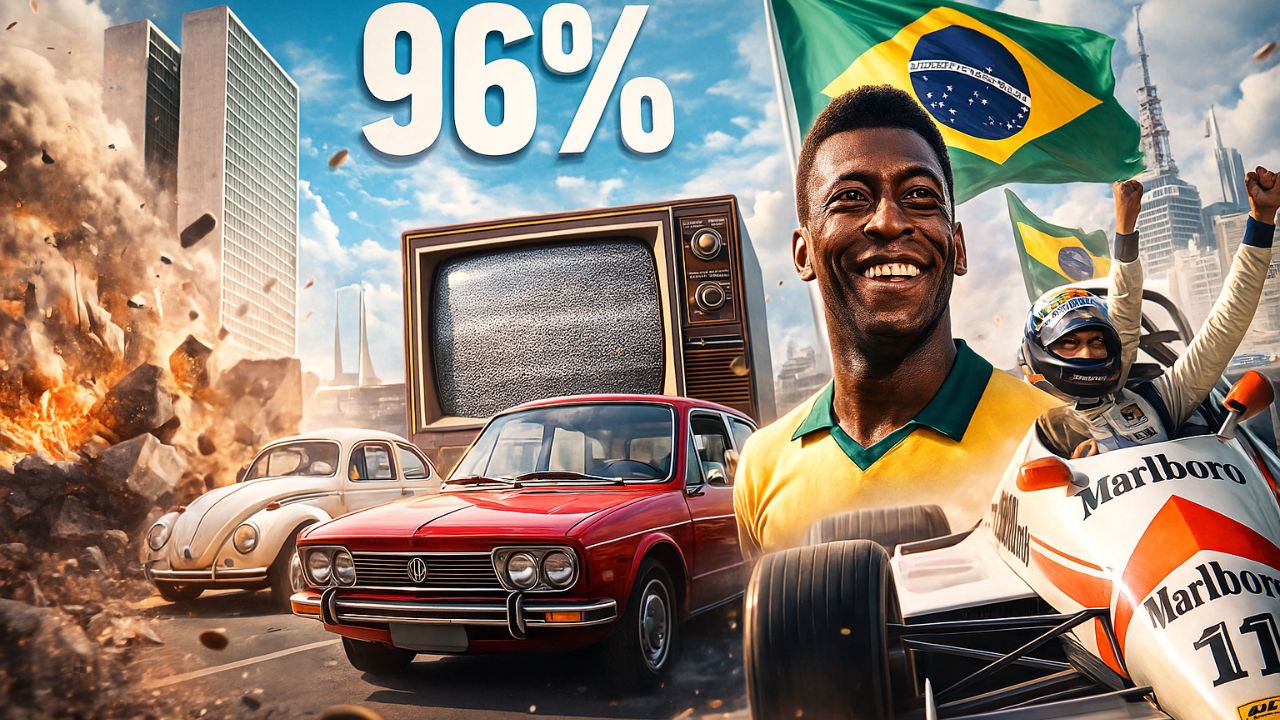
In 1981, Brazil experienced a heavy economic crisis, political attacks, and uncertainty, while witnessing Pelé being crowned Athlete of the Century, Piquet as champion, iconic cars emerging, and television dominating the country amid censorship and entertainment.
The drop of 4.3% in GDP, inflation close to 96%, and the bomb explosions at Riocentro made it clear that Brazil was living through a tense, unequal, and contradictory period, while political opening was slow and faced strong resistance. Still, daily life also revolved around soccer, soap operas, memorable commercials, and an automotive industry trying to survive tough times with exports, ethanol, and new models on the streets.
In everyday life, Brazil faced crisis on almost all fronts, but did not stop seeking relief in leisure, music, cars, and the television that was already dominating family routines.
In the second paragraph of the lead, it is important to show the contrast between crisis and culture, between fear and escapism, between politics and daily life. Here you tie in TV, soccer, music, and cars as elements that pulled Brazilians forward, even as everything went wrong in the economy.
-
Friends have been building a small “town” for 30 years to grow old together, with compact houses, a common area, nature surrounding it, and a collective life project designed for friendship, coexistence, and simplicity.

-
This small town in Germany created its own currency 24 years ago, today it circulates millions per year, is accepted in over 300 stores, and the German government allowed all of this to happen under one condition.

-
Curitiba is shrinking and is expected to lose 97,000 residents by 2050, while inland cities in Paraná such as Sarandi, Araucária, and Toledo are experiencing accelerated growth that is changing the entire state’s map.

-
Tourists were poisoned on Everest in a million-dollar fraud scheme involving helicopters that diverted over $19 million and shocked international authorities.


Daily Life Under Pressure: little money, high inflation and TV on
In 1981, Brazilians felt the impact of a decade that started off difficult. GDP fell 4.3% and accumulated inflation reached nearly 96%, eroding salaries even before the end of the month. Shopping at the supermarket or planning any expense became an exercise in survival.
Nevertheless, cultural life and leisure did not stop. Television was already the main means of entertainment and information in large cities and was starting to penetrate the homes of rural areas. Sunday nights had an almost obligatory script, with comedy shows, variety programs, and Fantástico closing the weekend with news and special attractions.
At the same time, the military regime still controlled the country. Political opening was moving forward, but slowly, monitored and filled with limitations. Censorship remained a shadow over soap operas, music, humor, and newspapers, forcing artists to resort to metaphors, ironies, and veiled critiques. Those who crossed the line risked having their work cut or faced exile.
In the middle class, however, there were signs of ascension. More families had access to education, household appliances, and, primarily, automobiles. In a country that was already getting used to alcohol as fuel, having a car in the garage was a symbol of status, freedom, and modernity, even if the installment payments weighed heavily on the budget.
Delicate Transition: Riocentro Attack and Political Maneuvers
If the economic scene was harsh, the political climate was explosive. The most significant episode was the Riocentro attack on April 30, 1981. During a concert to celebrate Labor Day in Rio de Janeiro, two bombs exploded in a car in the pavilion’s parking lot. Sergeant Guilherme Pereira do Rosário died and Captain Wilson Dias Machado was injured.
The case was attributed to radical sectors of the Armed Forces that wanted to halt political opening. Instead of retreating, these groups tried to create a climate of fear to justify the continuation of a tougher regime. The attack revealed how fragile the transition still was.
In institutional terms, President João Figueiredo resorted to electoral adjustments to try to maintain control. The so-called Figueiredo package instituted total linkage of votes, forcing voters to choose candidates from the same party for all positions, in addition to prohibiting coalitions. In practice, it was a way to make it difficult for opposition parties to organize, even as direct elections for some Executive positions were being reestablished, except for president, mayors of state capitals, and areas considered national security.
Pelé Athlete of the Century, Flamengo, Grêmio, and Piquet: The Pride of Sports

Amid so much tension, sports helped lift the nation’s self-esteem. In 1981, Pelé received the title of Athlete of the Century from the French newspaper L’Équipe, sealing his image as the greatest symbol of world football. For a Brazil experiencing economic and political crisis, seeing Pelé recognized abroad was a source of pride and reaffirmation of its own identity.
In domestic football, the year was also significant. Grêmio won the Campeonato Brasileiro for the first time by defeating São Paulo in the finals, solidifying the gaucho club among the country’s major forces.
And Flamengo had an unforgettable season. In November, it won the Copa Libertadores. In December, it went to Japan and defeated Liverpool 3-0, securing the intercontinental club title and embedding in the popular imagination the image of a team that seemed to play for all of Brazil.
On the racetracks, the atmosphere was one of speed and risk. In October, Nelson Piquet became the Formula 1 World Champion at the Las Vegas GP. Even finishing in fifth place, he reached 50 points and surpassed Argentine Carlos Reutemann, who finished the race with 49 points. Seeing a Brazilian at the top of the world of motorsport helped balance the fact that Brazil was experiencing an intense crisis off the tracks, at least emotionally.
When Brazil Experienced Crisis Also in the Automakers: Decline in Sales, Ethanol, and Exports
The Brazilian automotive industry, which had grown significantly in the 1970s, faced the reality of 1981. The internal crisis and high inflation drove down production and sales. The smaller and more economical cars were the most affected, with a drop of about half compared to the end of the previous decade.
To survive, automakers followed two paths. One was to increase exports, using the external market as a lifeline to compensate for the drop in domestic sales. The other was to invest in the popularization of alcohol as fuel. The program encouraging the use of ethanol remained strong, and Brazilians were already accustomed to refueling with alcohol, an alternative to reduce dependence on imported oil.
In the market, the four giants dominated: Volkswagen, General Motors, Ford, and Fiat. Volkswagen remained the absolute leader in production. Even in a difficult year, 1981 saw the birth or strengthening of models that would become icons. The Ford Del Rey was launched with the mission of replacing the traditional Landau, reflecting the global trend towards smaller and more rational cars.
Volkswagen launched the compact sedan Voyage, produced in Brazil as part of the BX family, alongside Gol, Parati, and Saveiro. GM, in turn, capitalized on the success of the Chevette and created the sporty SR version, featuring a more aggressive look and a 1.6 engine.
Fiat expanded its horizons. The Fiat 147 gained prominence, including sporty versions, and was already reaching Argentina, where it would soon have local production. The sporty Miura, equipped with the 1.6 engine from the Passat TS, showed that it was still possible to dream of performance and design in a tight market. The Alfa Romeo 2300, under Fiat’s control, began using hydrated alcohol, joining the ethanol wave.
In sales figures, the Del Rey debuted in ninth place, and the Voyage in 12th, with over 15,000 units sold in a year already marked by a sharp decline compared to 1980. Leadership changed hands: the Volkswagen Beetle lost its top spot to the Fiat 147, a clear sign that even while Brazil experienced crisis, consumers sought more compact and modern models.
1981 also marked the end of Chrysler in Brazil. Acquired by Volkswagen, the American brand ceased selling its models here, such as the Polara and Dart, closing a cycle of major national sports cars. From then on, the country began to coexist more with spiced-up versions of standard cars than with classic high-performance sports cars.
Dominant TV, Soap Operas, Humor, and Commercials Everyone Remembered
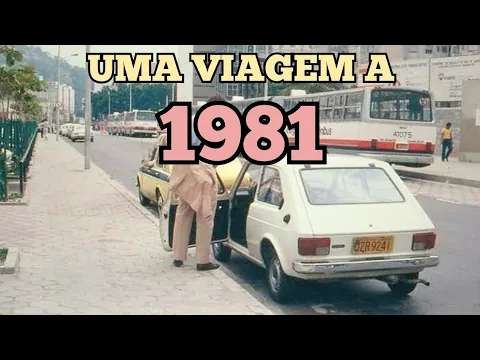

In the cultural sphere, 1981 was a year of effervescence. Brazilian popular music remained strong as national rock began to gain traction, with bands like Blitz and artists like Lulu Santos emerging to mark the decade.
On the radio, audiences listened to a bit of everything. Hits like Planeta Água by Guilherme Arantes accompanied reflections on the planet. John Lennon, who died the previous year, continued to play strongly with songs like Starting Over. Gilberto Gil shone with Palco, while Lady, sung by Kenny Rogers, showcased the strength of romantic country. The group Roupa Nova burst onto the scene with Clarear, and Kim Carnes’ raspy voice achieved international success on Brazilian charts.
However, TV was the center of domestic life. Rede Globo, the country’s largest broadcaster, aired soap operas that would become classics. Baila Comigo, by Manoel Carlos, premiered in March 1981 with the story of twins separated in childhood who reunited in adulthood. In August, Jogo da Vida, by Sílvio de Abreu, mixed comedy and drama as it dealt with the ambitions and conflicts of a São Paulo family. In May, at 6 PM, Ciranda de Pedra debuted, inspired by the novel by Lygia Fagundes Telles, set in São Paulo in the 1940s.
Sundays were a chapter apart. Programming began with O Planeta dos Homens, followed by Os Trapalhões, culminating in Fantástico, the so-called show of life, at 8 PM. These programs helped build the collective imagination of the country, setting trends, fashions, and even opinions on the week’s news.
Advertising also left its marks. Commercials like those for Martini Bianco, Kid’s milk candy, and Chokito chocolate showcased a Brazil eager to consume, celebrate, and, for a few seconds, forget about the heavy crisis in the real world. The catchy tunes from these ads stuck in people’s minds and became part of the era’s soundtrack.
Meanwhile, the World Was Also Facing Its Own 1981
While Brazil tried to balance between crisis and hope, the international scene was also tumultuous. On January 20, Ronald Reagan assumed the presidency of the United States with a neoliberal economic agenda and a tougher stance in the Cold War. Shortly after, in March, he survived an assassination attempt when shot in Washington by John Hinckley Jr.
In Vatican City, in May, Pope John Paul II was the target of an assassination attempt in St. Peter’s Square, being hit by shots fired by Mehmet Ali Agca. The Pope survived, underwent surgery, and later visited the shooter in prison, granting him forgiveness in a gesture that made headlines worldwide.
In Eastern Europe, Poland was experiencing extreme tension with the strengthening of the Solidarity trade union movement, led by Lech Wałęsa. In December, the communist government declared martial law to try to contain the wave of strikes and protests.
In science and technology, 1981 marked the year of the first flight of the space shuttle Columbia. The STS-1 mission, launched on April 12, marked the beginning of a new era in space exploration, with a reusable spacecraft returning to Earth two days later.
In global pop culture, the world bid farewell to Bob Marley, who died in May after fighting cancer. In July, over 700 million people paused in front of their TVs to watch the wedding of Prince Charles and Lady Diana Spencer at St. Paul’s Cathedral in London, one of the most-watched media events in history.
A Year of Contrasts That Still Echoes in Memory
By putting all these pieces together, 1981 emerges as a year when Brazil experienced a profound crisis, but also showed its capacity to create, cheer, consume, dream, and feel. The economy was sinking, politics were boiling, the industry was struggling as best as it could, while football, TV, music, and cars helped stitch together an identity amid the chaos.
It was a country that turned on the TV to watch soap operas, laugh at comedies, and get informed on Fantástico, that paused to listen to music on the radio, that followed Piquet, Pelé, Flamengo, and Grêmio, and that continued to fuel their cars, even amidst inflation, to try to maintain some sense of normalcy.
And you, when you think of 1981 and the early 80s, what comes to mind first: the memory of the crisis or the nostalgia of the music, soap operas, and cars of that time?









Seja o primeiro a reagir!