





 Portuguese
  English
  Spanish
  8 min of reading
  5 comments


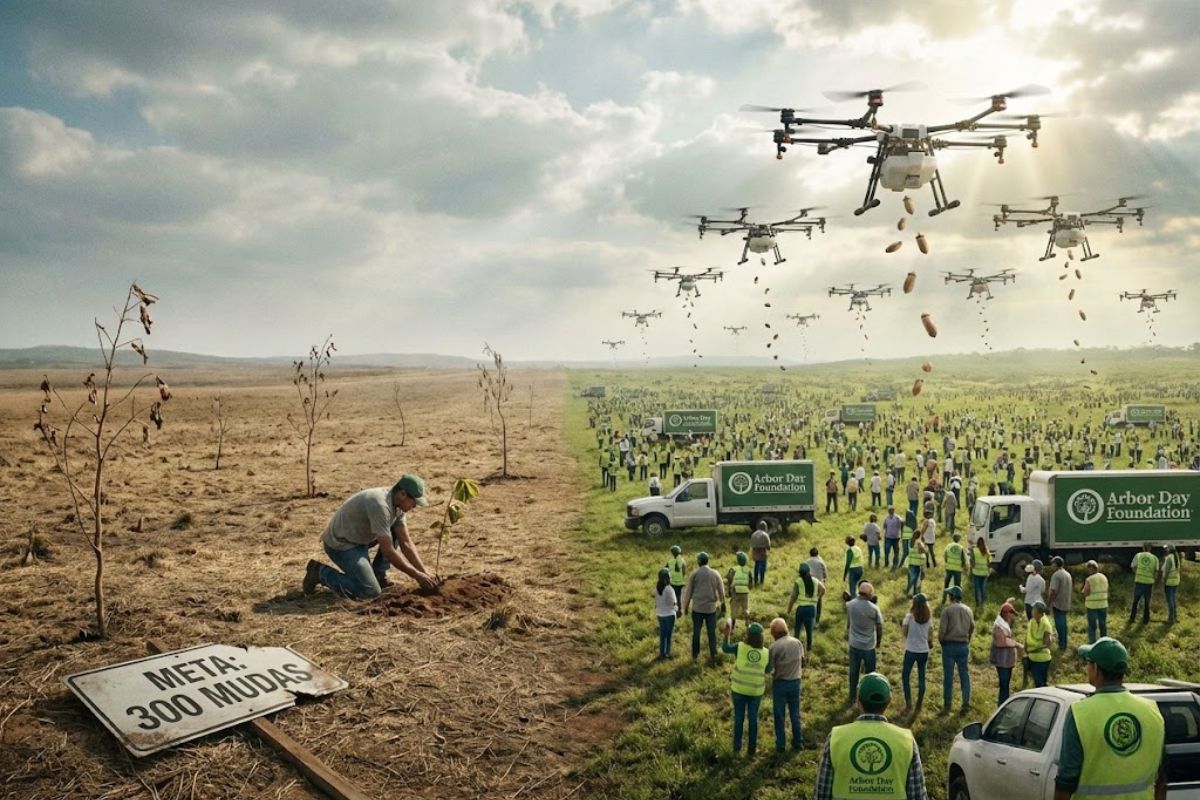


20 Million Trees Did Not Come Out By Hand: On The First Day, There Were Only 300 Seedlings, Even With Holes, Covering, And Pull Test. On Day Two, The Crowd Helped, But The Scale Required Drone, Mark Rober, Partnership With The Arbor Day Foundation And Teamtrees.org, Where US$ 1 Becomes 1 Tree.
20 million trees stopped being a beautiful goal and became a reality check when the planting pace revealed the size of the gap between intention and execution. The promise was simple, direct, and exciting, but the ground told another story: hole, tree, covering, water, repeated until exhaustion.
The turnaround came when the target began to sound like a joke in the face of an impossible-to-ignore number: in an entire day, only 300 seedlings. From that point on, the project shifted from “willpower” mode to “scale” mode, bringing together people, drone, partnership with the Arbor Day Foundation and an aggressive conversion rule: US$ 1 becomes 1 tree, centered on teamtrees.org.
The Beginning By Hand: Hole, Tree, Cover, Water And The Obsession With Survival

The planting began in the most physical way possible, with a sequence that seemed easy to explain and difficult to sustain for hours. Hole, tree, cover, water.
-
Spain surprises the world by erecting 62 artificial dunes, mixing sand with natural remains of posidonia, and causing the structure to lose only 1.4% of its volume in 1 year.

-
With 16 Bulava missiles, improvements in acoustic stealth, and a design focused on silent patrols, Russia’s nuclear submarine was born to ensure Moscow’s invisible retaliation and has become one of the pillars of its maritime strength.

-
‘Populous’ city in Rio among the worst in Brazil in national ranking and exposes silent development crisis.
-
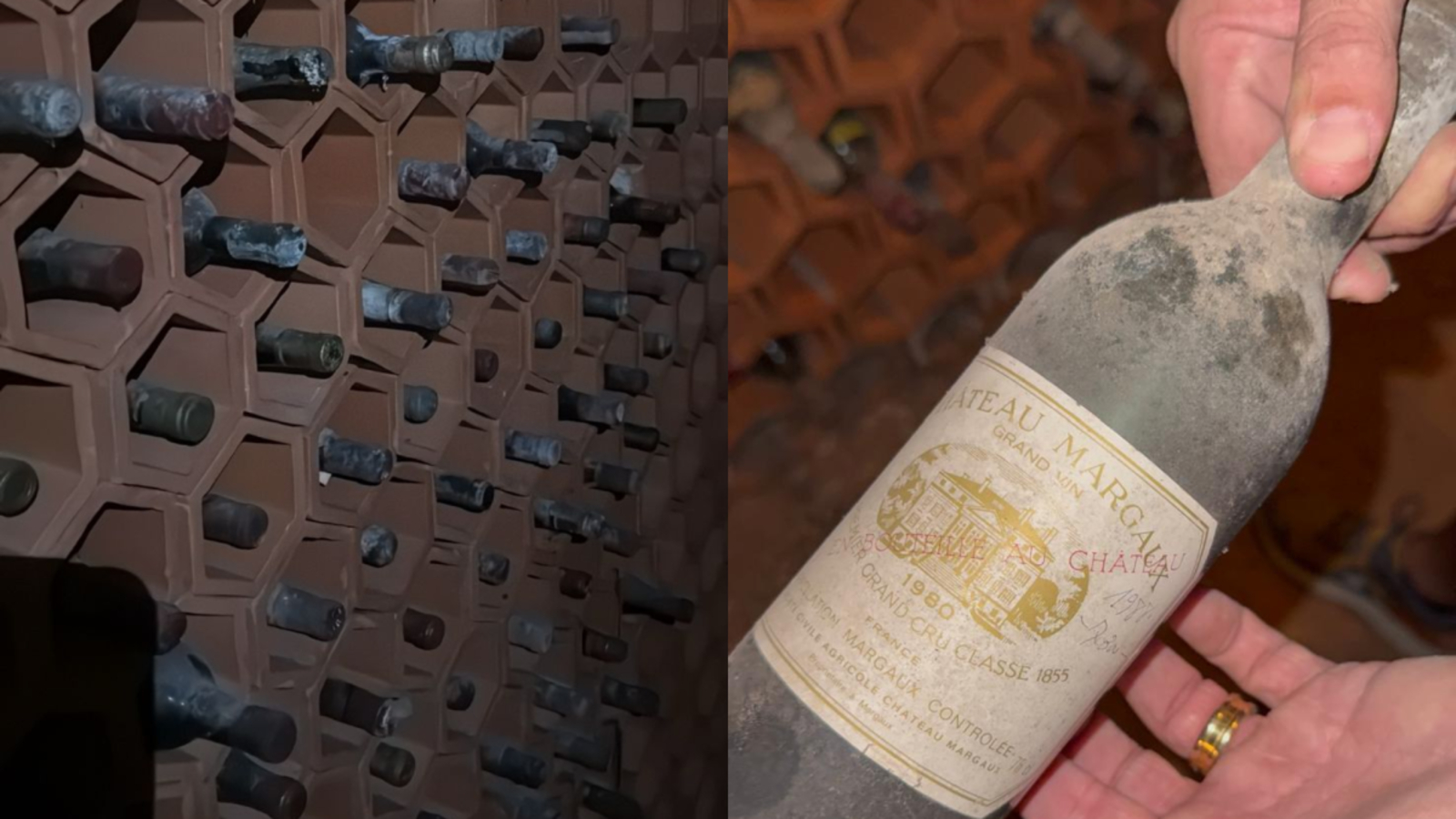
Couple buys house in the South Zone of São Paulo, opens a hidden door in the garage, and finds a secret wine cellar with dozens of old wines forgotten since the 1970s.

Then repeat. And repeat. Repetition is the key: to reach 20 million trees, each step needs to be quick, consistent, and flawless.
The covering around the seedling becomes part of the ritual. It serves as protection, as finishing, and as an attempt to hold moisture, making the planting look more “ready” and less improvised.
When it started to rain, watering ceased to be urgent, but the main message didn’t change: a rain doesn’t crush the ambition of 20 million trees, it just alleviates one step of the process.
In the midst of practice, a character appears who changes the tone of the effort: Sarah, introduced as a tree expert. She doesn’t bring theory; she brings checking.
The method is simple and almost brutal: pull the seedling to see if it comes out of the hole. If it comes out, the planting has failed. If it doesn’t come out, the tree is firm. This test becomes a reference for the entire group, a quick way to say “this will survive”.
The Pull Test And The Quality Standard: Firm Tree Is Well-Done Planting


The goal of 20 million trees is not just planting; it’s planting in a way that doesn’t waste resources. Therefore, the story insists on the firmness standard.
The tree needs to “hold” in the soil. The group pulls, checks, reinforces, adjusts. When someone says it’s “very firm,” the phrase becomes a quality seal.
The pull test also creates a curious contrast: planting seems simple, but survival depends on details.
The seedling coming out of the hole is a sign that hours of work could mean nothing. The obsession with firmness is the attempt to prevent the effort from dying in the first wind, in the first carelessness, in the first repeated mistake.
This concern for quality also appears in the care of the root system. The circulating idea is direct: without oxygen in the roots, the tree dies. This gives urgency to how the seedling is positioned, to the hole’s space, and to the final adjustment before covering.
Spacing Two Meters: Planting Turns Logistics, Not Just Good Will
When many people get hands-on, planting stops being just digging and watering. It becomes logistics. A practical rule emerges: space the trees two meters apart so roots can grow without competing.
This detail changes the scene. The spot ceases to be a jumble of seedlings and becomes a field design. The spacing decision also reinforces an important point: 20 million trees is not an image; it’s a system. If planted incorrectly, the target may be reached in numbers but loses in health and permanence.
In the midst of the effort, the conversation gains humor and fatigue. Some talk to the trees, as if that accelerates growth.
Some turn the repetition into jokes to cope. And some just want to finish another seedling without feeling their back complain. Lightness exists, but the weight of the goal never leaves the background.
The Target Becomes A Joke With 300 Seedlings Per Day And Reality Pushes For Scale
The number that becomes a watershed moment is brutal in its simplicity: in one day, only 300 trees. When someone says this out loud, the math explodes in everyone’s heads.
It’s the kind of pace that transforms 20 million trees into a distant dream, even with total dedication.
The feeling is not one of moral failure; it’s of physical limit. Backs hurt. The hole seems larger with each repetition. Manual planting shows that the problem is not wanting; it’s multiplying.
And it’s at this moment that the decision to call more people for the next day emerges, as if human volume could solve numerical volume.
The crowd arrives, each person receives a seedling, and the field becomes a collective operation. People digging, people carrying, people testing firmness, people helping those who are stuck in the hole.
One participant says they saw the call and “had to participate.” Another says it’s a once-in-a-lifetime opportunity. The energy is real, but the target remains there, intact.
Day Two With A Crowd: Mass Planting, Holes, Drone Photo And The Shock Of “Not Even Close”
With more people, the planting looks visually impressive. There’s a clear comparison between before and after: a drone photo showing an empty field and another showing the field full of seedlings.
The image serves as an emotional reward because it gives a sense of rapid transformation.
But the story doesn’t let the reader be fooled: despite the several people, they didn’t even get close to planting 20 million trees. This sentence is the second shock.
The first was 300 seedlings per day. The second is realizing that even a crowd, by itself, doesn’t solve the scale.
In this scenario, numbers appear that illustrate individual effort: one person says they dug 473 holes.
It’s a number that impresses on the human scale but reinforces the absurdity of the total. When a huge feat still seems small in the face of the goal, the method needs to change.
Enter The Drone: Using Strengths To Overcome The Manual Planting Bottleneck
The response to frustration isn’t to give up. It’s to reposition. An idea emerges that signals a category change: “I have an idea with a drone.”
The drone comes in as a promise of productivity and a symbol of scale, as manual planting has already shown its limitations.
The plan becomes clearer with the presentation of the tech partner: Mark Rober. He is described as someone who worked at NASA and sent something to Mars, and now would apply that engineering mindset to a forest problem. The logic is practical: use your strengths.
People plant, the drone accelerates, and the strategy tries to transform a strength challenge into a system challenge.
The drone is not just an accessory here. It’s an attempt to break the bottleneck that turned 20 million trees into a daily joke. It represents the shift from “let’s try” to “let’s design a method”.
Arbor Day Foundation: When Planting Becomes Professional Execution At Scale Of Millions
The definitive change happens when a partnership with the world’s largest tree planting NGO, the Arbor Day Foundation, enters the picture. The narrative begins to insist on three points: they plant millions, ensure high survival rates, and care about the results.
This section shifts the project’s proposal. Instead of relying solely on volunteers in the field, the goal of 20 million trees becomes something that can be executed by those already operating at scale. It’s the trade of manual effort for professional delivery.
The idea doesn’t erase the value of human mobilization. On the contrary: it redirects the crowd’s energy towards a mechanism that can truly grow without breaking people in the process.
US$ 1 Becomes 1 Tree: The Simple Rule That Turns Donation Into Forest
The rule is repeated because it’s the key to the plan: US$ 1 becomes 1 tree. One dollar donated, one tree planted. The demonstration is direct and almost didactic: donate US$ 1, you get one tree. Donate US$ 30, you get a series of trees. The mechanics are simple enough for anyone to understand without a tutorial.
This simplicity isn’t a detail; it’s a strategy. 20 million trees requires a rule that doesn’t create friction. The less friction, the more people participate. The more people participate, the quicker the goal stops being a joke and becomes an achievable number.
The website serves as the axis of the call: teamtrees.org. The message is clear: every dollar donated on YouTube or in teamtrees.org becomes a planted tree. Planting stops being just physical presence and turns into financial participation translated into professional execution.
100 Thousand Trees And The Turnaround: From Fun To Demanding Action
The story also brings a personal commitment to increase credibility. The promise is objective: to plant 100 thousand trees through a donation of US$ 100 thousand. This serves as a signal that it’s not just a public request but direct involvement in the goal of 20 million trees.
The discourse takes on a tone of demand. There’s self-criticism for not always being environmentally correct, for having made mistakes, and the provocation that many people still expect “someone else to do it.” The response is simple: it doesn’t work that way. Everyone is needed.
A social discomfort also arises: people laughing at the generation for “Twitter activism” without practical action. At this point, 20 million trees transforms from mere planting into a public test of execution capacity. The call is persistent: donate now, don’t delay, seize the chance to act.
Why Millions Are Called: The Goal Only Stops Being A Joke When It Becomes A Replicable Mechanism
The final arc closes the logic with clarity. First, a manual attempt. Then, the crowd. Next, drone as a scale solution. Lastly, partnership with the Arbor Day Foundation and the rule US$ 1 becomes 1 tree via teamtrees.org. What seemed like just a planting challenge becomes a conversion system: social energy into trees in the ground.
Do you think that 20 million trees only comes off the page with the rule US$ 1 becomes 1 tree, or can we still get there with manual planting and crowds in the field?








Vi el video de Mark Rober en YouTube. Esto ni siquiera lo resume bien. Devuelva me 5 min
En Chile, a travez de DL701 del año 1974,, sobre fomento forestal, se plantaron 5 mil millones de árboles, posicionando al sector forestal como la segunda fuente de ingresos y trabajo del pais.
Virou palhacada isso de fazer você perder tempo lendo algo que não é real criado por ia