





 Portuguese
  English
  Spanish
  5 min of reading
  0 comments


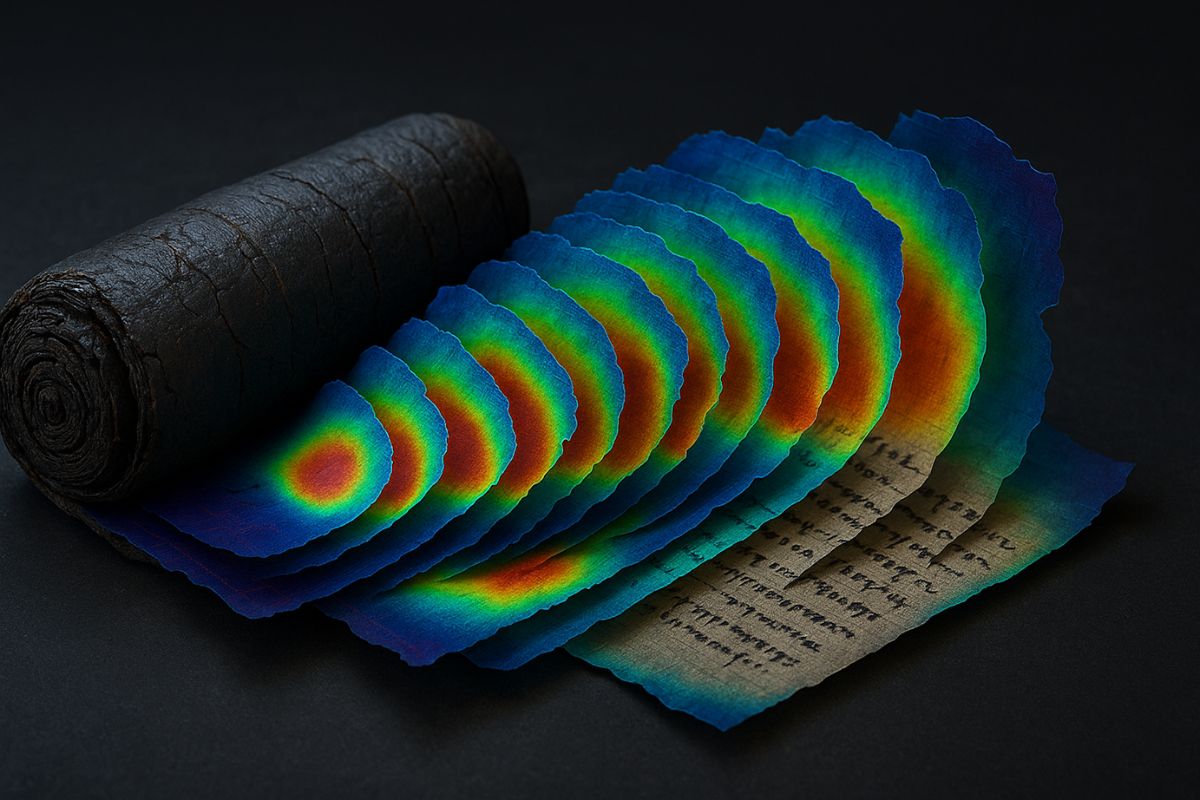
In AD 79, the eruption of Mount Vesuvius buried Herculaneum under layers of ash and pyroclastic flows, turning its library into fragments of charred papyrus. For centuries, any attempt to unroll these scrolls led to the irreversible destruction of the texts.
Now, researchers like Brent Seales from the University of Kentucky are combining high-resolution X-ray tomography with artificial intelligence algorithms to gain the first glimpse of these millennia-old layers without physically touching them, the information was published this week by Earth.com.
Archaeologists Make Extraordinary Find of Ocean-Engulfed City Built 140,000 Years Ago
ARTICLE CONTINUES BELOWSee also
Samsung launches cordless vertical vacuum cleaner with up to 400W of suction and relies on AI to automatically recognize corners, carpets, and different surfaces.

The lost continent beneath Europe: separated from North Africa about 240 million years ago, comparable in size to Greenland, Greater Adria was crushed over 40 million years and left geological marks from the Alps to the Balkans.

A cold front advances through the South this Saturday and reaches the Southeast on Easter Sunday with heavy rain and a drop in temperature, while the North and Northeast face the risk of storms and flooding throughout the holiday.
Brazil is about to inaugurate the largest maritime surveillance system in its history, with radars, infrared cameras, and autonomous sensors installed on Ilha Grande to monitor the entire Brazilian coast in real time.

The Eruption of Vesuvius in AD 79
According to historical records (Pliny the Younger) and archaeological evidence, the Mount Vesuvius erupted in mid-October AD 79, unleashing a Plinian column of ash and pumice over 30 km high, followed by six waves of pyroclastic currents that reached temperatures between 140 °C and 360 °C.

These incandescent clouds swept Herculaneum, burying buildings and taking lives instantly (Wikipedia). Archaeological fragments confirm that a significant part of the city was covered by pyroclastic deposits more than 10 m thick, preserving structures and objects but turning texts into charred, illegible papyrus.
Herculaneum, a neighbor of Pompeii, housed a prosperous Roman elite, whose library contained rolls of papyrus with literary, philosophical, and legal works.
Unlike Pompeii, whose wall inscriptions and decorative objects gained prominence, Herculaneum was famous for its bulky scrolls arranged on shelves.
However, the extreme heat and pressure of the ash compressed each roll into fragile layers that, until recently, seemed impossible to open without obliterating the text.
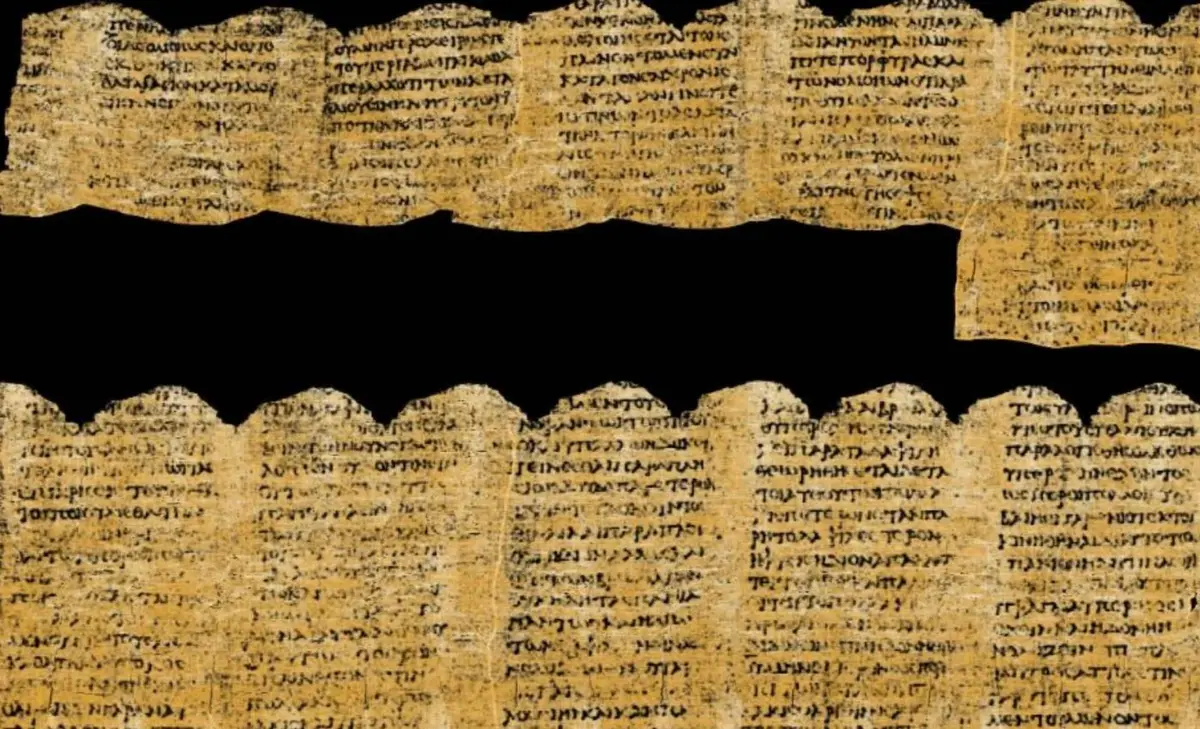
Technical Challenges in Reading Charred Scrolls
The scrolls are almost entirely converted into carbon-based materials—both the original papyrus and the ink. This chemical identity makes it extremely difficult to distinguish letters from the substrate by direct vision.
Mechanical attempts to unroll or separate layers resulted in fragmentation and permanent loss of content.
Many papyrologists concluded that only physical removal of layers, followed by manual restoration from text scraps, could reveal isolated fragments, a time-consuming task, with high margins of error and a great risk of completely ruining the artifact.
Conventional optical methods, such as ultraviolet or infrared light, did not provide sufficient contrast to differentiate the charred ink from the papyrus.
X-Ray Tomography: A Three-Dimensional Window
Researchers scanned charred rolls in high-energy X-ray accelerators, producing three-dimensional images of the internal layers without the need for any physical manipulation of the papyrus. Each pixel of the scan captures subtle differences in density, allowing the internal structure of the volume to be mapped.
The tomography produces digital “slices”—virtual cross-sections that depict the overlapping layers of the rolls. These cuts allow specialists to follow the natural curvature of the papyrus, selecting surfaces that correspond to each layer immediately below the previous one. Thus, thousands of concentric slices are formed, each recording residual minerals and traces of ink.
Artificial Intelligence: From “Noise” to Readable Text
Although both are carbon, the ink used by ancient scribes exhibited traces of impurities and metals—remnants of varnishes or metal oxides, which produced minimally different contrast in X-rays.
Machine learning algorithms were trained by researchers (led by Stephen Parsons) to recognize these contrast patterns amidst the papyrus’s background “noise.” Each voxel (volumetric pixel) with a metallic signature is highlighted as potential ink.
Parsons coordinates a global competition in which computer scientists improve neural networks capable of virtually separating the author’s hand-drawn strokes from the effects related to carbonized degradation.
Winners have already trained models that highlight whole words, partial phrases, and Greek and Latin abbreviations, approaching 100% reading accuracy.
Virtual Unwrapping: Restoring Lost Passages
Workflow to Read Fragments
- Scanning – The charred roll is positioned in a state-of-the-art microtomograph.
- 3D Reconstruction – Software reconstructs all slices into an accurate three-dimensional mesh.
- Layer Segmentation – Computer vision tools isolate each sheet of papyrus.
- Text Extraction – AI algorithms detect contrast regions corresponding to the ink.
- Stitching Fragments – A digital script “virtually folds” the layers, presenting the flat text in sequence.
This same “virtual unwrapping” technique was successfully used on the En-Gedi Scroll, a Hebrew manuscript from the 1st century AD, though less charred than the material from Herculaneum. Adapting to visibly more complex rolls required calibration of AI parameters, but the methodology proved to be scalable.
Initial Discoveries and Implications
The first legible areas indicate passages from Epicurean works, addressing theories about pleasure and everyday ethics. Partial quotes mention reflections on how scarcity impacts the pursuit of happiness in “the simple things in life.”
If confirmed, these fragments could fill gaps in the transmission of lesser-known Hellenistic philosophers.
More than fifty participants in academic programs have been awarded for contributing segmentation and ink pattern identification codes. Many are computer science and archaeology students who, in different parts of the world, worked remotely to refine each update of the AI model.
The “invisible library” encompasses papyrus and parchment manuscripts from across the Middle East and the Mediterranean, many of which are now kept in collections that do not dare to unroll them.
With proof that a roll can be read almost in its entirety, museums and institutes plan to scan entire series of charred collections, turning them into digital archives accessible to scholars worldwide.
In addition to restoring texts, the combination of X-rays and AI may reconstruct writing styles, dialectal variants, and lost vocabulary. It is expected that remnants of original spellings will reveal transitions between writing styles, assisting manuscript dating and literary genealogy reconstructions.
The joint work of X-ray tomography and artificial intelligence gives voice back to Roman authors lost for two millennia.
The first glimpse of the letters from a charred scroll, once considered unattainable, symbolizes the potential to rescue cultural memories deemed extinct.
As Parsons said, “We can assure that almost the entire roll is filled with text”; we just need to continue refining the models. Each revealed sentence helps reconstruct philosophical practices, everyday debates, and ways of life of a civilization that, although buried, remains alive in each recovered character.







Seja o primeiro a reagir!