





 Portuguese
  English
  Spanish
  5 min of reading
  1 comment


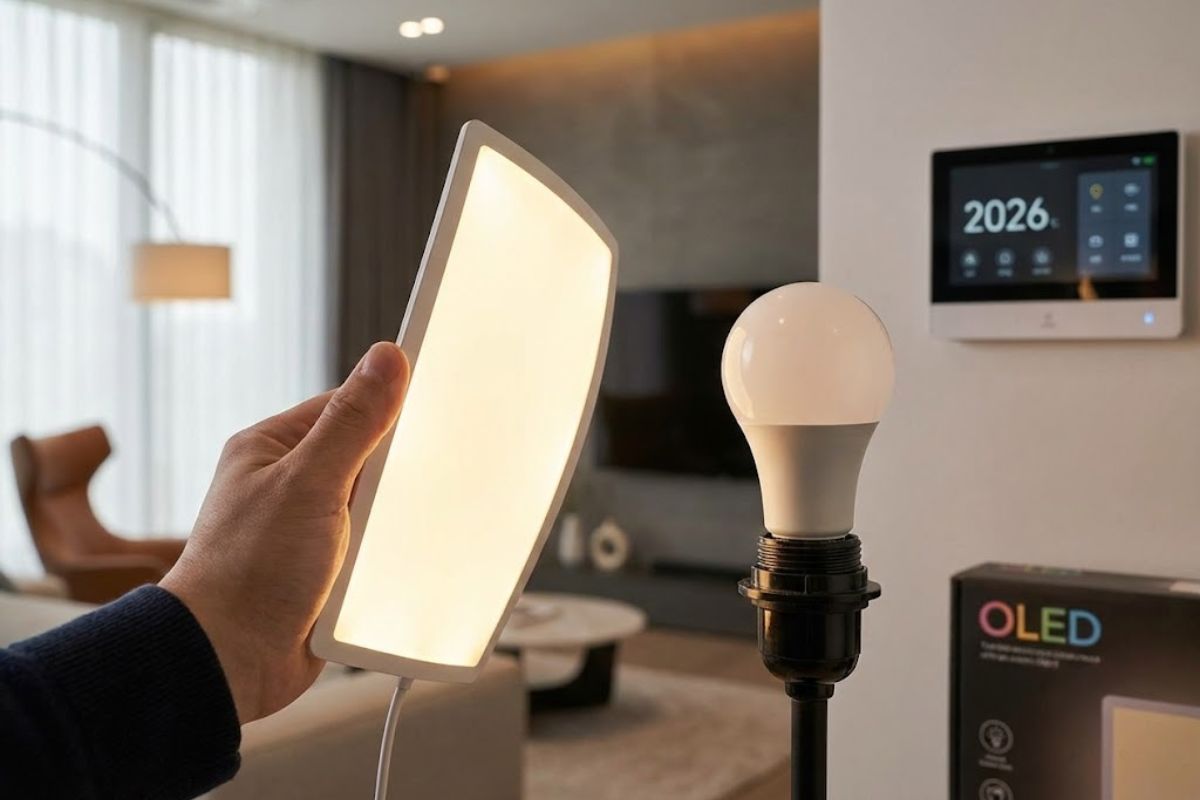


In 2026, Ultra-Thin OLED Lighting Panels Enter the Radar of Residential Lighting as an Alternative to LED, with Thin and Even Flexible Versions, Diffused Light, Less Glare, and Integration into Ceilings and Furniture; Dimming and Automation Features Start Defining Complete Projects, Avoiding Isolated Replacement of Common Bulbs Today.
The discussion on how residential lighting can reach a new level gained traction with the promise that ultra-thin OLED lighting panels will start appearing in more home projects from 2026, as an alternative to LED in environments where diffused light matters. The central hypothesis is simple: replace the light point with a luminous plane, featuring OLED lighting that is more homogeneous and less aggressive to the eye.
The novelty is not in “replacing bulbs,” but in redesigning surfaces. Instead of standout fixtures, the proposal for ultra-thin OLED lighting panels is to embed or integrate sources into ceilings, walls, furniture, and decorative elements, with dimming and automation to adjust OLED lighting to daily routines. LED remains relevant, but it may lose ground in specific uses.
What Are OLED Panels and Why Does the Shape of Light Change

OLED stands for Organic Light Emitting Diode, a technology based on organic layers that emit light when receiving electric current.
-
After so many blackouts, a family transforms an electric truck into a power source for their home and shows how a 100 kWh battery can keep everything running for days.

-
Ukraine is already testing, and China has already shown the world, and now the Brazilian Army is developing its own swarm of autonomous drones with artificial intelligence that share data in real time and operate without centralized control, uniting military and universities.

-
Few people know, but the most nutritious part of wheat has been discarded for decades to produce white flour, and the “polyamine” spermidine activates cellular cleaning, reduces mortality, and may slow down memory loss.

-
NASA and China issued a joint alert because a 60-meter rock could hit the Moon, and the impact could generate a storm of debris in space that would knock out the internet, satellites, and GPS worldwide for years.


In practice, this allows the emitter to be a panel and not just a point, bringing the experience closer to a “light wall” or an illuminated ceiling.
The perceived difference is in the behavior of light, which is more uniform in the visual field, with fewer hard shadows in household tasks.
This format also paves the way for ultra-thin and even flexible solutions, where the panel can follow surfaces and architectural details.
When the project incorporates ultra-thin OLED lighting panels, OLED lighting tends to reduce glare and unwanted reflections, in addition to softening contrasts that, in residential environments, often cause fatigue throughout the day.
Why 2026 Is on the Radar and What Still Limits Adoption


The point of attention for 2026 is not an automatic market turnaround, but rather a scenario of gradual expansion: greater supply, more formats, and the possibility of slowly falling prices with scale.
The technical reading is that OLED lighting still appears as a premium solution in residences because it requires specification, control compatibility, and more careful installation than common LED.
The main brake today is the initial investment, still described as higher compared to traditional LED alternatives in many cases.
At the same time, the argument in favor of ultra-thin OLED lighting panels lies in light quality and integration into the environment design, especially when dimming and automation are included from the start.
Uniform Light, Fewer Shadows, and Less Glare: The Effect on Daily Use
The most cited promise of OLED lighting is homogeneous distribution.
In kitchens, countertops, work tables, and hallways, panels can reduce shadows created by point fixtures, preventing the user’s body from becoming an obstacle to lighting.
This changes the ergonomics of light, a topic little discussed outside of professional projects.
Another point is glare. LED, when poorly applied, often appears as “bright spots” in the field of vision, especially in lowered ceilings and linear profiles without proper diffuser.
With ultra-thin OLED lighting panels, OLED lighting tends to spread luminance over a larger area, reducing the sensation of direct brightness, especially when there is dimming and fine control.
Dimming and Automation Become Infrastructure Rather Than Extras
In contemporary projects, the discussion is not just about “how many lumens,” but how light behaves throughout the day.
Dimming allows for reduced intensity at night, preserving visual comfort and avoiding excessive light in resting situations.
Automation organizes scenes, schedules, and sensors, aligning OLED lighting with routines of presence, sleep, and work.
In practice, dimming and automation also prevent the common mistake of oversizing lighting and then “living with the discomfort.”
When a space receives ultra-thin OLED lighting panels, the ideal is that the control is expected to regulate luminous flow and color temperature perception, instead of seeking a single fixed adjustment. LED and OLED lighting can coexist, but the control must be coherent.
How to Integrate into Ceilings, Furniture, and Walls Without Turning the Home into an Eternal Construction Site
Integration is what makes OLED lighting different.
Panels can serve as general lighting in ceilings, as indirect light in coves, as decorative surfaces, and even as ultra-thin fixtures in furniture.
The gain is aesthetic and functional, as the emitter becomes part of the finish, reducing the presence of visible components.
This does not eliminate LED. In many scenarios, LED remains more practical for highlights, spots, localized task lighting, and directional effects.
The difference is that by using ultra-thin OLED lighting panels as the base of the environment, LED can take on more specific roles, while OLED lighting maintains uniformity and comfort, supported by dimming and automation.
What to Consider Before Investing: Complete Project, Function of the Room, and Control
Lighting experts have argued that the choice of the system needs to come from a complete project, considering the function of the room, panel locations, color temperature, and control strategy.
It is not a simple product swap, but a decision in architecture and interior engineering.
In this context, OLED lighting tends to work better when the home already anticipates command infrastructure, such as compatible drivers and integration with automation.
Another point is maintenance and standardization. The more integrated into the finish, the more important it is to choose specifications and installations that facilitate technical access when necessary.
Dimming needs to be aligned with the chosen system to avoid flickering or inconsistencies in adjustment.
In homes with existing LED, the transition can be by zones: first social areas, then intimate spaces, always with well-planned automation control.
If 2026 truly marks the expansion of ultra-thin OLED lighting panels, the most likely effect will be gradual: more projects experimenting with OLED lighting where uniform light and low glare matter, keeping LED for occasional uses.
The practical step is to review the lighting design, include dimming and automation from the outset, and compare solutions by function, not by trend.
Would you place ultra-thin OLED lighting panels in the living room or kitchen, or do you still trust traditional LED more for your home?






Very well written. Thabk you. If only we could post your report in English.