





 Portuguese
  English
  Spanish
  6 min of reading
  0 comments


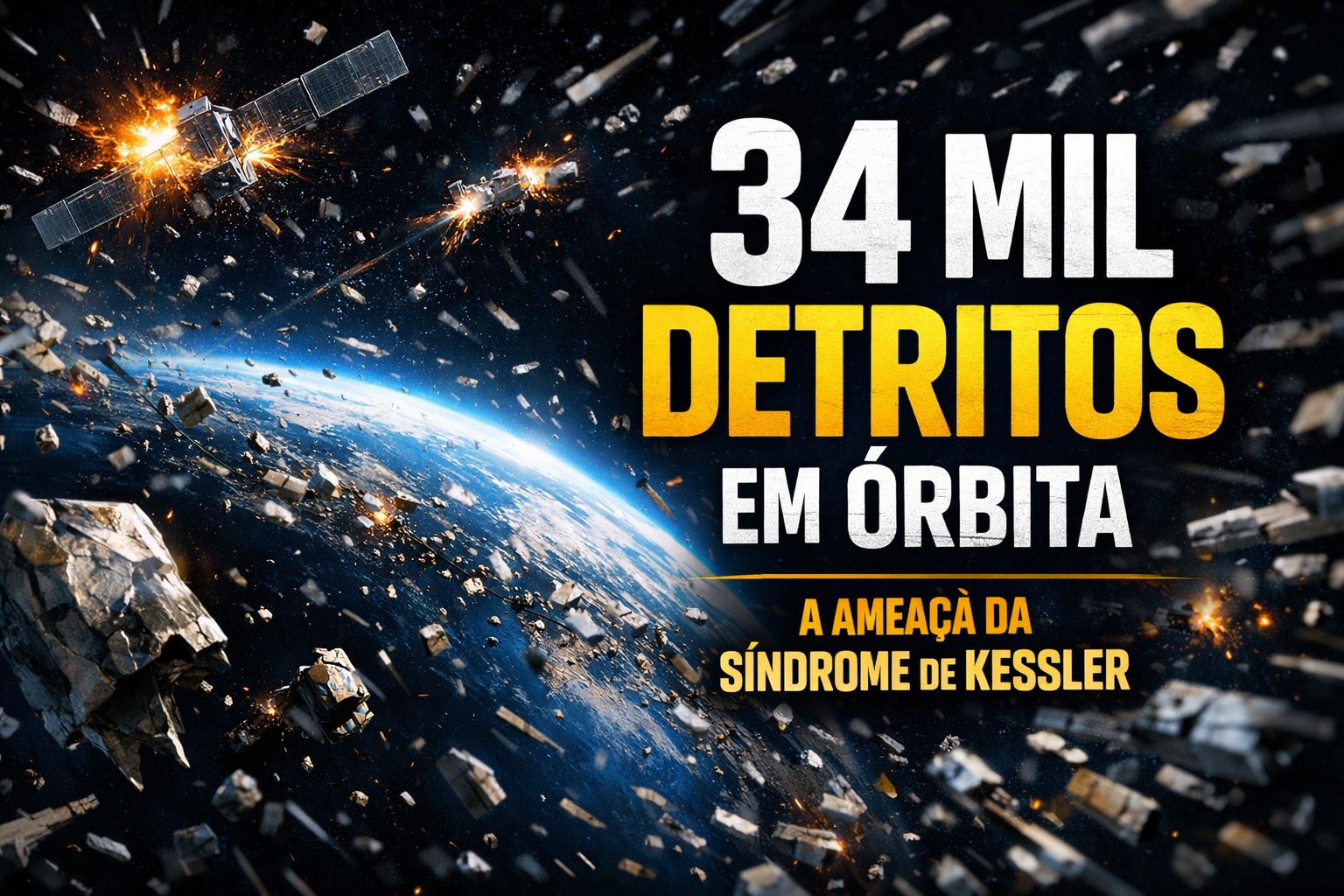
More Than 34 Thousand Space Debris Above 10 Cm Orbit the Earth at 28,000 Km/H. Scientists Warn of Real Risk of Kessler Syndrome and Billion-Dollar Impact.
The space around the Earth has never been so congested. Above our heads, at an altitude of about 400 to 1,200 kilometers — the range known as Low Earth Orbit (LEO) — circulates a growing population of satellites, abandoned rocket stages, and fragments from old collisions. According to data from the European Space Agency (ESA), there are currently more than 34,000 objects larger than 10 centimeters cataloged in orbit. Additionally, it is estimated that there are about 1 million fragments between 1 and 10 cm and more than 130 million particles smaller than 1 cm. They all travel at average speeds close to 28,000 km/h.
At this speed, even a screw can become a weapon. And the risk is not just theoretical.
What Is Space Debris and Why Is It So Dangerous
The term “space debris” refers to any artificial object that remains in orbit without operational function. This includes:
-
Motorola launched the Signature with a gold seal from DxOMark, tying with the iPhone 17 Pro in camera performance, Snapdragon 8 Gen 5 that surpassed 3 million in benchmarks, and a zoom that impresses even at night.

-
Satellites reveal beneath the Sahara a giant river buried for thousands of kilometers: study shows that the largest hot desert on the planet was once traversed by a river system comparable to the largest on Earth.

-
Scientists have captured something never seen in space: newly born stars are creating gigantic rings of light a thousand times larger than the distance between the Earth and the Sun, and this changes everything we knew about stellar birth.

-
Geologists find traces of a continent that disappeared 155 million years ago after separating from Australia and reveal that it did not sink, but broke into fragments scattered across Southeast Asia.

• Decommissioned satellites
• Upper rocket stages
• Fragments generated by explosions or collisions
• Tools lost by astronauts
• Parts detached over decades of missions
The central problem is not just the quantity. It’s the energy involved. At 28,000 km/h, a 1 cm object can puncture shielding. A 10 cm fragment can completely destroy a functional satellite.
The impact between two objects at this speed is equivalent to the energy released by high-power explosives.
Kessler Syndrome: The Chain Reaction That Could Block Space
In 1978, NASA scientist Donald J. Kessler proposed a scenario that today bears his name: Kessler Syndrome.

The theory describes a critical point where the density of objects in orbit becomes so high that collisions create more fragments than the system can naturally absorb.
Each collision creates thousands of new debris. This debris increases the chances of new collisions. The cycle feeds on itself.
In an extreme scenario, Low Earth Orbit could turn into a debris barrier that would make space launches dangerous or unviable for decades.
This is not science fiction. Real events have already demonstrated the fragility of the system.
The Alert Has Happened: Real Collisions in Space
In February 2009, the American commercial satellite Iridium 33 collided with the inactive Russian satellite Cosmos 2251. The impact generated more than 2,000 trackable fragments and thousands of smaller particles.
In 2007, an anti-satellite test conducted by China destroyed an old weather satellite, creating over 3,000 cataloged fragments, many of which are still in orbit.
These two events alone represented a significant jump in debris density in LEO. And since then, the number of active satellites has exploded.
The Accelerated Growth of Commercial Constellations
In recent years, private companies have begun launching massive constellations of satellites for global internet connectivity.
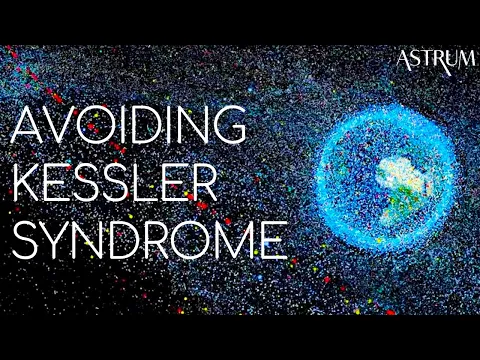
SpaceX, with its Starlink system, has already placed thousands of satellites in orbit. Other companies like OneWeb and Amazon (Project Kuiper) are following the same path.
Today, there are more than 9,000 active satellites in orbit — a number that was below 2,000 just over a decade ago.
This increase raises the statistical probability of collisions. The ESA estimates that the number of cataloged objects grows each year, even with mitigation measures.
What Is at Stake: US$ 2.8 Trillion in Space Infrastructure
The space economy is not marginal. Reports from the Space Foundation indicate that the global space economy already exceeds US$ 500 billion annually, with projections to reach trillions in the coming decades.
Satellites support:
• Global communication
• Internet
• GPS navigation
• Banking transactions
• Weather forecasting
• Climate monitoring
• Defense and surveillance
Any significant disruption to this ecosystem would have a direct impact on the global economy. Some estimates place the total value of space assets in the trillions of dollars, considering infrastructure, services, and economic dependence.
Why Is the Problem So Difficult to Solve
Unlike trash on Earth, space debris cannot simply be picked up with trucks. Removing debris in orbit requires:
• Specific launches
• Complex maneuvers
• Interception of objects at very high speeds
• High energy costs
Additionally, many fragments are too small to be tracked individually but large enough to cause catastrophic damage.

Today, space agencies and companies continuously monitor trajectories to avoid collisions. Satellites perform evasive maneuvers with increasing frequency. But this does not eliminate the structural risk.
Low Orbit as a Critical Zone
Most commercial satellites operate in low orbit (LEO), between 300 and 1,200 km. This region is the most congested.
Although fragments in this range eventually re-enter the atmosphere over decades, the rate of new launches may exceed the rate of “natural cleanup.”
This increases orbital density. And density is the fuel of Kessler Syndrome.
The Role of Space Agencies and New Regulations
NASA, ESA, and other agencies have adopted mitigation guidelines, including:
• Deorbiting satellites at the end of their operational life
• Designing rockets to minimize post-mission explosions
• Reducing fragment generation
Recently, the United States announced a commitment not to conduct destructive anti-satellite tests. Private companies have also begun to incorporate controlled deactivation systems.
But experts warn that current measures may not be sufficient if the pace of launches continues to accelerate.
Is There Immediate Risk of Space Blockage?
The scenario of complete blockage is not imminent. However, scientific modeling shows that certain orbital regions are already operating close to a point of instability.
Even without new military tests, accidental collisions can feed the cycle.
Each new relevant collision elevates systemic risk. The question is not whether there will be more collisions. It’s when.
Moon, Mars, and beyond missions depend on safe launches through low orbit. If debris density grows significantly, launch windows could become more complex and costly.
Human crews would also face additional risk. The International Space Station regularly performs maneuvers to avoid fragments.
The more congested it becomes, the more frequent these maneuvers.
Emerging Active Removal Technologies
Various initiatives are in development to tackle the problem:
• “Tow” satellites
• Capture nets
• Space harpoons
• Atmospheric drag systems
• Experimental ground-based lasers to alter the orbits of small fragments
Although promising, these technologies still operate on a limited scale. The challenge is not to remove one object. It’s to remove thousands.
The Strategic Dilemma: National Security vs. Orbital Sustainability
Space is a strategic domain. Missiles, surveillance, and defense systems rely on it. This creates tension between:
• National security
• Geopolitical competition
• Orbital sustainability
The absence of a robust global treaty specifically addressing space debris makes coordination difficult. And each country has its own priorities.
Space is no longer empty. It is an active layer of global infrastructure.
Above the atmosphere, hundreds of kilometers up, circulates a mix of technological innovation and accumulated risk. The Kessler Syndrome is not a movie plot.
It is a mathematical model based on real physical principles. As launches continue to increase, the balance between expansion and sustainability becomes increasingly delicate.
And while the sky may look clear when we look up, Earth’s orbit is more congested than ever.
If the critical point is surpassed, the impact could extend for decades affecting economy, defense, communication, and space exploration.
Space has become essential to modern civilization. And protecting it may be one of the greatest invisible challenges of the 21st century.








-

-

-

-

-

10 pessoas reagiram a isso.