





 Portuguese
  English
  Spanish
  4 min of reading
  0 comments



From Its Unusual Chemical Composition to Its Controversial Trajectory, Understand the Points That Make the Object One of the Greatest Astronomical Enigmas Today.
The interstellar traveler 3I/Atlas has established itself as the most controversial cosmic object in recent history, challenging scientists to define its true nature. Following in the footsteps of its predecessors, ‘Oumuamua and Borissov, this celestial body displays a series of anomalies that, as noted by Fatos Desconhecidos, fuel an intense debate in the scientific community: is 3I/Atlas a super comet, as conventional science suggests, or something completely different?
The discussion is so deep that it has led scholars, such as Harvard astrophysicist Avi Loeb, to question existing classifications. Observations of 3I/Atlas have revealed characteristics so peculiar, from its size and speed to its chemical composition, that the simple label of “comet” seems insufficient. This article recaps the points that have caught the world’s attention and that may help us gain a clearer idea about this fascinating wandering being.
Unusual Size, Speed, and Trajectory
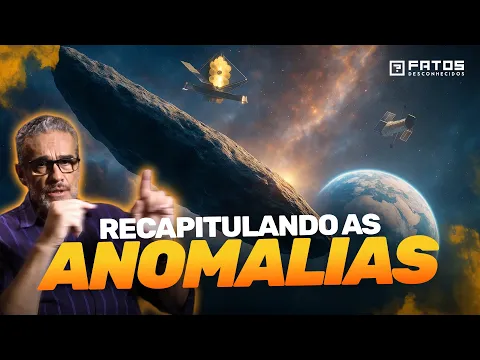

One of the first anomalies noted about 3I/Atlas was its size. According to Avi Loeb, the object may be over 5 km in length and have a mass of around 33 billion tons. The difficulty in determining its exact diameter, which estimates range between 440 meters and 5 kilometers, is due to the cloud of gases surrounding its core, requiring scientists to wait for new images, possibly captured by instruments on the surface of Mars.
-
While the world looks at oil, the war with Iran is already disrupting helium supply from Qatar, affecting car and iPhone chips, threatening AI expansion, and putting pressure on aluminum packaging at the highest value in four years.

-
Global warming will expose a treasure hidden under the ice of Antarctica and may spark an international dispute over gold and valuable minerals.

-
A street vendor from Praia Grande built a robot made of scrap from scooters and washing machines that pulls his popcorn cart on the beach, emits sounds, and interacts with customers, becoming an attraction on the coast of São Paulo.

-
The specifications of the Xiaomi 18 Pro Max have been leaked, and the highlight is a dual 200 MP camera with a new 22-nanometer technology that promises to consume less energy and capture details in shadows and bright areas using LOFIC HDR.


Its speed, described as “too fast for a comet”, is also a point of contention. Researchers have pointed to supposed variations in its pace, with accelerations and decelerations that have not been officially confirmed by NASA. The space agency states that the speed of 3I/Atlas may increase naturally due to the Sun’s gravitational pull, but assures that the object poses no threat to Earth, with its closest approach to our planet being 270 million kilometers. Its closest point to the Sun is expected to occur around October 30 of this year.
The Mysterious Color Change and the Tail Controversy
Perhaps the most intriguing characteristic of 3I/Atlas has been its color change. Observations indicate that the object changed from a reddish hue to green. Speculations abound: some suggested that such a change could only be possible if the celestial body were remotely controlled. On the other hand, Loeb himself, while skeptical of its nature as a comet, raised the hypothesis that the presence of cyanide could have caused the transformation.
The tail of 3I/Atlas also sparked controversy. Initially, scientists were intrigued to observe that the dust plume extended in the direction of the Sun, rather than in the opposite direction, as is conventional. This observation led Loeb to suggest that it might be an artificial object. However, subsequent analyses by the Hubble Telescope revealed a faint and wide tail pointing away from the Sun, as expected. The difficulty in initial visualization may have been caused by the object’s geometric position relative to Earth.
Chemical Composition and A Possible Enigmatic Origin
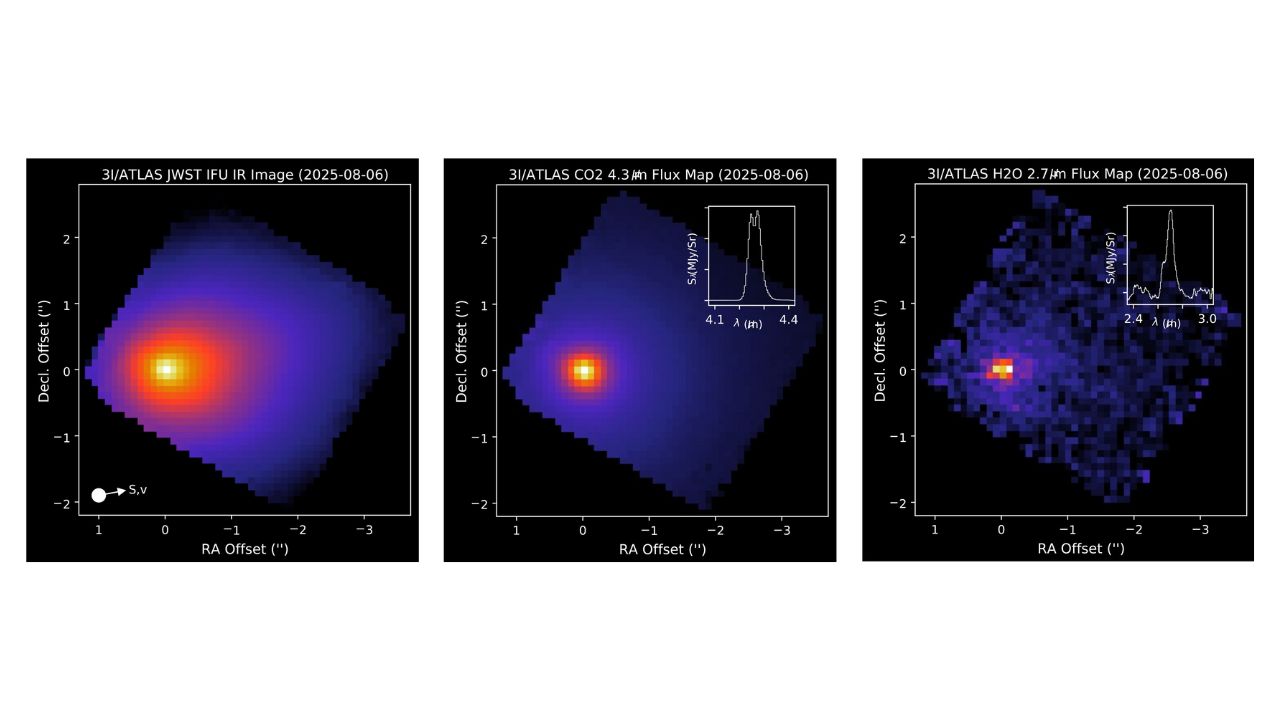
The chemical composition of 3I/Atlas reinforces its strangeness. Analyses of the gas plume surrounding it showed “much more nickel than iron, as in industrial alloys”, and a predominance of carbon dioxide instead of water, unlike the comets in our solar system. Polarimetry tests confirmed that the properties of its ice and dust are unprecedented compared to any other object ever observed.
Its origin is perhaps the greatest mystery of all. Tracing its path with the Gaia satellite, scientists concluded that 3I/Atlas may have traveled for about 10 million years without being associated with a specific stellar system. One of the boldest hypotheses, raised by Avi Loeb, is that the object came from the same direction as the famous “Wow! Signal” captured in 1977. With an estimated age of 7 billion years, its true origin remains an enigma.
Ultimately, 3I/Atlas continues to be an object that challenges our definitions. Each anomaly points to a cosmic traveler that does not fit perfectly into any known category, keeping alive the question about its true nature and purpose.
Given so many unusual points, what is your theory about 3I/Atlas? Is it a rare natural phenomenon, a new type of cosmic object, or something more? Share your opinion in the comments, we want to know what you think about this mystery.







-

-

-

-

-

-

167 pessoas reagiram a isso.