





 Portuguese
  English
  Spanish
  9 min of reading
  0 comments


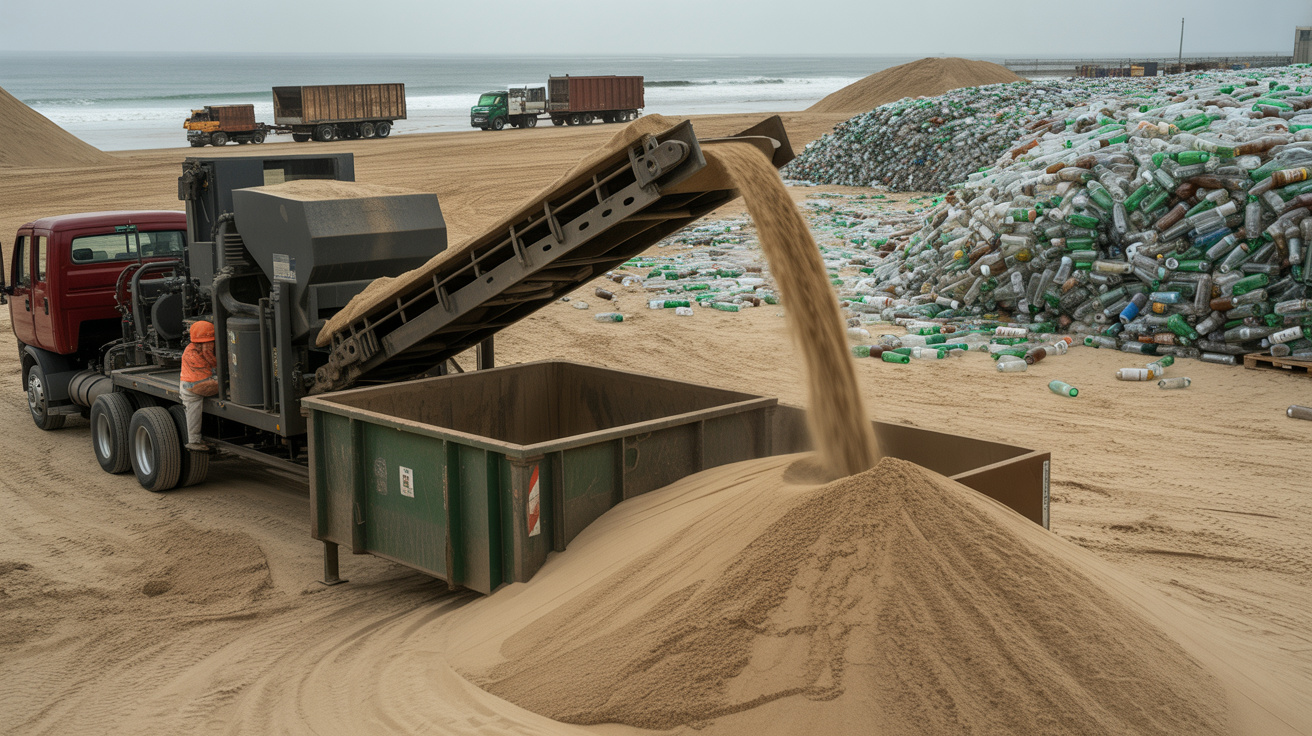
New Zealand Transforms Beer Bottles Into Artificial Sand In 5 Seconds And Creates Sustainable Alternative To Combat Coastal Erosion And Predatory Extraction.
While beaches around the world are receding by 75% to 90% due to rampant sand extraction, New Zealand has developed a circular solution that turns the problem into a resource. DB Export brewery created machines that crush discarded beer bottles and convert them into sand substitutes in just 5 seconds. Each 330ml bottle produces exactly 200 grams of artificial sand with the same grain size as natural sand.
The process has already transformed over 300 tons of glass that would have gone to landfills, where it would take up to 1 million years to decompose, into material used to restore eroded beaches, build roads, create golf courses, and produce eco-friendly concrete sold in retail chains.
In Auckland, where studies show that the coastline could recede between 8 and 38 meters by 2100 depending on the region, bottle sand represents a sustainable alternative to beach dredging that destroys coastal ecosystems and accelerates erosion.
-
Spain surprises the world by erecting 62 artificial dunes, mixing sand with natural remains of posidonia, and causing the structure to lose only 1.4% of its volume in 1 year.

-
With 16 Bulava missiles, improvements in acoustic stealth, and a design focused on silent patrols, Russia’s nuclear submarine was born to ensure Moscow’s invisible retaliation and has become one of the pillars of its maritime strength.

-
‘Populous’ city in Rio among the worst in Brazil in national ranking and exposes silent development crisis.
-
Couple buys house in the South Zone of São Paulo, opens a hidden door in the garage, and finds a secret wine cellar with dozens of old wines forgotten since the 1970s.
The Planet Is Running Out Of Sand
It may sound absurd, but humanity is depleting the sand on the planet. After water, sand is the most exploited natural resource in the world. It is a fundamental component in the production of concrete, glass, plastic, electronics, pharmaceuticals, and countless other products. To build just 1 kilometer of highway, 30,000 metric tons of sand are required. A nuclear power plant consumes 12 million metric tons.
According to the Surfrider Foundation, between 75% and 90% of the world’s beaches are receding. The problem is so severe that illegal sand extraction has become a lucrative criminal business in various countries. Beaches disappear overnight when gangs steal hundreds of tons of sand to sell to the construction industry.
Desert sand, however abundant it may seem, is not suitable for construction. The grains are too smooth and rounded by the wind’s action, failing to bond properly in concrete. Only beach and riverbed sand — shaped by water — possesses the necessary roughness. And that sand is running out.
New Zealand: A Country of Threatened Beaches
New Zealand, with its 3,200 kilometers of coastline including three major ports and a variety of sandy beaches, dunes, rocky coasts, cliffs, estuaries, and offshore islands, faces serious challenges from coastal erosion. Auckland has the highest ratio of population density to coastline in New Zealand, resulting in high exposure to coastal risks.
A comprehensive study in 2024, resulting from five years of collaborative work involving over 40 researchers, created the first detailed survey of national erosion rates since the late 1970s. The dataset maps coastal changes with data points at 10-meter intervals, covering from the 1940s to the present.

The results are alarming. Parts of New Zealand’s coast are crumbling at rates equivalent to a football field every generation. In Port Waikato, authorities were forced to close the Sunset Beach parking lot in 2024 after about 2 meters of it collapsed in a single night.
In Hawke’s Bay, councils were informed that urgent works were needed to protect properties threatened by erosion in Haumoana, Te Awanga, Westshore, and Bay View, at a potential cost of nearly 35 million New Zealand dollars.
A 2006 report on areas susceptible to coastal erosion in Auckland predicted that beaches in the Hauraki Gulf could recede 8 meters by 2050 and 20 meters by 2100.
The outer Hauraki Gulf had even worse forecasts: a receding of 10 meters by 2050 and 25 meters by 2100. For the West Coast, including Muriwai and Piha Beach, the numbers were 15 meters by 2050 and 38 meters by 2100.
About 70% of New Zealanders live in coastal cities and towns, most along the quarter of the country’s coastline that is eroding. The demand for homes near beaches with sea views means many have been built on low sandy land or unstable coastal cliffs.
From Beer To Beach: The Innovation By DB Export
In 2017, facing this concerning scenario, DB Export, one of New Zealand’s largest beer producers, announced its mission to help save the country’s beaches by producing a product of artificial sand. The company was motivated by the knowledge that beaches were receding partly due to sand mining occurring at some of New Zealand’s most beautiful beaches.
The DB Export Beer Bottle Sand project was designed to mitigate some of the impacts inflicted on beaches by sand dredging.

The sand dredged from beaches is an important component in roads, pathways, commercial and residential construction, plumbing installations, DIY home projects, and even golf course bunkers in New Zealand. The average person uses 200 kg of sand per year in consumables and infrastructure, most dredged from beaches.
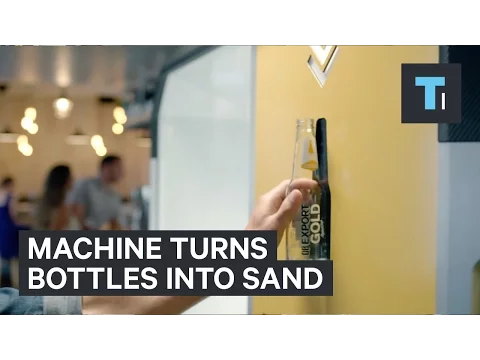
The company developed specialized machines that transform empty beer bottles into sand substitutes. The process is surprisingly quick: each bottle is crushed in just 5 seconds. The machines use two vacuum systems to remove labels and silica, leaving only pure glass. A 330ml bottle produces approximately 200 grams of sand.
“Our beautiful beaches are being dredged for their precious sand, which is used in many products and almost every construction project. DB Export Beer Bottle Sand is a simple initiative that we believe will have a significant impact,” said Sean O’Donnell, Marketing Director at DB Breweries.
“We cannot solve the problem alone, but we knew we could do more to help. Our ambition is to help drive more recycling while caring for beaches that are an integral part of Kiwi DNA.”
The Glass Problem In Landfills
The initiative could not be more timely. Every year in New Zealand, 27% of residual glass consumption is not recycled due to dirt or improper disposal, ending up in landfills. This amounts to approximately 60,000 tons of glass annually.
Over 600 million glass containers are recycled in New Zealand each year, but bottles and jars make up 82% of the recovered residual glass, yet there is still a substantial amount that escapes the recycling system.
The glass that goes to landfills poses a peculiar environmental problem. Unlike biodegradable materials that return to the land in months, a glass bottle sent to a landfill can last up to 1 million years.
Glass is primarily made of silica, an extremely stable and durable compound. It does not have the carbon-based structure that bacteria and other decomposers can break down, making it resistant to the natural decomposition process.
During this vast period, glass does not chemically degrade. Instead, it slowly erodes into smaller and smaller pieces, eventually resembling sand — but this process takes geological eras. Meanwhile, glass occupies valuable space in landfills and represents a waste of resources that could be infinitely recycled.
How The Beer Bottle Sand Machine Works
DB Export built a fleet of Beer Bottle Sand machines that visited major cities in New Zealand so people could crush their beer bottles and see the sand created by themselves. The strategic design ensured that each machine transformed a DB Export bottle into sand in just 5 seconds.
When consumers place the bottle in the machine, it is pulverized by a vacuum system that removes contaminants like plastic labels, leaving behind 200 grams of sand substitute. As the machines were connected to social networks, the campaign anticipated a massive public response and achieved it.
DB Export partnered with New Zealand’s largest recycling company, Visy Recycling in Auckland, to create commercial quantities of sand by combining DB Export bottles with non-recyclable glass destined for landfills. By 2018, about 10,000 tons of glass at Visy Recycling could not be recycled. Instead of diverting it to landfills, this glass now goes to the industrial beer bottle sand machine.
The machine can process any type of glass, and the resulting sand has physical, chemical, mechanical, and engineering properties similar to natural sands. As glass can be sorted by color, the sand can be specifically selected to match the color of a particular beach’s sand.
Practical Applications of Glass Sand
So far, DB Export has crushed over 300 tons of glass into sand substitutes. The initial goal was to produce 100 tons of sand substitute, equivalent to over half a million beer bottles. This goal has been exceeded, and the sand is now being used in a variety of applications:
Road Construction: Bottle sand has been used by Downer in paving and resurfacing projects. The cost was similar to the regular asphalt previously used at the sites. A highway in North Hamilton was built using glass sand, and engineers report that it is wearing better than expected.
In Palmerston North, a new subdivision is part of a long-term paving test where half the road has a glass aggregate base and the other half does not. Monitoring is ongoing to compare road performance.
Airports: Queenstown Airport used beer bottle sand combined with recycled printer toner cartridges to create an aggregate to resurface 40,000 square meters of the airport tarmac, the first project of this kind.
Golf Courses: The Akarana Golf Club in Auckland uses beer bottle sand in the bunkers. Members may not be aware that their errant shot is technically sitting among beer bottles and other glass. The sand replaces bunker sand that would otherwise be sourced from beaches.
Eco-Friendly Concrete: DB Export signed a two-year agreement with Drymix, New Zealand’s largest concrete producer, to use the sand in making eco-friendly concrete.
The product, called “Super Easy Eco Concrete”, is sold through the DIY retail chain Mitre10 and is best used for home projects like installing mailbox posts, clotheslines, pathways, and paving projects.
Construction: Construction companies, paving projects, drainage systems, and landscaping companies across the country have requested the sand. An electronics manufacturer even investigated its suitability for microchip production.
Beach Restoration: Although most of the sand has been used for industrial applications, the concept of using crushed glass for beach recovery has been explored globally.
In 2003, the town of Lake Hood, New Zealand, created a beach entirely made of crushed glass at an artificial recreational lake to encourage recycling and raise environmental awareness.
The Science Behind Glass Sand
Research on the viability of crushed glass as an alternative fill material began in the 1990s. These studies focused on the geophysical properties of crushed glass and its effect on the environment.
A 1993 study on various physical and engineering properties of crushed glass compared to natural aggregates of comparable grain size (such as offshore sand) showed that all tested materials behaved very similarly to one another.
For crushed glass to be a viable aggregate material for beach recovery, it must be similar in size and appearance to native sand, as well as react comparably to the physical forces of waves, currents, and wind.
Glass can be polished or thermally treated to remove sharp edges and points, and grain sizes can be blended with specific beach characteristics. Crushed glass has advantages for use in beach recovery: it is an inert material, does not contaminate the environment with chemicals, and can be processed to match both the texture and color of a specific beach’s natural sand.
The Impact And The Future
The results of the Beer Bottle Sand campaign have been impressive. Although final results have yet to be fully calculated, the film of the machine was viewed over 53 million times in a few weeks and shared over 700,000 times. Thousands of user-generated videos were shared from the machines.
Thanks to the human element of the campaign, Beer Bottle Sand has been supplied to construction companies, paving projects, golf courses, and drainage companies around the country. A two-year agreement was signed with Drymix and a three-year agreement with Placemakers and Downer (DIY and road infrastructure service network).
In a declining category of 6%, DB Export consumers emptied 35 million bottles, helping DB Export become the only mainstream beer to grow in value and volume during this period. For every 12-pack of beer sold in New Zealand, 3 bottles end up in landfills. DB Export Beer Bottle Sand kept both the sand on the beaches and the glass out of landfills.
Glass Recycling: The Untapped Potential
Glass is uniquely sustainable because it can be recycled repeatedly without losing quality, purity, or clarity. In 2024, Visy in New Zealand achieved a significant milestone: an average of 70% recycled content in glass bottles and jars manufactured locally.
The company produces over 700 million glass bottles and jars in New Zealand every year for the country’s iconic wineries and local food and beverage companies.
A Visy glass container made with 70% recycled content can be up to 30% less greenhouse gas intensive than a glass container made entirely from raw materials. Recycling not only diverts glass from landfills, but also safeguards precious natural resources and reduces energy use during remanufacturing.
This means that the virgin material used to make glass (sand, soda ash, among others) is only needed for the other 30%. “That’s the beauty of glass — it is infinitely recyclable and what many people don’t realize is that we can do all of this here in New Zealand,” said Dominic Salmon, scheme manager of the Glass Packaging Forum.








-

-

-

-

-

-

72 pessoas reagiram a isso.