





 Portuguese
  English
  Spanish
  5 min of reading
  0 comments


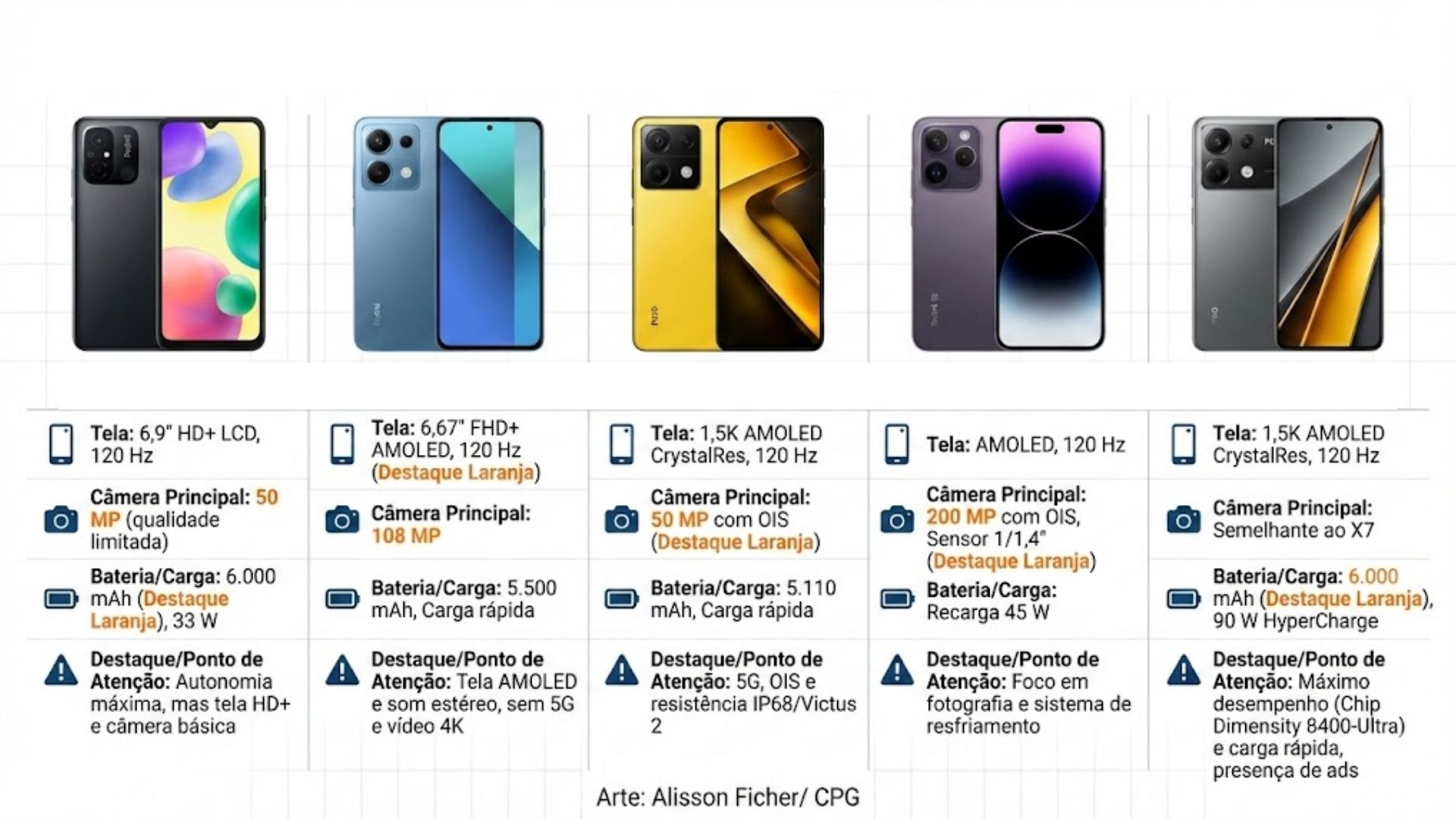
Xiaomi’s Portfolio in 2025 Highlighted Smartphones with Large Batteries, Advanced Screens, High-Resolution Cameras, and Efficient Chips, Balancing Robust Specifications and Competitive Prices in Marketplaces from Entry-Level to Premium Mid-Range.
Throughout 2025, Xiaomi maintained its strategy in Brazil to compete with smartphones that combine high technical specifications and lower prices than direct competitors in similar categories.
Within a broad portfolio, some models began to attract attention by combining long-lasting battery, high refresh rate screens, high-resolution cameras, and more efficient processors, including chips manufactured with 4 nanometer (nm) lithography.
These attributes appeared, in certain online retail ads, in price ranges close to R$ 2,000.
-
While the world looks at oil, the war with Iran is already disrupting helium supply from Qatar, affecting car and iPhone chips, threatening AI expansion, and putting pressure on aluminum packaging at the highest value in four years.

-
Global warming will expose a treasure hidden under the ice of Antarctica and may spark an international dispute over gold and valuable minerals.

-
A street vendor from Praia Grande built a robot made of scrap from scooters and washing machines that pulls his popcorn cart on the beach, emits sounds, and interacts with customers, becoming an attraction on the coast of São Paulo.

-
The specifications of the Xiaomi 18 Pro Max have been leaked, and the highlight is a dual 200 MP camera with a new 22-nanometer technology that promises to consume less energy and capture details in shadows and bright areas using LOFIC HDR.

The selection includes five devices from the brand that ranked among the best-selling in major marketplaces throughout the year.
The selection ranges from an entry-level model focused on battery life to a premium mid-range one geared towards performance and gaming, considering recurring criteria in consumer choices, such as battery, screen, cameras, and a set of features.
Selection Criteria and Price Context
The prices cited were observed in marketplace ads, a mode where values can vary according to offers, stock, color, storage capacity, and seller reputation.
In this type of purchase, it is also common for the product not to have the same warranty coverage and support offered by the brand’s official channels in Brazil.
Even with these caveats, the five smartphones illustrate how Xiaomi structured its strategy in 2025, seeking to expand technical features across different price ranges.
Among these features are less common items in more affordable models, such as dust and splash resistance certifications, 120 Hz screens, stereo sound, and fast charging.

Redmi 15C Prioritizes Battery Life and Uncommon Features in the Basic Segment
Positioned as an entry-level smartphone, the Redmi 15C focuses its proposal on energy autonomy.
According to the specifications released, the model has 6,000 mAh battery, support for 33 W fast charging, a 6.9-inch screen with a 120 Hz refresh rate, and IP64 certification.
The combination of a high-capacity battery and a high refresh rate screen is less common in this price range.
The device is aimed at users who prioritize long periods of use away from the outlet, focusing on video consumption, social media, and everyday tasks.
On the other hand, the HD+ resolution of the screen is noted as a factor that reduces pixel density, especially considering the size of the panel.
In the camera set, despite the presence of a primary sensor of 50 MP, the original article reports limitations in image quality.
The same applies to the front camera of 8 MP, which positions the model more as an option focused on battery and connectivity than on photography.
Redmi Note 14 4G Highlights AMOLED Screen and Above-Average Features
In a higher price range, the Redmi Note 14 4G appears as an alternative for those who prioritize screen quality.
The device features a 6.67-inch AMOLED panel, with Full HD+ resolution and a 120 Hz refresh rate, along with a 5,500 mAh battery.
The technical specifications also include a primary camera of 108 MP, a number that typically draws attention in mid-range smartphones.
This set tends to meet users who frequently consume multimedia content and seek screens with greater contrast and more vivid colors.
Among the features mentioned in the text are the under-display fingerprint sensor and the stereo sound system with Dolby Atmos, characteristics more common in higher-end models.
Conversely, the article points out limitations related to performance and video.
The processor used is classified as entry-level, and the camera set does not offer optical image stabilization (OIS) or 4K recording.
These points may affect the experience of those who frequently record videos or take photos in low-light environments.
Poco X7 Expands Features in the Mid-Range with 5G and Greater Durability
The Poco X7 positions itself as a mid-range device with support for 5G and a focus on physical durability and camera stability.
According to the specifications, the model has a 1.5K CrystalRes AMOLED screen, a 120 Hz refresh rate, Dimensity 7300-Ultra processor manufactured in 4 nm, a primary camera of 50 MP with OIS, Gorilla Glass Victus 2 protection, and IP68 certification.
The combination of above Full HD resolution and water and dust certification places the device in a more robust category within the mid-range segment.

The original article cites evaluations from the GSMArena website, which classify the camera as “reliable” in daylight and nighttime photos.
This type of analysis reinforces the proposal of a more stable camera setup, even without relying on ultra-high-resolution sensors.
Still, the text highlights a point of concern regarding battery life.
Despite the 5,110 mAh battery, mentioned tests indicated below-average performance in simple tasks, such as web browsing.
Redmi Note 14 Pro 5G Reinforces Premium Proposal with 200 MP Camera
The Redmi Note 14 Pro 5G appears as a premium mid-range option, focusing on camera and more comprehensive technical features.
The model features a primary camera of 200 MP with OIS and a 1/1.4″ sensor, specifications generally associated with greater light capture and detailing.
Another feature mentioned is the graphite cooling system, noted as important for extended sessions of intense use, including gaming.
The technical specifications mentioned in the article also include 45 W fast charging, along with IP68 certification and NFC.
These elements position the device as an alternative for those seeking advanced features without migrating to a flagship model.
Poco X7 Pro Concentrates Performance and Battery in the Most Complete Model
The Poco X7 Pro concludes the selection as the group’s most robust model.
The device’s proposal is to offer greater processing power within the premium mid-range category.
According to the disclosed information, the smartphone features a Dimensity 8400-Ultra processor, a 6,000 mAh battery, 90 W HyperCharge, and a 1.5K AMOLED CrystalRes screen with a 120 Hz refresh rate.
Compared to the standard Poco X7, the Pro maintains similar screens and cameras but incorporates a larger battery and a more powerful chip.
This combination meets users who run multiple applications simultaneously or perform more demanding tasks, such as gaming.
Reviews cited in the original text, such as from Tech Advisor, highlight good performance and battery life while noting criticism regarding pre-installed apps and ads in the system.
Even with these observations, the tests highlight battery life and performance across different usage scenarios.
With frequent price variations in online retail and different user profiles, which of these five Xiaomi models tends to better meet your day-to-day needs?








-

-

-

5 pessoas reagiram a isso.